
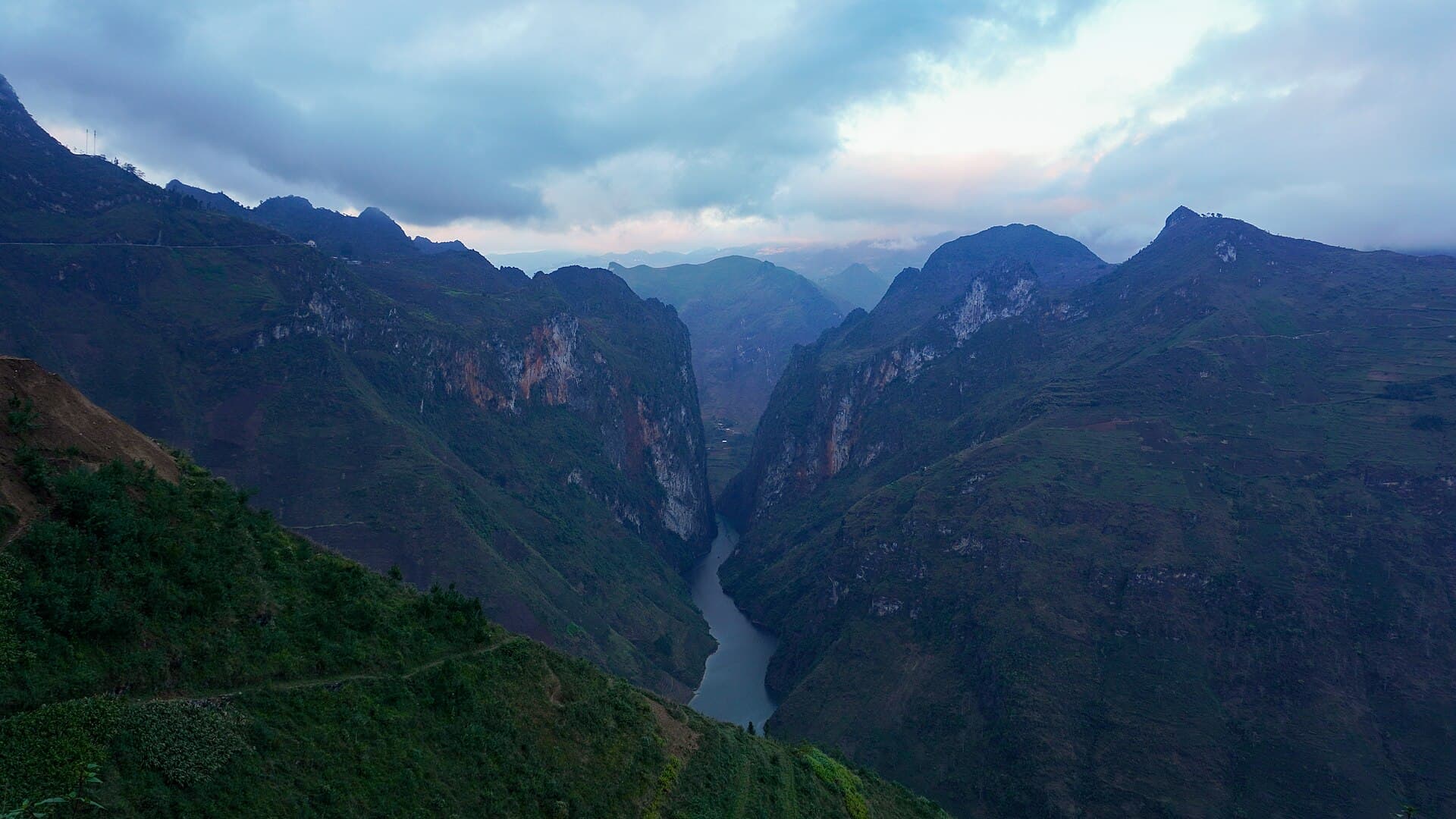
If you have room for one northern Vietnam motorbike loop, the split is clean. Ride Ha Giang for the most spectacular road in the country and logistics that ask nothing of you. Ride Cao Bang for the same karst-and-homestay north with a fraction of the foreign traffic, gentler passes and Vietnam's biggest waterfall at the far end — accepting that more of the planning falls on you.
Both provinces hold UNESCO Global Geopark status: Dong Van Karst Plateau was listed in 2010 as Vietnam's first, Non Nuoc Cao Bang in April 2018 as the second. What separates them is everything wrapped around the rock. For the routes themselves, see the Ha Giang loop planner and the Cao Bang loop guide.
The 60-second verdict
- Pick Ha Giang if this is your first Vietnam loop, you want the biggest single view, you are arriving unbooked, or you need an easy-rider seat at short notice.
- Pick Cao Bang if you have ridden Ha Giang already, you dislike convoy tourism, or you want a waterfall as the centrepiece on gentler roads.
- Do both with around ten days in the north. The provinces adjoin, and riders link them via Bao Lac in a long day.
Side by side
| Ha Giang Loop | Cao Bang Loop | |
|---|---|---|
| Distance from Hanoi | About 300 km, 6-7 hours by bus | About 282 km, 6-8 hours by bus |
| Loop length | About 350 km | Two arms, roughly 250-300 km |
| Signature sight | Ma Pi Leng Pass, 1,500 m | Ban Gioc waterfall |
| Geopark listing | Dong Van, 2010 | Non Nuoc Cao Bang, 2018 |
| Technical difficulty | High: switchbacks, sheer drops | Moderate: gentler passes, freight |
| Foreign visitor density | Heavy in season | Light, rising fast |
| Rental market | Dozens of shops, walk-up | A handful of outfits, book ahead |
| Easy-rider availability | Deep and competitive | Limited, via homestays |
| Homestay style | Hostels, dorms, social kitchens | Family stilt houses, stone village |
| Riding days needed | 3 minimum, 4 better | 3 minimum, 4 better |
| Best months | September to November | September to November |
| English spoken | Widely on the loop | Thin outside main homestays |
Getting there from Hanoi
Neither province has an airport or a passenger train, so both trips start on a bus from Hanoi's northern terminals. Ha Giang is the better-served route: sleepers run day and night, take roughly six to seven hours, and as of mid-2026 cost about 950,000 to 1,370,000 VND round trip, roughly 36 to 52 US dollars. Overnight departures land at dawn, when the rental shops open.
Cao Bang is about 282 km via the Bac Giang to Lang Son expressway and then QL4A, six to eight hours depending on class and border-truck traffic. One-way sleeper and limousine-cabin fares sit around 350,000 to 700,000 VND, roughly 13 to 27 US dollars as of mid-2026, with Hiep Giang, Thanh Ly and Khanh Hoan among the operators. The Dong Dang to Tra Linh expressway under construction will eventually cut this leg, but do not plan around it yet. One footnote that trips up searches: Vietnam's 2025 restructure folded Ha Giang into Tuyen Quang province, while Cao Bang kept its name.
The roads, and what "harder" actually means
Ha Giang's difficulty is concentrated and vertical. QL4C, the Happiness Road, climbs to about 1,500 m at Ma Pi Leng Pass, cut into a cliff above the Tu San canyon — roughly 800 m deep, 1.7 km long, walls at 70 to 90 degrees, widely described as the deepest canyon in Southeast Asia. Long stretches have no guardrail, fog arrives without warning, and the switchbacks can stall an underpowered semi-automatic on the climb.
Cao Bang's roads are gentler. QL3 over Ma Phuc Pass and DT206 north through Trung Khanh are mostly good asphalt with forgiving gradients. The hazard is not the drop but the traffic: freight serving the China border gates overtakes on blind bends, worst nearest Cao Bang city. Side roads into the valleys degrade to dirt.
Neither is a beginner road. But if you ride competently and dislike exposure, Cao Bang will not frighten you.
Two different kinds of beautiful
Ha Giang is vertical and geological: the Dong Van plateau is a grey sea of limestone fins with maize planted in the cracks, H'Mong villages on saddles, and the emerald Nho Que river a long way down. It reads as spectacle and photographs accordingly.
Cao Bang is horizontal and agricultural. The karst stands over rivers, rice and forest rather than bare rock: the Quay Son threading the Phong Nam valley, the Thang Hen lakes, the pine highlands of Phia Oac, the hole-through-the-mountain of Angel Eye, Nguom Ngao cave three kilometres from the falls. It accumulates over three days rather than arriving in one hit.
And then there is Ban Gioc: roughly 30 m high and over 300 m wide across three tiers, the largest natural waterfall in Vietnam and the fourth-largest on an international border, behind Iguazu, Victoria and Niagara. It runs fullest during and just after the rains, roughly July to September; entry has been around 45,000 to 50,000 VND, under 2 US dollars, as of mid-2026. The Ban Gioc guide has the timing detail, and the border crossings guide the frontier context.
The crowd gap, and why it cuts both ways
The gap is real and large. Ha Giang targeted 3.5 million visitors in 2025, having taken over 848,000 arrivals in the first quarter alone, nearly 108,000 of them international. Cao Bang aimed for 2.5 million and took 1.52 million in the first half of 2025 — but only about 58,000 foreign. Foreign-traveller density is the number you feel, and Cao Bang's is a small fraction of Ha Giang's.
Here is the part most comparisons skip: Ha Giang's infrastructure is good because it is busy. Dozens of rental shops means walk-up availability and competitive pricing; a deep easy-rider bench means being matched to a driver the same morning. Mechanics, English, ATMs and a bus back to Hanoi at almost any hour exist because the volume pays for them. Cao Bang has none of that depth, so booking ahead matters and a breakdown between towns can mean a long wait.
Cao Bang's quiet is also shrinking: that 47.7 percent jump, with international arrivals up 176.8 percent from a tiny base, is the curve Ha Giang rode a decade ago.
Easy rider or self-drive, and the licence reality
Both loops offer the same three modes: ride your own bike, ride pillion behind a local easy rider, or take a jeep. The legal position, once: Vietnam recognises International Driving Permits issued under the 1968 Vienna Convention and not the 1949 Geneva Convention permits issued by the United States, Canada, Australia, New Zealand, Japan, China and India, and riding without a licence Vietnam accepts voids most travel-insurance claims. Decree 168/2024 sets fines of roughly 2 to 8 million VND, about 75 to 305 US dollars, plus impoundment.
Ha Giang's easy-rider market is mature: chauffeured three-day, two-night tours ran roughly 170 to 220 US dollars per person as of mid-2026, and the April 2026 Tuyen Quang directive on operator licensing pushed out the cheap unlicensed end. The Ha Giang cost guide has the per-mode breakdown. Cao Bang's easy riders come through homestays and small local outfits rather than a marketplace, so line one up before you arrive.
Days, money and homestays
Three riding days is the working minimum for both, four is what most riders prefer, and either way you add two travel days from Hanoi — about four and a half days door to door for a three-day loop, five and a half for a four-day one. Cao Bang's fourth day earns its keep, because Pac Bo cave and the Phong Nam valley do not fit into three.
On money the two are close. A do-it-yourself three-day Ha Giang loop worked out at roughly 90 to 130 US dollars per person as of mid-2026, with Honda Wave rentals around 185,000 to 210,000 VND a day. Cao Bang rentals sit lower at roughly 100,000 to 180,000 VND a day, but the thinner market means fewer bikes in good condition. The Vietnam budget guide sets that against the rest of a trip.
Homestays are where the character gap is sharpest. Ha Giang's run from hostel dorms at around 130,000 to 210,000 VND a night to private rooms at 390,000 to 525,000 VND, roughly 5 to 20 US dollars as of mid-2026. Cao Bang's are family houses — Tay stilt homes, the Khuoi Ky stone village by Nguom Ngao cave — typically 260,000 to 525,000 VND with breakfast: quieter, warmer, harder to book late.
Which one you should ride
First loop, limited time, no booking: Ha Giang. It is built to absorb an unplanned traveller.
Nervous rider or non-rider: Ha Giang, behind an easy rider. The bench is deeper and the 2026 licensing regime raised the quality floor.
Second loop, or you have already done Sapa and Ha Giang: Cao Bang. For the more famous pairing, see Sapa versus Ha Giang.
Water and forest over bare rock: Cao Bang, in September or early October, when Ban Gioc still carries the rains and the valley rice is turning.
Photographers chasing one frame: Ha Giang, late October or November, for buckwheat and clear air over the canyon. Start at the Ha Giang destination guide.
Limitations
Prices here are mid-2026 figures from operators, rental shops and bus aggregators, converted at roughly 26,400 VND to the US dollar, and they move. Cao Bang's rental market is small enough that one shop changing its rate shifts the range, and Ha Giang's guided pricing rose 10 to 20 percent in 2026 as operators absorbed licensing costs. Workaround: treat every figure as a planning band, confirm directly with the operator, and budget a further 10 percent for deposits, damage claims and tips.
The crowd comparison is likeliest to age badly. Provincial visitor figures are targets and self-reported counts, not audited ones, and the 2025 restructure means some Ha Giang numbers now report under Tuyen Quang. Workaround: if quiet is the deciding factor, ride Cao Bang midweek and outside the September to November peak, and check recent trip reports rather than a gap that is closing.