
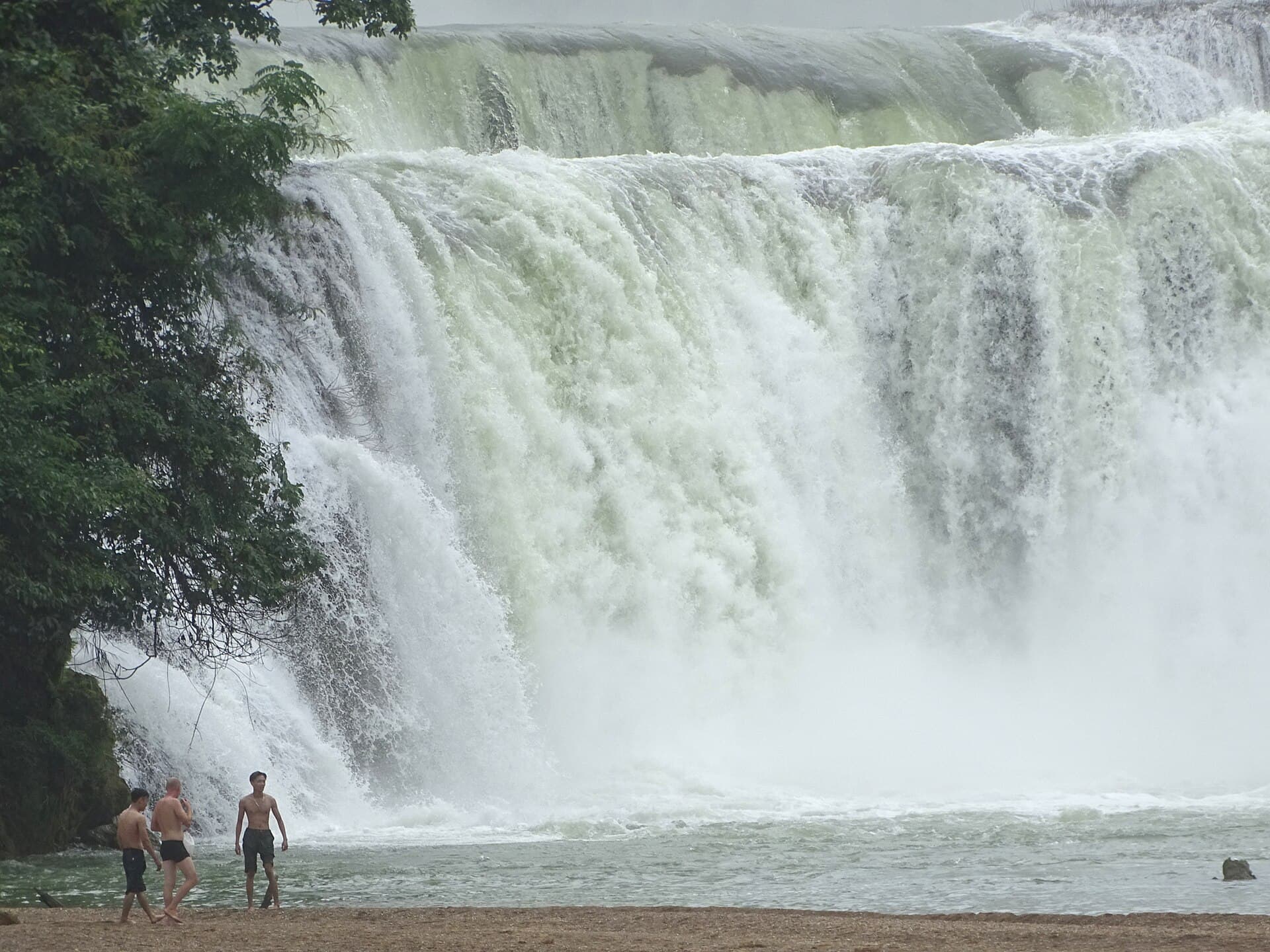
Ban Gioc is Vietnam's largest waterfall, and it sits about as far off the main tourist trail as northern Vietnam gets: on the Quay Son river in Trung Khanh district, Cao Bang province, hard against the Chinese border, roughly 360 km northeast of Hanoi. There is no airport and no train — the realistic route is a 6-8 hour bus from Hanoi to Cao Bang city (around 350,000-475,000 VND as of mid-2026), then a local bus, rented motorbike, or hired car for the final 83 km. That makes it a two-day trip at minimum and a comfortable three-day one. Entry costs around 45,000 VND at last verified report, a bamboo raft to the falls face runs roughly 50,000-100,000 VND, and the water peaks in September and October, right after the summer rains.
Ban Gioc gets one short entry in our off-the-beaten-path atlas; this page is the deep version — transport, prices, season logic, and the overnight strategy that makes the long haul pay off.
Getting there from Hanoi
Everything starts with the Hanoi-Cao Bang bus. More than a dozen operators run the route, mostly from My Dinh station, in two broad formats: double-deck sleeper buses (operators like Thanh Ly) and 7-9 seat limousine vans (Duc Duong and others), with cabin-style sleepers from operators like Hiep Giang in between. As of mid-2026, fares sit roughly between 350,000 and 475,000 VND depending on class, departures run from around 5am to after 10pm, and the trip takes 6-8 hours — night sleepers tend toward the shorter end. Schedules shift often, so check a booking platform like Vexere a day or two ahead rather than trusting any fixed timetable, including this one.
From there you have a fork: continue independently (next section), or skip the logistics entirely with an organized tour. Two-day, one-night small-group tours from Hanoi run around $200 per person as of mid-2026, typically leaving the Old Quarter around 6:30am, overnighting near the falls or in Cao Bang, and bundling entrance fees, meals, Nguom Ngao cave, and sometimes a pagoda or viewpoint stop. They are long driving days, but they solve every connection for you.
The honest framing on trip length:
- Two days (tour or fast DIY): bus up, sleep near the falls or in Cao Bang, waterfall and cave the next morning, bus back. Doable, tiring.
- Three days: adds Phong Nam valley, a slower morning at the falls before the crowds, and breathing room if a bus runs late. This is the version most travelers should plan.
- Four days or more: fold the falls into the wider Cao Bang loop by motorbike — the strongest version of the trip if you ride.
From Cao Bang city to the falls
The last 83 km is the slowest and prettiest part. Three options, as of mid-2026:
- Local bus — around 70,000 VND each way, roughly 1.5-2 hours. Services run frequently from early morning until about 6pm, leaving from near the Bang Giang bridge area on the east side of Cao Bang city; reported frequencies vary between every 30 minutes and hourly, so confirm the return schedule when you board. Cheapest, and perfectly workable for a day trip.
- Motorbike — rentals in Cao Bang city run around 180,000-250,000 VND per day for a semi-automatic or scooter. The route follows QL3 east over the switchbacks of the Ma Phuc pass, then provincial road DT206 north through Quang Uyen and Trung Khanh to the falls; riders often loop back via DT207. Allow 2-3 hours each way with photo stops — the karst scenery along this road is half the reason to come.
- Taxi or private car — around 700,000 VND one way by taxi, or arrange a car with driver for the day through your hotel. The default choice for groups and families; splitting a day car among three or four people costs little more than the bus.
At the falls: tickets, rafts, and light
The entrance fee was around 45,000 VND per adult at the most recent reports we could verify, with children typically half price or free under 1.2 m; some 2026 sources cite higher figures, up to around 100,000 VND, so carry small cash and treat the booth price as final. Parking adds roughly 10,000-20,000 VND.
The signature move is the bamboo raft. Operators pole flat rafts across the plunge pool to within metres of the main cascade — close enough that in high season you will be wiping spray off your lens. The ride lasts roughly 10-20 minutes and costs around 50,000-100,000 VND per person as of mid-2026 (sometimes quoted per raft, split among passengers). Swimming is prohibited, so the raft is the only way into the spray zone.
Timing matters more than most visitors expect. Day tours from Cao Bang and Hanoi arrive in a wave around 9am, and overhead midday sun flattens the tiers into a single bright sheet. The falls photograph best in the softer side light of early morning (roughly 8-10am) or late afternoon (3-5pm) — and if you sleep nearby, you can have the viewpoints almost to yourself at opening time.
When to go: the September-October peak
Ban Gioc is really two different waterfalls depending on the calendar. The summer monsoon (roughly June through September) feeds the Quay Son until the falls peak at a thundering, 300 m-wide curtain — but mid-summer rain can also churn the water brown and make the long bus ride miserable. The sweet spot is September into early October: the falls still carry peak volume, the rains are tapering, and the rice terraces around Trung Khanh hit their golden harvest at the same time. Vietnam Coracle's illustrated guide — the best independent resource on the falls — singles out September for exactly this combination.
From November the flow thins gradually. In the dry months (roughly December to May) the falls braid into narrower, clearer strands over the limestone steps, and the pools turn a striking turquoise — less thunder, more postcard, and honestly still worth the trip if you are already in the northeast. Just arrive with calibrated expectations: the dry-season falls bear little resemblance to the peak-flow photos.
If you are weighing northern regions against each other for a fixed travel window, our Ha Giang loop routes guide and Sapa vs Ha Giang comparison cover how Cao Bang's calendar lines up against its better-known neighbours.
The China side and the cross-border zone
The border runs down the middle of the Quay Son, which means Ban Gioc is literally half a waterfall — the Chinese side is called Detian, and together they form one of the largest transnational waterfalls in Asia. That long-sealed line began opening with a cross-border tourism cooperation zone that piloted from September 2023 and entered official operation in October 2024 — the first arrangement of its kind between Vietnam and China, with thousands of visitors crossing in organized groups during the pilot year, according to Vietnamese state media.
As of mid-2026, the practical picture is this: crossings happen as guided day groups arranged through authorized agencies on each side, not as walk-up border crossings, and independent reports differ on how freely traffic flows in each direction and who qualifies. We are deliberately not giving visa or border-crossing advice here, because the rules are genuinely in flux. If seeing the Detian side matters to you, ask at your accommodation or a Cao Bang agency about current arrangements when you arrive — and do not build your itinerary around it.
Nguom Ngao cave, Phong Nam valley, and nearby stops
The strongest argument for staying overnight is what surrounds the falls.
- Nguom Ngao cave — a few kilometres from the falls, near Khuoi Ky village, and genuinely one of northern Vietnam's better caves: a long, well-lit walking route through chambers of stalactites and rice-terrace-like stone formations. Entry is around 45,000 VND for the standard route as of recent reports, with a longer guided section around 200,000 VND. It pairs naturally with the falls in a single half-day.
- Phong Nam valley — roughly 15 km from Trung Khanh town, a river valley of rice fields walled in by karst that has become the region's quiet photography pilgrimage. The viewpoint is a rough, unmarked hike of about an hour — slippery after rain — and sunrise is the moment, when mist hangs between the peaks. Late September to October, during harvest, the whole valley turns amber. If you enjoy this kind of walking, our Vietnam trekking guide maps where else the northeast rewards boots.
- Khuoi Ky stone village — a small Tay-ethnic village of traditional stone houses between the cave and the falls, now home to a cluster of homestays. Even if you sleep elsewhere, it is worth a wander.
Day-tripping from Cao Bang city sees the falls and the cave; overnighting in Trung Khanh district gets you Phong Nam at sunrise and the falls before the tour wave.
Where to stay
Close to the falls, the established mid-range option is the Saigon-Ban Gioc Resort, whose upper terraces look toward the waterfall. The Khuoi Ky stone village homestays — Yen Nhi, Lan Rung, Tay, and Minh Khang are among the named ones in recent guides — offer the more atmospheric night: stone houses, family cooking, and a five-minute ride to both the cave and the falls. Trung Khanh town, about 25 km from the falls, has simple guesthouses. Cao Bang city has the widest choice, from budget hotels up to business-standard properties, and works fine as a day-trip base — you just trade the sunrise advantage for convenience. Book your first night ahead in September-October — homestay supply out here is small, and harvest season is when everyone comes.
Limitations
- Bus schedules and operators churn. The Hanoi-Cao Bang route gains and loses operators, and departure times shift seasonally. Check Vexere or a similar platform within a day or two of travel; do not plan tight connections around any printed timetable.
- Prices at the falls are drifting. Our sources already disagree — entry reports range from 45,000 VND to around 100,000 VND in 2026 — and raft pricing flips between per-person and per-raft quotes. Treat every figure here as a planning band, not a quote.
- The border zone is a moving target. Cross-border visit rules have changed repeatedly since 2023 and may change again; nothing in this guide should be read as visa or crossing advice. Separately, a very large resort development for the Ban Gioc area was proposed in late 2025 — if it proceeds, access, pricing, and the feel of the place could all shift.
- Seasonality varies year to year. A weak monsoon means a thinner September; a late one pushes peak flow into October. If peak volume is the whole point of your trip, look for recent photos or ask accommodations about current flow before committing to the buses.
- We have not stayed in every property named. Homestay names come from recent independent guides; offerings out here change quickly, so confirm on a booking platform or by phone before arriving late in the day.