
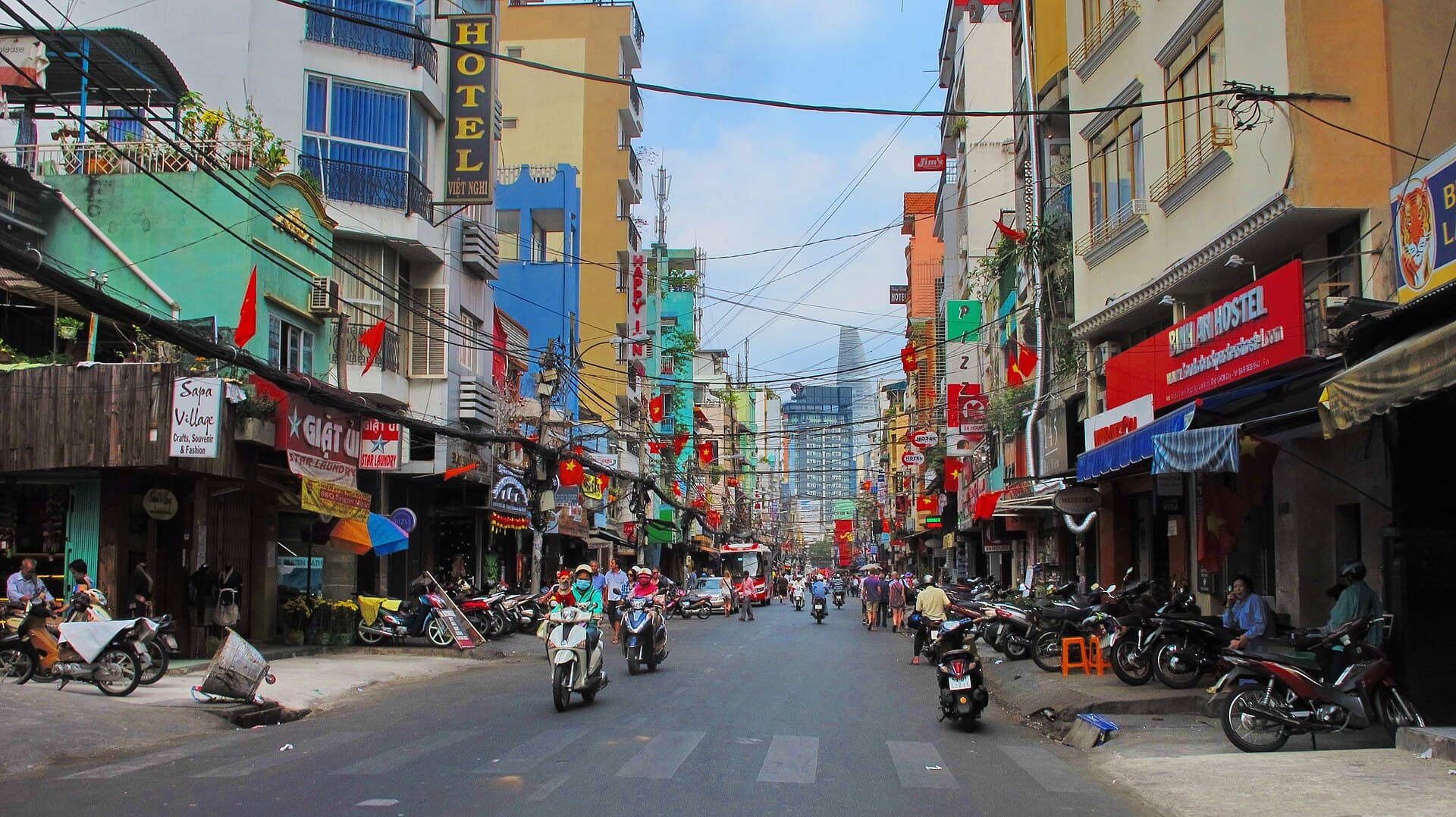
For a solo traveller in Vietnam, hostels win on cost and nothing else. For two people, a budget private double is barely more per head and better in every other way. And in the northern valleys and the Mekong Delta, a homestay is not the budget option at all — it is the accommodation those places actually have, and the reason to go. As of mid-2026 a dorm bed runs 130,000-470,000 VND ($5-18), a budget private double 360,000-1,430,000 VND ($14-55), and a homestay 260,000-1,040,000 VND ($10-40) per person with dinner and breakfast included.
All the bands below come from our Vietnam accommodation price index 2026, which prices four tiers across 12 cities and publishes the grid as open data.
What each type costs a night
| Type | Per night | Priced per | Meals included |
|---|---|---|---|
| Hostel dorm bed | 130,000-470,000 VND ($5-18) | Person | Sometimes a basic breakfast |
| Budget private room | 360,000-1,430,000 VND ($14-55) | Room | Breakfast almost always |
| Mid-range 3-4 star | 650,000-6,760,000 VND ($25-260) | Room | Breakfast, usually a buffet |
| Homestay | 260,000-1,040,000 VND ($10-40) | Person | Dinner and breakfast |
The unit matters more than the number. Dorms and homestays are priced per person; hotel rooms are priced per room. Every comparison below turns on that difference.
The single-supplement maths
Take a standard two-week route: three nights in Hanoi, two in Sapa, one in Ninh Binh, one in Hue, three in Hoi An, two in Da Lat, two in Ho Chi Minh City. Using the midpoint of each city's band as of mid-2026, for one person:
| Plan | 14 nights, solo | Per night | Same trip, per person sharing |
|---|---|---|---|
| Hostel dorms throughout | about 4,160,000 VND ($160) | $11 | about $160 |
| Budget private rooms | about 10,920,000 VND ($420) | $30 | about 5,460,000 VND ($210) |
| Homestay where available, budget private elsewhere | about 10,660,000 VND ($410), less roughly $45 of included meals | $26 net | about $250 |
| Entry-level 3-star throughout | about 14,170,000 VND ($545) | $39 | about 7,070,000 VND ($272) |
Read the last column and the argument changes completely. Alone, choosing a private room over a dorm costs about $260 across two weeks. Sharing, it costs about $50 — three-and-a-half dollars a night for a door that locks, a bathroom nobody queues for and a bed you can nap in at two in the afternoon. That is the whole decision for couples and friends travelling together, and it is why the hostel-versus-hotel question is really a solo-travel question.
Where hostels genuinely win
Beyond price, hostels do two things hotels do not. The first is people: Vietnam's route is linear and everybody is doing roughly the same run, so a hostel common room in Hanoi or Hoi An is a functioning introduction service for the Ha Giang loop, a Halong cruise or a bus you would otherwise book alone. The second is tour-booking. Hostels sell the motorbike loops, cruises and canyoning trips at prices set by volume rather than by a concierge, and the good ones will tell you which operator had a bad month.
The trade is privacy and rest. A dorm has no desk, no call privacy and no control over when the lights come on. Bandwidth is shared with a common room full of people streaming, which is why Vietnam's genuinely fast, cheap wifi feels slow in exactly the buildings that advertise it hardest.
Where hotels genuinely win
Reliability and location. A mini-hotel in Hanoi's Old Quarter or a three-star off Da Nang's beach road delivers the same product every night: air conditioning that works, a keycard, breakfast at seven, laundry back by six. That consistency is worth more on a two-week trip than any single upgrade, and Vietnam sells it cheaply — a $40 three-star here is closer to a Western two-star in room size but ahead of it on service, as our hotel price reference sets out tier by tier.
Hotels also win the work question outright. If you are working even a few hours a day, the desk, the lockable door and the quiet call are not luxuries. Da Nang, Hoi An and Da Lat have the deepest supply of cheap private rooms with a real work surface, which is why they have become the informal remote-work triangle.
Where homestays genuinely win
In the north and the Mekong, a homestay is the point rather than the saving. Sapa's Muong Hoa valley villages, the Ha Giang loop stops, and the Thai stilt houses of Mai Chau and Pu Luong all offer a village bed instead of a town hotel bed, and the difference is the trip: dinner cooked and eaten with the family, rice wine afterwards, and a morning that starts in the valley rather than an hour's drive from it. The Mekong Delta's orchard-and-river homes work the same way around boats and fruit gardens. Our homestay guide covers etiquette and how to read a listing.
Two honest caveats. The word has drifted: in cities and beach towns, most listings marketed as homestays are small guesthouses with hosts on site, which is fine but is not a family stay. And at the simple end you are buying thin walls, shared bathrooms and a mattress on a communal floor — the accommodation index records homestay bands only for the four cities where the real thing exists.
Safety, lockers and breakfast
Vietnam's exposure for travellers is low, and the mainstream hostel market is professionalised: staffed reception around the clock, keycard floor access, and female-only dorms widely available in Hanoi, Hoi An and Ho Chi Minh City. Opportunistic theft is the realistic risk, so the checks that matter are whether the locker fits a full-size pack, whether it takes your own padlock, and whether the dorm door self-closes. Hotels solve all of that structurally with a safe and a lockable door. Homestays solve it socially — you are in someone's house — which most people find reassuring and some find inescapable.
Breakfast quietly moves the comparison. Hotels from the mini-hotel tier up include it as standard; homestay rates include dinner and breakfast, worth roughly 210,000-260,000 VND ($8-10) a day; hostels are the only tier where you may pay 50,000-80,000 VND extra for bread and eggs.
Booking channels
The commission structure runs in opposite directions at the two ends. Hostels, guesthouses and homestays pay roughly 15-18% on an agency booking and will often trade 5-15% of it away for a direct reservation on a multi-night stay. Branded hotels contract for rate parity, so the agency price plus a loyalty discount typically matches or beats direct. One rule covers everything: Agoda holds the deepest Vietnamese inventory and can display a pre-tax figure by default, so compare final checkout totals, never headline rates. Above three stars, a "++" quote excludes a 5% service charge and the 8% VAT that runs through 31 December 2026, about 13.4% once compounded.
Limitations
- The 14-night worked example is one route at midpoint rates. Real trips cluster differently, and midpoints hide the width of each band. Treat it as a ratio between plans rather than a quotable total.
- Every figure is a typical mid-2026 online rate, midweek and out of season. Da Lat and Sapa weekends run 50-100% higher, beach cities 20-50% higher in the June-to-August domestic summer, and Tet exceeds all of it.
- Hostel quality varies more than hotel quality. A well-reviewed dorm and a bad one carry the same price in the same city, and no band can separate them. Recent reviews can.
- The homestay comparison is not like-for-like. It is per person and includes meals, so a couple should roughly double it before setting it against a room rate.
- Solo female travellers face a different calculus on dorms versus private rooms than this cost table represents, and the answer is personal rather than arithmetic.
The short version
Alone and social, take the dorm — the money is real and the introductions are worth more than the money. Alone and working, take the budget private room and stop pretending a dorm is a viable office. Travelling as two, take the private room without doing the sum, because the sum comes out at about three dollars a night. And in Sapa, Ha Giang, Mai Chau, Pu Luong or the Mekong, take the homestay regardless of what any of the numbers say. For the city-by-city version of that call, our where to stay in Vietnam guide has the neighbourhood layer this page deliberately skips.