
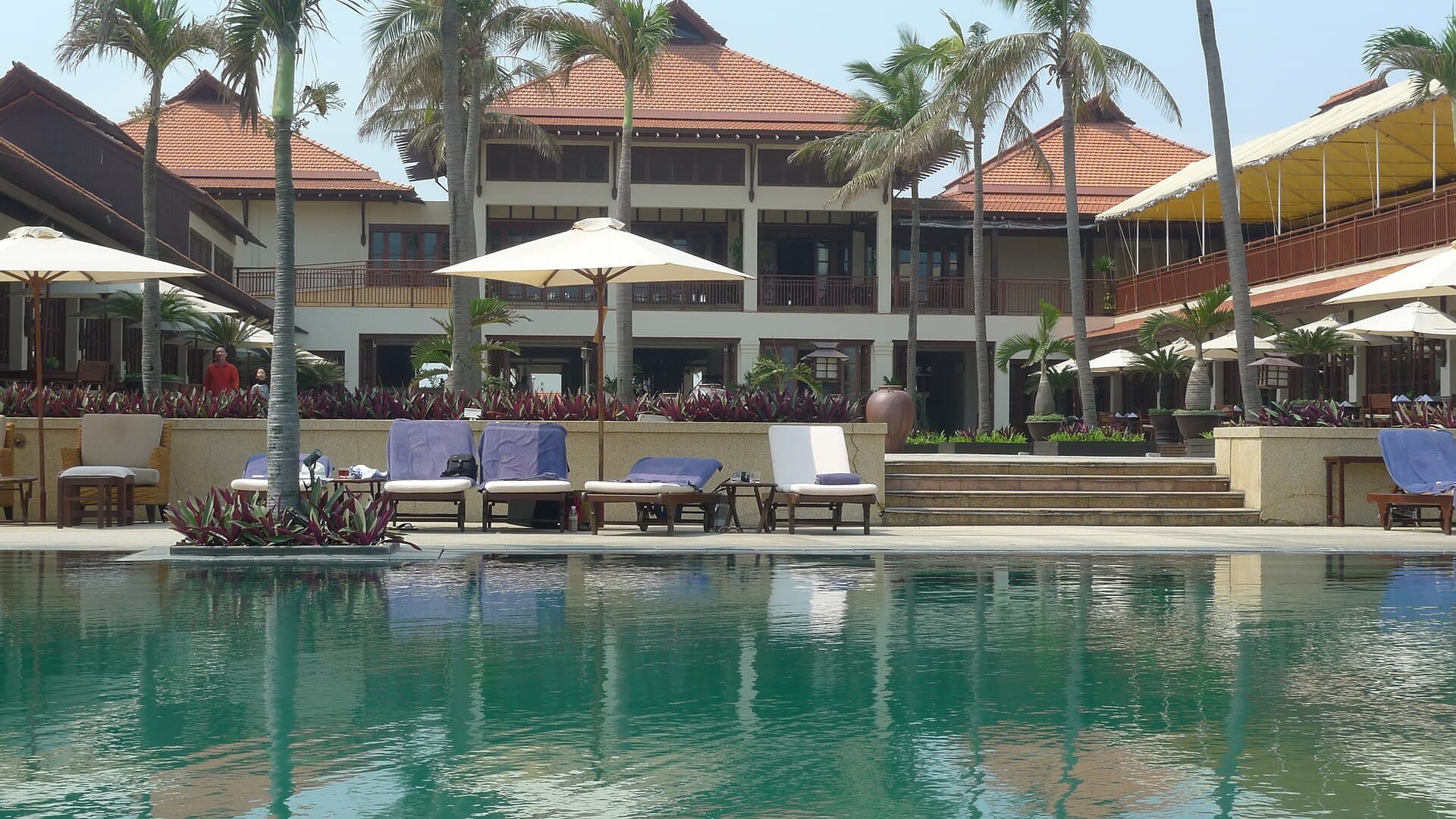
A hostel dorm bed in Vietnam costs 130,000-470,000 VND ($5-18) a night as of mid-2026, a budget private double 360,000-1,430,000 VND ($14-55), a mid-range 3-4 star double 650,000-6,760,000 VND ($25-260), and the upper resort tier from 1,820,000 VND ($70) in Can Tho to 23,400,000 VND ($900) at the top of Phu Quoc. Accommodation is the largest line in almost every Vietnam budget, and it is the one line that moves most — not with distance, but with the calendar.
This index prices a night's sleep across 12 Vietnamese cities on a comparable basis, the same 12 the Pho Index 2026 uses, so the two datasets join city by city. Four tiers per city, a per-person homestay band where the city has a real homestay economy, plus each city's seasonal peak uplift and weekend effect. Every row carries its own sources and a confidence grade in the open dataset.
The index: what a night costs in 12 cities
Bands are for one midweek night, standard double, two adults, booked roughly 60 days out through a mainstream online travel agency. Dorm rates are per bed. Peak uplift is the typical lift over this midweek shoulder baseline at that city's own peak.
| City | Dorm bed (VND) | Budget private (VND) | 3-4 star (VND) | Upper / resort (VND) | Peak uplift |
|---|---|---|---|---|---|
| Hanoi | 260,000-470,000 | 650,000-1,300,000 | 1,430,000-5,980,000 | 6,760,000-15,600,000 | +15-25% |
| Sapa | 180,000-360,000 | 470,000-830,000 | 780,000-3,900,000 | 3,900,000-10,400,000 | +50-100% |
| Ninh Binh | 160,000-310,000 | 390,000-780,000 | 650,000-3,120,000 | 3,120,000-7,280,000 | +30-50% |
| Hue | 180,000-310,000 | 470,000-780,000 | 730,000-3,380,000 | 3,900,000-9,100,000 | +15-25% |
| Da Nang | 230,000-390,000 | 570,000-1,040,000 | 1,040,000-4,680,000 | 4,680,000-11,700,000 | +30-60% |
| Hoi An | 210,000-360,000 | 520,000-910,000 | 910,000-4,420,000 | 5,200,000-13,000,000 | +30-50% |
| Quy Nhon | 130,000-310,000 | 360,000-730,000 | 650,000-2,340,000 | 2,600,000-6,500,000 | +40-80% |
| Nha Trang | 180,000-360,000 | 470,000-910,000 | 780,000-3,380,000 | 3,640,000-9,100,000 | +30-60% |
| Da Lat | 160,000-310,000 | 390,000-780,000 | 650,000-3,380,000 | 3,120,000-7,800,000 | +50-100% |
| Ho Chi Minh City | 260,000-470,000 | 730,000-1,430,000 | 1,430,000-6,240,000 | 7,280,000-16,900,000 | +10-20% |
| Can Tho | 160,000-310,000 | 360,000-730,000 | 650,000-2,340,000 | 1,820,000-5,200,000 | +20-35% |
| Phu Quoc | 230,000-420,000 | 780,000-1,430,000 | 1,300,000-6,760,000 | 7,800,000-23,400,000 | +60-100% |
The same bands in US dollars
Converted at a rounded 26,000 VND to the dollar; the dong traded around 26,250-26,300 in mid-2026 (Trading Economics), so these understate by roughly 1%.
| City | Dorm bed | Budget private | 3-4 star | Upper / resort |
|---|---|---|---|---|
| Hanoi | $10-18 | $25-50 | $55-230 | $260-600 |
| Sapa | $7-14 | $18-32 | $30-150 | $150-400 |
| Ninh Binh | $6-12 | $15-30 | $25-120 | $120-280 |
| Hue | $7-12 | $18-30 | $28-130 | $150-350 |
| Da Nang | $9-15 | $22-40 | $40-180 | $180-450 |
| Hoi An | $8-14 | $20-35 | $35-170 | $200-500 |
| Quy Nhon | $5-12 | $14-28 | $25-90 | $100-250 |
| Nha Trang | $7-14 | $18-35 | $30-130 | $140-350 |
| Da Lat | $6-12 | $15-30 | $25-130 | $120-300 |
| Ho Chi Minh City | $10-18 | $28-55 | $55-240 | $280-650 |
| Can Tho | $6-12 | $14-28 | $25-90 | $70-200 |
| Phu Quoc | $9-16 | $30-55 | $50-260 | $300-900 |
How to read the tiers
The 3-4 star column is deliberately wide, and that width is the finding rather than a failure of precision. Vietnamese star ratings are self-declared with no independent audit, so a strong three-star and a tired four-star overlap heavily on both price and quality. Treating them as one band is more honest than pretending the labels sort cleanly. Our hotel price reference splits the two where the split is meaningful.
The upper column measures each city's ceiling, not its average. Phu Quoc's 23,400,000 VND top reflects a flagship cluster of three or four properties; mid-range Phu Quoc sits mid-pack nationally. Can Tho's ceiling is a quarter of that because the Mekong Delta simply has no five-star market to speak of.
Three cities set the extremes. Ho Chi Minh City has the highest city-hotel baseline, driven by District 1 rents and weekday business demand. Hue is the cheapest destination most itineraries actually visit. Can Tho and Quy Nhon are the cheapest rows outright, and also the two thinnest markets in the index, which is why both are graded medium confidence.
The seasonal swing is the biggest number on this page
Geography sets the baseline; the calendar sets the bill. The same room in Da Lat is a different product on a Tuesday and a Saturday, and no city-level average survives that.
| City | Weekend effect | Peak windows |
|---|---|---|
| Da Lat | Extreme | Every Friday and Saturday, Tet, the April 30-May 1 block, late December |
| Sapa | Strong | Vietnamese weekends, September rice harvest, late December, Tet |
| Phu Quoc | Strong | Tet, December-February international, June-August domestic |
| Quy Nhon | Strong | June-August only; November-February near dormant |
| Da Nang, Nha Trang | Strong | June-August domestic school holidays, plus weekends year-round |
| Hoi An, Ninh Binh | Moderate | February-April dry season, summer weekends |
| Can Tho | Moderate | Tet and summer weekends out of Ho Chi Minh City |
| Hanoi, Hue | Mild | March-April and October-November international shoulder |
| Ho Chi Minh City | Flat to negative | No true peak; Tet softens as the city empties |
Three patterns matter more than the rest. Da Lat and Sapa price off Vietnamese weekenders, so Friday and Saturday nights run 50-100% over midweek and a valley-view room that lists at 900,000 VND on a Tuesday can ask 1,800,000 on a Saturday. The coast peaks in the domestic summer, June to August, which is low season for international visitors and the opposite of what most Western travellers assume. Tet inverts the big cities: Hanoi and Ho Chi Minh City often soften over Lunar New Year while every beach and highland town doubles, because residents are the ones travelling.
Where a homestay is a real option
Four of the twelve cities have a homestay economy worth pricing separately. Everywhere else the label has drifted to mean a small guesthouse, so those rows are null rather than guessed. Rates are per person and normally include dinner and breakfast, which changes the comparison against a hotel rate considerably.
| Area | Per person (VND) | USD | What it usually means |
|---|---|---|---|
| Sapa (Muong Hoa valley) | 260,000-780,000 | $10-30 | Hmong, Dao and Giay stilt houses, trekking-based |
| Ninh Binh (Tam Coc, Trang An) | 310,000-910,000 | $12-35 | Family-run bungalow properties, semi-commercial |
| Hoi An (Cam Thanh, Tra Que) | 390,000-1,040,000 | $15-40 | Small family guesthouses on the rural fringe |
| Can Tho and the Delta | 310,000-780,000 | $12-30 | Orchard-and-river family homes, boat trips included |
Our homestay guide covers etiquette and how to tell a real family stay from a mini-hotel wearing the word, and the three-way accommodation comparison works through when each type actually wins.
Direct or agency, and what the rate excludes
The booking-channel spread runs in opposite directions at the two ends of the market. Family-run guesthouses, mini-hotels and homestays pay roughly 15-18% commission on an agency booking and will often trade 5-15% of it away for a direct reservation, particularly on multi-night stays. International-brand hotels contract for rate parity, so the agency price plus a loyalty discount typically matches or beats direct. Agoda holds the deepest Vietnamese inventory and can display a pre-tax figure by default, which is why the only fair comparison is final checkout total against final checkout total.
Above three stars, the quoted rate is frequently a "++" rate. It excludes a 5% service charge and VAT, reduced to 8% and explicitly covering accommodation through 31 December 2026 under Resolution 204/2025/QH15 (Taxand). Compounded, that is about 13.4% on top: a 5,000,000 VND villa settles near 5,670,000. Below three stars this disappears entirely — guesthouse pricing is net.
Methodology
What was priced. One night, standard double, two adults, midweek, booked roughly 60 days ahead through a mainstream online travel agency. Dorm rates are per bed; homestay rates are per person with meals. Four tiers per city: hostel dorm bed, budget private room (two-star, mini-hotel or good guesthouse), mid-range 3-4 star double, and upper/resort double.
How rates were gathered. Observation window August to September 2026. Each row anchors on our own dated 2026 tier-by-tier rate tracking, published in the Vietnam hotel price reference and aligned with the accommodation lines of the travel cost index, then cross-checked against a per-city third-party listing and national market data. Savills reported Q1 2026 national occupancy at 80% with RevPAR up nearly 15% on 2024, which is the macro backdrop these bands sit inside (Savills Vietnam).
On aggregator lead-in prices. Tripadvisor showed "hotels from" figures of $10-13 across all twelve cities in mid-2026. Those are recorded as corroboration for the bottom of the dorm and budget columns only. They are not usable rates for a standard double and were never used to set a band.
Conversions. USD bands converted at a rounded 26,000 VND per dollar and rounded to the nearest 10,000 dong, matching the Pho Index convention so the two datasets stay comparable.
Confidence. High means all four tiers are corroborated by both our own dated 2026 observations and a per-city external anchor. Medium means one leg is thin — no per-city anchor beyond an aggregator lead-in price, or a shallow top-end market. Ninh Binh, Quy Nhon and Can Tho are the three medium rows.
Limitations
- These are planning bands, not quotes. Every figure is a typical online rate as of mid-2026 in a roughly 60-day window. Peak uplifts are typical lifts, not ceilings: individual Tet nights and single-night weekend beach stays exceed them.
- Star ratings are self-declared. The 3-4 star column spans a factor of four in some cities because the label carries no audit behind it. Recent reviews sort that band better than any price range can.
- Three rows are thin. Quy Nhon and Can Tho rest on shallow markets with few published tier-level observations, and Ninh Binh's upper column is a handful of properties rather than a market. All three are graded medium.
- Supply is moving fast. Da Nang and Phu Quoc keep adding rooms, and one new tower can soften a local band within months while a rebrand pushes an individual property out of it entirely.
- The homestay column is not comparable to the hotel columns. It is per person and normally includes two meals, so a party of two should roughly double it before comparing against a double-room rate.
- Long-stay and serviced-apartment pricing is out of scope. Monthly rates follow different economics and are not represented here.
Annual update commitment
The index is re-priced each year with the year in the slug, so citations stay anchored to the edition they quote. The 2027 edition will re-price all twelve cities against this baseline and add a per-city direct-versus-agency spread if we can observe it consistently.
Revision history:
| Date | Changes |
|---|---|
| 2026-09-18 | Initial publication. Twelve cities, four tiers, homestay bands for four cities; Ninh Binh, Quy Nhon and Can Tho graded medium confidence. |