
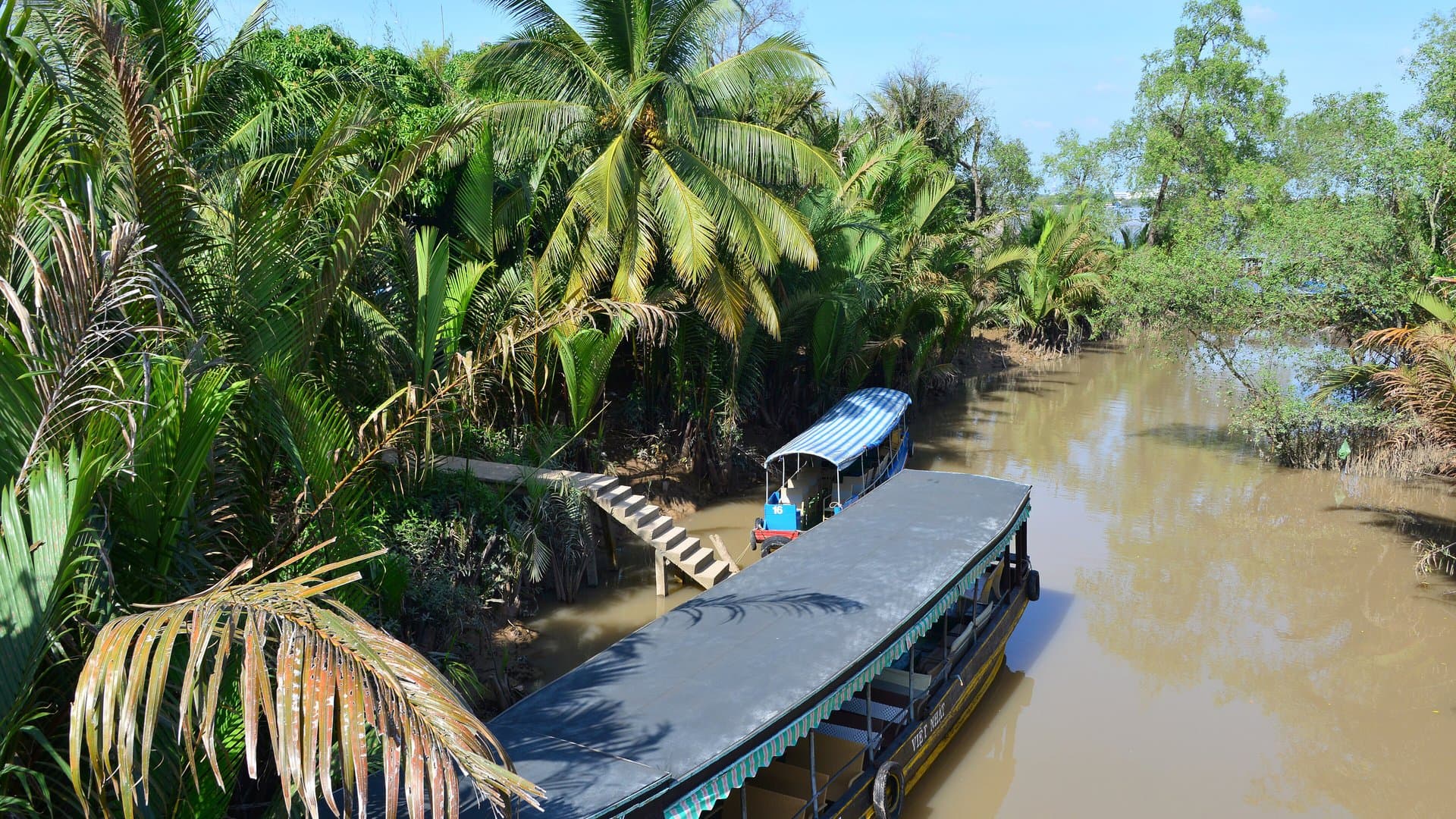
Ben Tre is the coconut country of the Mekong Delta, about 85 to 95 km south of Ho Chi Minh City and roughly two hours away by road. It is the closest place to the city where the delta still feels rural: flat concrete lanes under coconut palms, narrow canals lined with water coconut, family workshops making candy and coir, and homestays on the riverbanks. Cycle the lanes, take a sampan down a palm-lined canal, watch coconut candy being cut and wrapped by hand, and sleep in a riverside homestay. Give it one night, ideally two.
Ben Tre is also a name in transition. Under Resolution 202/2025/QH15, from 1 July 2025 the province was merged with Vinh Long and Tra Vinh into an enlarged Vinh Long province, and districts were abolished across Vietnam. The former city of Ben Tre is now five wards, An Hoi, Phu Khuong, Ben Tre, Son Dong and Phu Tan, as Vietnamese Wikipedia's entry on Ben Tre ward sets out. Buses, signs and booking sites still say Ben Tre, and so does this guide; just expect addresses to end in "Vinh Long". The Mekong Delta destination guide puts it in context with the rest of the region.
Getting there from Ho Chi Minh City
| Option | Time | Price (2026) | Notes |
|---|---|---|---|
| Bus from Mien Tay | ~2-2.5 hours | ~80,000-170,000 VND | Many operators; Futa listed at 170,000 VND |
| Limousine van | ~1.5-2 hours, plus pickups | ~150,000-250,000 VND | Pickup in District 1 |
| Private car | ~1.5-2 hours | ~1.2-1.8 million VND one way | Door to door |
| Group day tour | ~11 hours return | See the day trip guide | Usually via My Tho |
By bus. Buses leave from Mien Tay bus station in Binh Tan, 30 to 45 minutes from District 1 by taxi, and most stop at Ben Tre bus station on the edge of the city. On the booking site Vexere in October 2026, Futa, also known as Phuong Trang, listed sleeper and limousine seats at 170,000 VND with departures from early morning, and smaller companies listed seats from about 120,000 VND. A VietnamTourism.com guide, updated in October 2026, puts a standard bus at 80,000 to 120,000 VND and 1.5 to 2.5 hours. The Futa bus guide explains how the company's tickets and shuttles work.
By car or van. The same guide gives about 1.5 to 2 hours by private car, for about 1.2 to 1.8 million VND one way, and 150,000 to 250,000 VND for a seat in a limousine van from District 1. Shared vans stop for pickups, so allow extra time. The Vietnam Travel Time Atlas explains why bus and car times differ on the same road.
The bridges. The road runs down the expressway towards My Tho and then crosses the Tien River into Ben Tre. The first Rach Mieu bridge replaced the ferry in 2009, and on 19 August 2025 a second crossing, Rach Mieu 2, opened about 4 km upstream: a 1.97 km cable-stayed bridge on a 17.6 km route that ends near the Ham Luong bridge, built to relieve the jams on the old bridge at weekends and holidays, as Tap chi Cong Thuong reported.
From Vinh Long, Tra Vinh and the rest of the delta
Ben Tre sits on river islands between branches of the Mekong, so every road out crosses water. The Ham Luong bridge links the city with Mo Cay to the south, and the Co Chien bridge carries on to Tra Vinh. The direct road west to Vinh Long city still crosses the Co Chien river on the Dinh Khao ferry from the Cho Lach side. A 1.54 km bridge to replace it was still looking for an investor in May 2026, as Bao Dau Thau reported, so expect the ferry for some time yet. For Can Tho and its floating market, the Ho Chi Minh City to Can Tho guide covers the main route.
Day trip or overnight?
Most people see Ben Tre on a day tour from Ho Chi Minh City, and that shows them its busiest corner. A typical group tour drives to My Tho, boards a motorboat and crosses to Con Phung or Con Quy, islets on the Ben Tre side of the Tien River, for a coconut candy workshop, honey tea, fruit and a short sampan ride, then drives back: about 11 hours door to door, as the Mekong Delta day trip guide describes. If one day is all you have, it is a pleasant sampler, and the two-day Saigon and Mekong itinerary explains how to choose a smaller, better tour.
A night changes the trip. You can ride the coconut lanes at six in the morning, before the heat and the tour boats, paddle a canal at dusk when it is quiet, and eat dinner with the family that runs your homestay. What Ben Tre does not have is a working floating market. If that is your goal, add a night in Can Tho; the floating markets guide explains which ones still trade.
Cycling the coconut lanes
Ben Tre is flat, laced with small concrete lanes, and shaded by coconut palms, which makes it the best cycling country in the delta for most visitors. Many homestays lend bicycles, and rental costs about 50,000 to 100,000 VND a day, according to the VietnamTourism.com guide. The same guide suggests three loops: about 15 to 20 km out to the river islets in 2 to 3 hours, 25 to 30 km past orchards and workshops in 4 to 5 hours, and a 50 to 60 km full day through Giong Trom and Ba Tri. Small local ferries carry you and your bicycle across the rivers for about 5,000 to 15,000 VND.
Three areas are worth aiming for:
- Cho Lach, west of the city, is the province's orchard and plant-nursery country, around Cai Mon. Fruit gardens charge an entry fee that covers what you eat in the garden, and before Tet its trucks of flowers and ornamental plants queue for the Dinh Khao ferry.
- Giong Trom, south-east of the city, has the craft villages of Son Doc, known for puffed rice crackers, and My Long, known for rice paper made with coconut milk. Both crafts were listed as national intangible cultural heritage in 2018, as Thoi bao Tai chinh reported.
- Ba Tri, further east towards the sea, has the tomb of the 19th-century poet Nguyen Dinh Chieu and the Vam Ho bird sanctuary, a long day's ride or a short drive.
Ride early, carry water and small notes, and expect to share the lanes with motorbikes.
Coconut workshops: what you will see
Coconut is the economy here, not a theme. Ben Tre grows about 80,000 ha of coconut, and together with Tra Vinh and Vinh Long the enlarged province has about 120,000 ha, more than half of Vietnam's coconut area, as Tuoi Tre reported in April 2025.
The workshop most visitors see makes coconut candy: coconut milk, sugar and malt syrup cooked down, cooled, cut into small bars and wrapped by hand. Mo Cay, south of the city, is traditionally credited as the home of the candy. Other workshops twist coir into rope and mats, burn shells into charcoal, turn shells into handicrafts, or ferment coconut wine from the sap of the flower stalk. The workshops on Con Phung and Con Quy are built for tour groups and end in a sales room; small family workshops along the lanes are usually free to watch, with cash expected if you buy, according to the VietnamTourism.com guide.
Con Phung and the river islets
Con Phung, or Phoenix Islet, lies in the Tien River opposite My Tho, in the old Tan Thach commune. It was the base of the Coconut Monk, Nguyen Thanh Nam, who lived from 1909 to 1990 and founded the Coconut Religion in 1963; it was banned in 1975. His terrace of dragon-wrapped columns and towers still stands, more kitsch than solemn, beside candy workshops, a crocodile pond and horse carts. A 2025 Vietjet travel guide gave entry as 50,000 VND for adults and 30,000 VND for children, with a return boat at about 60,000 to 80,000 VND per person. Most visitors arrive by boat on tours from My Tho, and neighbouring Con Quy is usually on the same loop. It is worth an hour, not a day.
Where to stay: homestays and riverside lodges
Most homestays sit 10 to 20 km from the bus station, in the orchard villages across the rivers, and a motorbike taxi or car from the bus station costs about 50,000 to 150,000 VND. The VietnamTourism.com guide puts homestays at about 200,000 to 500,000 VND a night, riverside guesthouses at 800,000 to 2,000,000 VND and city hotels at 400,000 to 1,200,000 VND, as of 2026. Meals are usually extra; the Vietnam homestays guide gives about 375,000 to 750,000 VND per person with breakfast across the delta.
I name only places with guest reviews from 2026:
- Ben Tre Farm Stay, on the river about 3 km from the centre, in the former Phu Nhuan commune, now part of An Hoi ward. It has bungalows and its own dock, and its boat trip visits a brick kiln, a coconut candy workshop and a mat-weaving village. Guests reviewed it on Hostelworld as recently as March 2026.
- Mango Home Riverside, a small lodge on the Ham Luong River in the Giong Trom countryside, in the same old commune as the My Long rice-paper makers, with a pool according to booking listings. Trip.com showed guest reviews posted as recently as September 2026.
Stay in the city if you arrive late or want restaurants and the market; stay out in the villages if you came to cycle. Book ahead for weekends and public holidays.
What to eat
Coconut turns up everywhere: in rice, in porridge, and in chuoi dap, bananas flattened, grilled over charcoal and served with coconut milk. In season, look for banh xeo made with rice snails, giant river prawns cooked in young coconut water, and pomelo and durian from the Cho Lach orchards. The souvenirs worth carrying home are Son Doc rice crackers, My Long rice paper and a bag of candy from a family workshop.
When to go
- December to April: the dry season and the best time for cycling and canal trips. The heat builds to about 34°C by April, and salt water pushes up the rivers from about February to April, a serious problem for farmers that rarely affects visitors.
- June to August: the fruit season in the Cho Lach orchards, with heavy afternoon downpours and sunny mornings.
- May to November: the rainy season, peaking in September. Ben Tre is in the lower delta, so the flood season of the upper delta around Chau Doc is not a feature here.
- Tet: Tet 2027 falls on 6 February. Avoid the days around it, when many businesses close, traffic is heavy and prices rise; see the Tet 2027 guide.
The Mekong Delta weather guide has the month-by-month figures. Ben Tre's coconut festival last ran, in its fifth edition, in November 2019, and I found no confirmed date for the next one.
How Ben Tre fits a Mekong trip
Ben Tre works best as the first night of a delta loop: it is the closest stop to Ho Chi Minh City and the gentlest introduction. From here, continue to Vinh Long and Can Tho for the dawn floating market, and on to Chau Doc if you are heading for Cambodia. The Mekong Delta without a tour guide explains how to link the towns by public bus.
Limitations
Prices are ranges from booking listings and travel guides, not quotes from operators, and bus fares vary by company and seat class. The Con Phung entry and boat prices come from a 2025 guide I could not confirm with the site. I could not confirm a current bus timetable from Ben Tre to Can Tho, the timing of the Dinh Khao bridge, or the date of the next coconut festival. Homestays change hands and close, and I name only those with 2026 reviews. After the 2025 reforms, addresses, ward names and signs are still catching up.
Workaround: confirm fares and departure times when you book, carry cash, ask your homestay to arrange boats and ferry crossings, and give the old district names, such as Cho Lach or Giong Trom, as well as the new address when you ask for directions.