
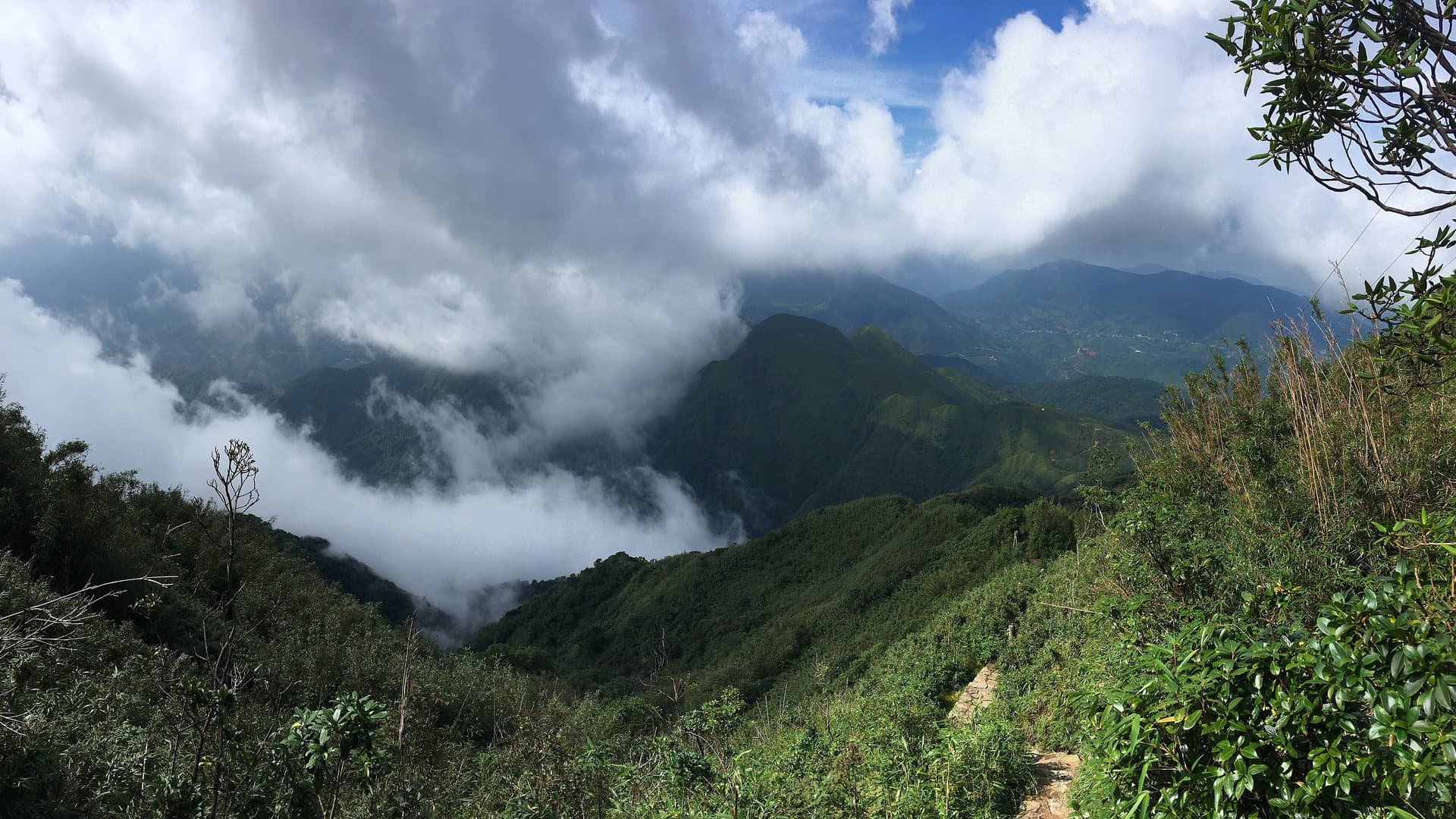
Yes, it snows in Vietnam, but not often and not in many places. Snow falls in the mountains of the far north during strong winter cold waves, usually between December and February, and mostly above about 2,000 metres. The most reliable spot is the summit of Fansipan, at 3,143 metres the highest point in Indochina, reached by cable car from Sa Pa. Even there, some winters bring no snow at all. Hanoi, Da Lat and the centre and south never see it.
What visitors meet far more often is cold without snow: frost on the grass, ice on the trees at the summit, and days in thick cloud. If snow is the whole reason for a trip, treat it as a lottery ticket, and plan the trip around the mountains themselves.
Where it snows
Snow in Vietnam is a matter of altitude and latitude. The northern mountains along the Chinese border are the only part of the country that gets cold enough, and only the highest ground regularly drops below freezing.
| Place | Elevation | How often |
|---|---|---|
| Fansipan summit, Lao Cai | 3,143 m | Some winters, during strong cold waves |
| Hoang Lien Son ridges and O Quy Ho pass | 2,000 m+ | Some winters, during strong cold waves |
| Y Ty, Bat Xat district | about 2,000 m | Some winters, during strong cold waves |
| Sa Pa town | about 1,500 m | Exceptional, as in January 2016 |
| Hills near Hanoi (Ba Vi, Tam Dao) | about 1,000-1,600 m | Exceptional, as in January 2016 |
| Hanoi, Da Lat, centre and south | low or tropical | Never |
The Dong Van plateau in Ha Giang can also see frost, ice and occasional snow in hard winters; our Ha Giang weather guide covers its cold season.
When it snows
Snow comes with the strongest of the winter cold waves that push down from the north between December and February, sometimes lingering into early March. Nights in the far north can approach freezing in any winter. Snow needs more: a deep cold surge and moisture at the same time.
These are the snowfalls we can document from recent years:
- January 2016. The strongest cold wave in modern Vietnamese records, on 23-24 January, brought snow to Sa Pa town and the high mountains of Bat Xat, to the Ba Vi mountains near Hanoi, to Tam Dao and to the Moc Chau area, and the first recorded snowfall to parts of the North Central Coast. Sa Pa fell to -4.2°C, its lowest since records began in 1956, and downtown Hanoi to about 5°C, its lowest in more than 20 years, according to the record of the cold wave.
- December 2022. Snow on the summit of Fansipan.
- 26 January 2025. The first snow on Fansipan's peak since December 2022, falling heavily above about 2,900 metres, with snow also on the O Quy Ho pass and at Y Ty, as VnExpress reported.
- 18 December 2025. About five minutes of light snow on Fansipan's summit at 1-2°C, which melted almost at once, according to VnExpress.
The gap between December 2022 and January 2025 shows how irregular it is: two full winters with no snow on the country's highest peak.
Frost and ice are the common version
Most cold snaps bring frost and ice rather than snow. On the high ground, freezing fog coats trees, railings and grass in white rime ice, which Vietnamese media call băng giá. It forms on Fansipan's summit, on the high passes and at Mau Son in Lang Son province, which dropped below -5°C in January 2016. From a distance it looks like snow, and it draws crowds of Vietnamese travellers who go "snow hunting", săn tuyết, whenever a cold wave is forecast.
How to try to see it
Snow cannot be booked weeks ahead. What you can do is be in the right region in the right months and react to the forecast.
- Go in December to February, with January the most likely month for a strong cold wave.
- Watch the forecasts. The national forecaster, NCHMF, issues cold-wave warnings, and snow on the peaks is usually forecast only two or three days out.
- Base yourself in Sa Pa. Our Hanoi to Sapa guide covers getting there in a day.
- Take the Fansipan cable car on the coldest morning. A return ticket costs about 850,000 VND as of mid-2026. The summit sits in cloud on more than 200 days a year, so there is no guarantee of a view.
- Don't drive icy passes yourself. Roads like O Quy Ho can be dangerous when frozen. Use a local driver who knows them.
Our Sapa weather guide shows what winter is like the rest of the time: cold, dry and often foggy, with average lows of about 6°C.
What to pack for a cold-wave trip
On a snow-watching trip, the summit can be several degrees below freezing with a strong wind. Pack thermal base layers, a warm mid-layer, a windproof and waterproof shell, gloves, a hat and warm socks. Shoes with grip matter on icy steps. Most homestays and many hotels in the region have little heating, so bring layers you can sleep in. Our January guide and December guide cover the rest of the country in those months, which is mild in the south and dry in the centre.
Limitations
Official long-run climate normals are published for towns, not for the summits where snow falls, so we cannot give a reliable average number of snow days for Fansipan or Y Ty. Our list of recent snowfalls comes from news reports and may not be complete, and small, brief falls on the peaks can go unreported. Cold waves vary a great deal from year to year.
Workaround: use this page to choose the region and months, follow NCHMF cold-wave warnings from December to February, and keep your Sa Pa dates flexible if snow is the goal.