
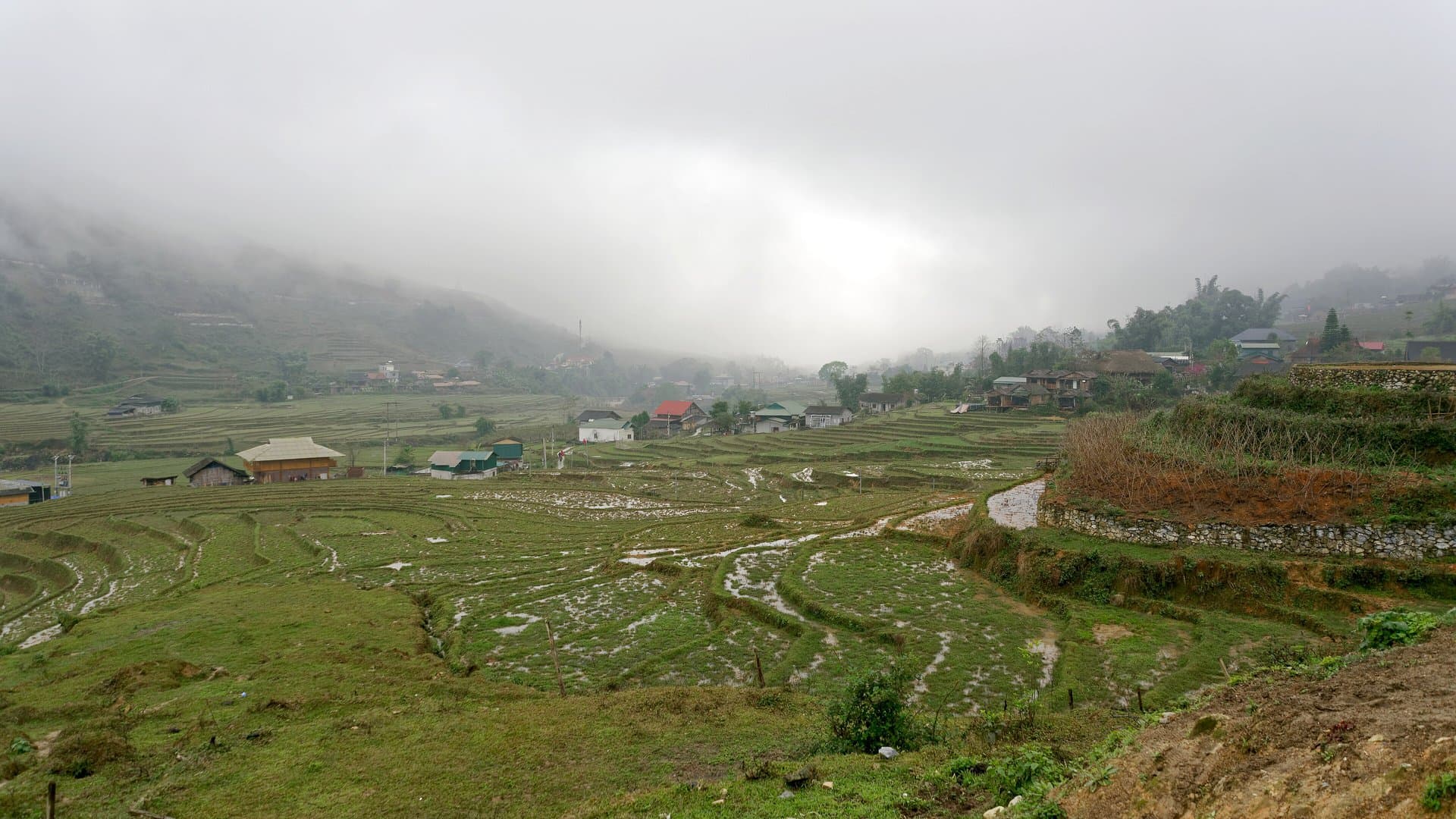
Sapa has two good seasons and one very wet one. Late September to October is the harvest, when the terraces turn gold and the rain eases. March to May is the green season, with mild days and terraces flooded for planting. May to September brings most of Sapa's roughly 2,835 mm of annual rain, peaking at about 465 mm over 26 days in July. Winter, from December to February, is the driest stretch, but it is cold and often foggy, with average lows of about 6°C and rare snow on the high ground.
The one thing to understand first is altitude. Sapa sits at about 1,500 metres in the Hoang Lien Son mountains, so it runs around 10°C cooler than Hanoi all year, and it spends a lot of time in cloud. Average sunshine is only three to six hours a day in any month. A forecast of rain in Sapa often means drizzle and mist rather than downpours, and the view can change within an hour.
Sapa weather at a glance
The table gives long-run averages for Sa Pa town from Climates to Travel. Rain days are days with at least 1 mm.
| Month | High | Low | Rain | Rain days | Sunshine (h/day) |
|---|---|---|---|---|---|
| January | 12.5°C | 6.2°C | 65 mm | 15 | 4 |
| February | 14.1°C | 7.5°C | 80 mm | 16 | 4 |
| March | 18.1°C | 10.7°C | 105 mm | 16 | 5 |
| April | 21.2°C | 13.8°C | 215 mm | 18 | 6 |
| May | 22.4°C | 16.3°C | 345 mm | 22 | 5 |
| June | 22.8°C | 17.6°C | 410 mm | 24 | 3 |
| July | 23°C | 17.7°C | 465 mm | 26 | 3 |
| August | 23.1°C | 17.4°C | 450 mm | 24 | 4 |
| September | 21.6°C | 15.9°C | 315 mm | 20 | 3 |
| October | 19°C | 13.5°C | 215 mm | 18 | 3 |
| November | 15.9°C | 10.1°C | 110 mm | 14 | 4 |
| December | 13.4°C | 6.9°C | 65 mm | 12 | 4 |
The year averages 12.8°C at night and 18.9°C by day, with about 2,835 mm of rain over roughly 226 days and humidity near 87 percent. Even the driest month has a dozen rain days, which tells you how much of Sapa's weather is mist and light drizzle.
Autumn, September to November: the harvest
Autumn is the season most people come for. The rice ripens in the last weeks of September and the harvest runs into October, turning the Muong Hoa valley terraces from green to gold before the fields are cut. Rain falls steadily through the season, from about 315 mm in September to 215 mm in October and 110 mm in November, and highs ease from about 22°C to 16°C.
The gold does not last. By mid-October many fields are stubble, and in an early year the peak can finish in September. If the terraces are the reason for your trip, aim for the last ten days of September or the first week of October, and confirm with your homestay or guide a week out. November is quieter, drier and cooler, a good month for trekking once the photographers have gone. Our 3 days in Sapa itinerary is built around this window.
Spring, March to May: green and flooded terraces
Spring is the second window, and many trekkers prefer it. March is still fairly dry at about 105 mm, with highs of about 18°C. April and May bring the "water mirror" season, when the terraces are flooded before planting and reflect the sky, and the valleys turn a fresh green. The trade-off is rising rain, to about 215 mm in April and 345 mm in May, so late May already feels like the start of the wet season.
This is also when Sapa is at its most comfortable for walking: days of 18-22°C, nights of 11-16°C, and sunshine at its annual best of around five to six hours a day in April and May.
Summer, June to August: the wet season
Summer is warm by Sapa standards, with highs of about 23°C, and very wet. June to August each average 410-465 mm over 24 to 26 days, and July is the wettest month of the year. On the trails that means mud and slippery steps. In the valleys it means cloud that can hide the views for days, and on the roads it means occasional landslides after heavy storms.
It is also the greenest time of year, and the rain often comes in bursts rather than all day. If you travel in summer, plan shorter walks with a local guide, start early while mornings are clearer, and keep a spare day in case a storm closes a trail.
Winter, December to February: cold, foggy and quiet
Winter is the driest season, with about 65-80 mm a month, but it is cold. Average highs are only 12-14°C and lows 6-7°C, and on some days the high stays below 5°C. Fog can settle in the valley for days at a time. Most homestays have no heating, so bring layers you can sleep in.
Snow is rare. The famous exception was January 2016, when a cold wave brought snow to Sa Pa town and the high mountains of Bat Xat, and the town recorded -4.2°C, its lowest reading since records began in 1956. Snow falls more often on Fansipan's summit, which it did in January 2025 and, for a few minutes, in December 2025.
What the weather means for your trip
Trekking. The Lao Chai to Ta Van walk and the longer valley treks are best from March to May and from September to November. In the wet months, choose shorter routes and a local guide, and start early.
Fansipan. The 3,143 m summit sits in cloud on more than 200 days a year, and the return cable car costs about 850,000 VND as of mid-2026, with no refund for weather. Look at the sky from the valley that morning before you commit.
Getting there. Our Hanoi to Sapa guide compares the sleeper bus, the night train and private cars. To stay somewhere quieter than town, see where to stay in Sapa and Sapa without the crowds. If you are choosing between the northern mountain regions, Sapa vs Ha Giang and our Ha Giang weather guide set the two side by side.
Limitations
The table uses long-run averages for Sa Pa town at about 1,500 metres. The Muong Hoa valley villages sit lower and are a little warmer, while Fansipan and the Hoang Lien Son ridges are far colder, wetter and cloudier, and we have not found a published long-run record for them. Datasets for Sapa disagree, especially on rainfall, and single years vary widely: harvest timing moves by a week or two, and cold waves like January 2016 are exceptional.
Workaround: use this page to choose the season, then check the Sapa forecast and the Fansipan summit conditions in the week you travel, ask your homestay about the terraces before timing a harvest trip around them, and keep one flexible day for weather.