
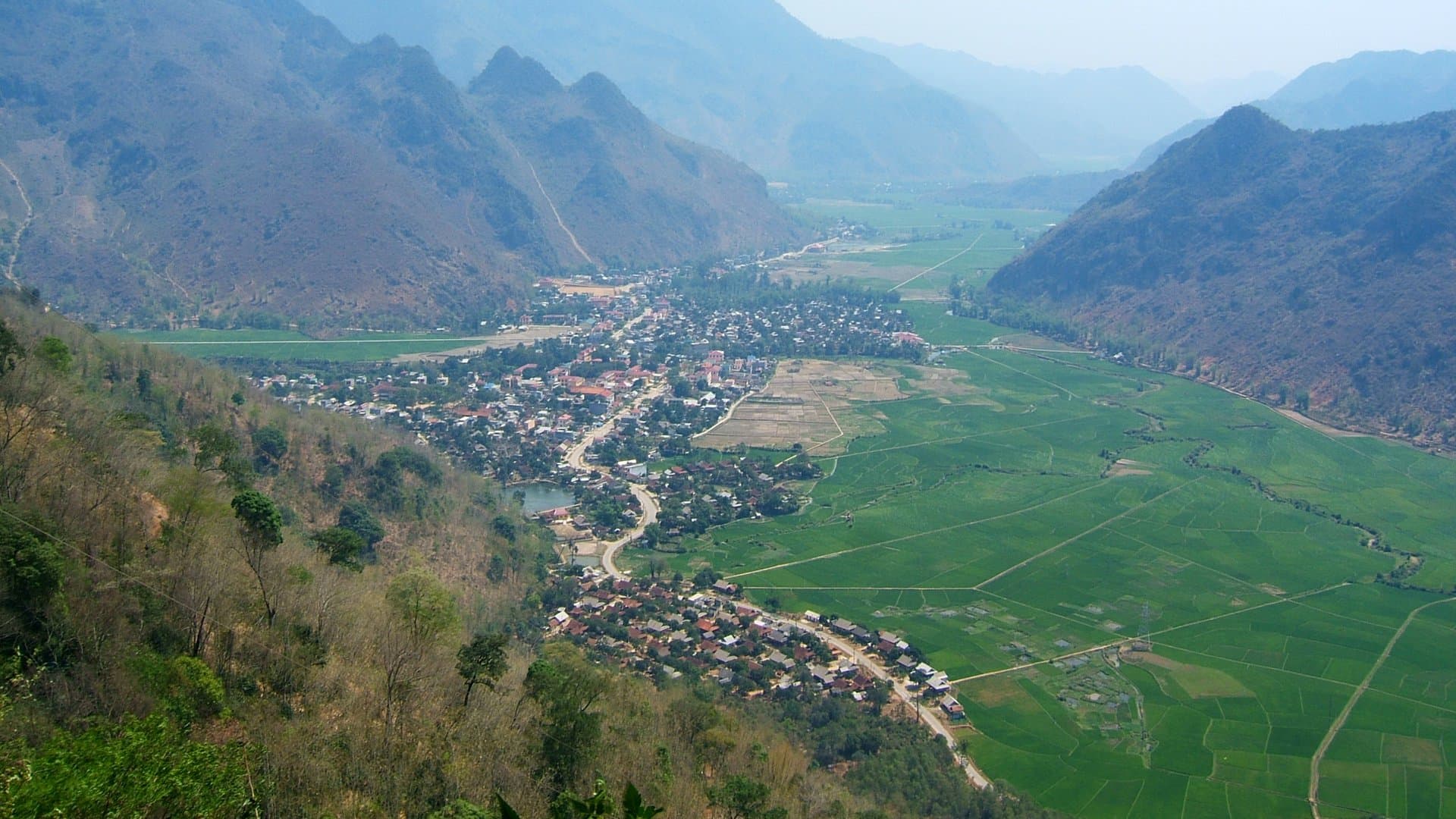
Mai Chau is a flat valley of rice fields and White Thai stilt-house villages about 140 km west of Hanoi, boxed in by forested limestone ridges. It is closer to Hanoi than Sapa or Pu Luong and gentler than both: lanes to cycle, looms in the villages and a family dinner in a stilt house. Plan on one or two nights, not a day, because the drive takes 3 to 3.5 hours each way and the valley is at its best in the evening and early morning.
This guide covers staying overnight. If you really only have one day, the Mai Chau day trip guide covers the tours and an hour-by-hour plan, and the comparison of Sapa, Mai Chau and Pu Luong helps if you are still choosing a valley.
Why stay the night
The case for staying is mostly arithmetic. Group day tours leave Hanoi around 7:30 am and return around 7 or 8 pm, buying four or five midday hours in the valley for seven on the road. Stay the night and the valley changes: the day-trippers leave by mid-afternoon, cooking smoke rises over the fields at dusk, and at dawn the lanes are empty and often misty. You eat with the family that hosts you and can cycle out before the first vans arrive.
Mai Chau is also busier than its size suggests. The Mai Chau area received 471,640 visitors in the first half of 2025, 187,530 of them international, and had 203 places to stay, 158 of them community homestays concentrated in Lac, Pom Coong, Hang Kia and Pa Co, according to Tin nhanh Chung khoan in November 2025. Seven ethnic groups live in the area, Thai people make up nearly 60% of the population, and more than 300 looms are still weaving.
Getting there from Hanoi
| Option | Time | Price (2026) | Notes |
|---|---|---|---|
| Limousine van | ~3-3.5 hours | ~250,000 VND (Huong Kien) | Old Quarter hotel pickup, drop at your homestay |
| Local bus | ~4 hours | ~100,000-150,000 VND | From My Dinh; drops on the main road |
| Private car | ~3-3.5 hours | ~1.5-2.5 million VND one way | Door to door; stop at the Thung Khe pass |
| From Pu Luong | ~1.5-2 hours | private car, ~$35-48 | About 46 km; no public transport |
Limousine vans are the easy choice, from your Old Quarter hotel to your homestay, usually in Lac or Pom Coong. On the Baolau booking platform, Huong Kien Limousine listed at least six departures from Hanoi for 24 October 2026, between 07:00 and 19:00, at 250,000 VND, each timed at 3 hours 5 minutes over 137 km. Other operators charge roughly 140,000 to 350,000 VND, depending on the vehicle, according to LocalVietnam's July 2026 route notes. Allow 3 to 3.5 hours door to door for Hanoi pickups and the winding Thung Khe pass on Highway 6; the limousine van guide explains how the vans work.
Local buses from My Dinh bus station, heading for Son La and the northwest, are the cheapest option at roughly 100,000 to 150,000 VND, but take about 4 hours and drop you on the main road a few kilometres from the villages. I could not find a 2026 operator timetable, so ask at the station. A private car costs roughly 1.5 to 2.5 million VND one way in operator listings, none clearly dated, so get two or three quotes. No expressway serves the corridor yet, as the Vietnam Travel Time Atlas notes, so the drive has not shrunk the way Ninh Binh's has.
Lac, Pom Coong and the other villages
Most visitors stay in Lac or Pom Coong, a short walk or cycle apart, and both are lived-in Thai villages rather than resorts. Since the July 2025 reforms, Hoa Binh province has been part of Phu Tho and the old districts are gone, so booking confirmations may show either province.
Lac (Ban Lac) is the original homestay village, where Thai families have lived for more than 700 years by local accounts. It is now the busiest, with about 80 households in the tourism business and the most cafes, craft stalls and rooms. A February 2026 report by the VCCI places Lac in Mai Ha commune, which had 88 places to stay. Expect tour groups in the late morning.
Pom Coong sits in the centre of Mai Chau commune and has a little over 70 households and more than 300 residents, most of them Thai, according to Bao Quoc te. Its stilt houses stand about 2 m off the ground on wooden posts, women weave scarves, bags and skirts, and some homestays host evening performances of xoe and bamboo-pole dancing.
Further out, Na Phon sits west of the centre, and the Hmong communes of Hang Kia and Pa Co are high in the hills to the north, at about 1,000 m, a day out rather than a base.
Where to stay: homestays and lodges
| Tier | Example | Price per night | Source and date |
|---|---|---|---|
| Shared stilt-house floor | Dorm bed, Mai Chau Countryside Homestay | ~220,000-240,000 VND per person | Rate sheet, March 2025 |
| Private homestay room | Double, same homestay | ~400,000-450,000 VND per room | Rate sheet, March 2025 |
| Eco-lodge | Mai Chau Ecolodge | ~$70-100 | Independent review, 2024 |
| Luxury resort | Avana Retreat | from about £220 | Advance-purchase offer, 2026 |
Homestays are the point of staying: a mattress under a mosquito net in a shared room upstairs, and often a few private rooms. Homestay No. 12 in Lac, for example, has two private rooms and one communal room, according to the same VCCI report. Mai Chau Countryside Homestay, at number 30 in Pom Coong, published March 2025 rates of about 400,000 to 450,000 VND for a standard double and 220,000 to 240,000 VND for a dorm bed, and rents bicycles and motorbikes, as Xanh SM reported. Dinner is usually extra, so ask the price when you book. The Vietnam homestay guide covers etiquette and how to tell a family stay from a mini-hotel.
Mai Chau Ecolodge, in Na Phon just west of the centre, has more than 40 thatched villas facing the fields, a pool and free bicycles, at about $70 to $100 a night in Vietnam Coracle's review; guest reviews from January 2026 show it still operating. Avana Retreat, a hillside resort with pool villas, is the top end. The lodges buy comfort but lose the family dinner.
Book ahead for weekends, the April 30 and September 2 holidays, and Tet, when many homestays fill up and guests book a week to a month ahead.
What to do over one or two nights
Mai Chau is a slow place, and the best plan leaves gaps.
Cycle the valley and walk the villages
The flat valley floor makes cycling the main activity. Bicycles cost about 30,000 to 50,000 VND a day from homestays, and some lodges lend them free. The short loops between Lac, Pom Coong and the fields take one to two hours; a longer loop out through Na Phon to Cha Long and back is roughly 15 to 20 km and two to three hours at an easy pace. Ride before 11 am or after 4 pm, when the lanes are yours. In the villages, ask before photographing people and take your shoes off in a stilt house. The Vietnam trekking guide grades Mai Chau as the gentle option among the northern regions.
Chieu cave and Go Lao waterfall
Hang Chieu sits on a forested hillside above the valley, reached by about 1,200 stone steps, as VinWonders describes; the climb is steep, and the view over the fields is best in the late afternoon. Go Lao waterfall drops from a cliff of about 30 m in Go Mu hamlet, about 3 km off Highway 6, with a steep stepped path down to boulders at the base. It flows strongest from May to September, when the path is also slippery.
Pa Co's Sunday market
On Sunday mornings, Pa Co, a Hmong commune in the hills, holds a market from about 6 am, with brocade skirts, herbs and meat. Sources put it 20 to 40 km from the valley, so ask your homestay to arrange a driver. From October to April, the ridges around Pa Co and Hang Kia often sit above a sea of cloud early in the morning.
A one-night plan
Arrive by lunchtime, cycle the valley floor in the afternoon and walk into the fields for sunset. Dinner at your homestay comes with rice wine and, in some houses, a xoe dance show; the shows are staged for visitors, so ask to skip it if you want a quiet night. Get up early, cycle again before breakfast, walk Lac or Pom Coong and leave after lunch.
A two-night plan
Add a full middle day for Chieu cave, Go Lao waterfall, or Pa Co on a Sunday, and leave the second evening free. For a longer northern trip, continue to Pu Luong: Don village is about 46 km away, 1.5 to 2 hours by private car, about $35 to $48, with no public transport, as the Hanoi to Pu Luong guide explains. With less time, the best day trips from Hanoi cover shorter escapes.
When to go
Mai Chau grows two rice crops a year, so it turns gold twice.
- Late September into October: the second crop turns gold and is harvested, and the weather is dry and cooling. The best time.
- Late May into early June: the first gold window, hotter, with the rainy season starting.
- March to May: green, pleasant and less crowded.
- July and August: hot and wet, with heavy rain and a risk of landslides on the roads.
- November to February: dry, cool and often foggy, with cold nights in the stilt houses.
Harvests shift by a week or two with the weather, so check with your homestay. Thai and Hmong festivals, including Xen Muong and the Hmong Gau Tao, fall early in the lunar year, around Tet. The Hanoi weather guide shows the northern seasons for the rest of your trip.
Practical tips
- Cash. Bring enough for your homestay, bicycles, drivers and any weaving you buy, and let your homestay arrange cars for Pa Co, Go Lao and onward travel.
- Packing. A warm layer from November to February, mosquito repellent, and shoes you can slip off at every stilt-house door.
- Budget. The Vietnam Travel Cost Index has the wider price picture for the rest of your trip.
Limitations
The homestay rates come from one March 2025 rate sheet and the eco-lodge price from a 2024 review, and I found no 2026 survey of homestay prices with meals. Workaround: confirm the rate and what it includes, especially dinner, when you book.
The limousine fare comes from one operator's listing for October 2026, and I could not find a 2026 timetable for the local buses from My Dinh or a dated private-car price. Workaround: book the van through your homestay, which knows the operators, and ask at My Dinh for bus times.
The new commune names after the 2025 reforms appear inconsistently in sources, the visitor figures cover the wider Mai Chau area rather than the two villages, and distances to Pa Co vary from about 20 to 40 km. Workaround: use village names when you book, and ask your homestay for current road conditions and driving times.