Vietnam is two things at once for plant-based travellers. It is genuinely tricky: fish sauce (nước mắm) is the default seasoning in almost everything, shrimp paste hides in broths, and a soup labelled "vegetable" is often built on pork bones. It is also secretly one of the best countries in Asia to eat meat-free, because the Buddhist cơm chay tradition means nearly every town — down to small provincial ones — has dedicated vegetarian eateries where the entire menu is safe by default. The difference between a frustrating trip and an excellent one is knowing how the chay system works and using it, rather than trying to subtract ingredients from a meat-first menu.
This guide covers the dietary profile only. For what the dishes are and where to eat them city by city, see the Vietnamese food guide; for the full dish catalogue, the street food atlas; for hygiene and stomach safety, the street food safety guide. Here the only question is how to eat well with no meat — and, if you are vegan, no egg, dairy, or honey either.
How the chay system works
Chay (pronounced roughly "chai") means vegetarian in the Buddhist sense: no meat, no seafood, and no fish sauce. It is the single most useful word in this guide. A quán chay is a dedicated vegetarian eatery; cơm chay is a vegetarian rice plate; adding chay to any dish name — phở chay, bánh mì chay — asks for the vegetarian version.
The reason the system runs so deep is religious practice. Vietnamese Mahayana Buddhism encourages vegetarian eating on set days, so a large share of otherwise-omnivorous people eat chay regularly — which sustains a parallel food infrastructure most visitors never notice. Quán chay range from point-at-the-tray canteens near pagodas, where a heaped plate costs 25,000–40,000 VND, to polished vegan restaurants in the big cities. Inside one, you do not have to interrogate anything: the broth is vegetable or mushroom stock, the dipping sauce is soy-based, and the "fish sauce" on the table is a fermented soy stand-in (nước mắm chay).
Two calendar dates matter. On the first and the fifteenth of each lunar month (mùng một and ngày rằm), many Vietnamese eat chay for the day. Markets fill with trays of vegetarian food, ordinary restaurants add chay options, and quán chay pack out with office workers. If your trip crosses one of those days, it is the easiest vegetarian eating you will find anywhere.
The mock-meat culture is part of the tradition, not a modern gimmick. Buddhist kitchens have spent centuries making tofu, wheat gluten (mì căn), mushrooms, young jackfruit, and banana blossom imitate pork, chicken, and fish — sometimes down to a seaweed "skin" on a vegetarian fish. A cơm chay tray delivers the full Vietnamese flavour range with none of the animal products, which is precisely the point.
Where animal products hide
The working rule outside a quán chay: assume fish sauce until proven otherwise. Nước mắm is the salt of Vietnamese cooking — it goes into marinades, dressings, stir-fry sauces, fried rice, and dipping bowls, usually during cooking rather than at the table. That is what makes it hard to dodge after the fact.
The map of the usual suspects:
- Fish sauce (nước mắm) — near universal. Assume it is in anything savoury unless the kitchen is chay or you asked before the wok got hot.
- Shrimp paste (mắm tôm, mắm ruốc) — pungent and buried deep in certain broths and dipping sauces, including several central and northern noodle soups.
- Pork-bone stock — the silent base of many "vegetable" soups (canh) and of the free soup that comes with rice plates.
- Egg — default in bánh mì via pâté and mayonnaise, and present in fried rice and egg noodles (mì). Rice noodles — phở, bún — are egg-free.
- Toppings — pork floss on sticky rice, dried shrimp in papaya salad, lard in some fried-shallot oils.
The honest navigation advice: do not order phở at a regular stall and ask for it without fish sauce — the broth was made from beef bones hours ago, and no amount of asking un-cooks it. For anything broth-based, go to a quán chay. At regular restaurants, your best odds are made-to-order dishes where the animal products go in last — stir-fried greens, tofu in tomato sauce, fried rice — combined with the phrases below, said at ordering time.
The phrases that actually work
Two phrases do most of the work: ăn chay when you sit down, không nước mắm when you order. Vegans add thuần chay.
| English | Vietnamese | Notes |
|---|---|---|
| I eat vegetarian | Tôi ăn chay | The opener — understood everywhere |
| I eat vegan | Tôi ăn thuần chay | Newer term; in rural areas spell out the exclusions below |
| No fish sauce | Không nước mắm | Say it while ordering, not after |
| No shrimp paste | Không mắm tôm | Matters for noodle soups and dipping sauces |
| No egg | Không trứng | Essential for bánh mì and fried rice |
| No milk | Không sữa | Covers condensed milk in coffee |
| Does this have meat? | Món này có thịt không? | Useful at market trays |
| Is there a vegetarian eatery nearby? | Gần đây có quán chay không? | Locals almost always know one |
Google Translate handles Vietnamese well and works offline if you download the language pack; showing the written phrase sidesteps tonal pronunciation entirely. The HappyCow app lists quán chay with reviews — coverage is strong in Ho Chi Minh City, Hanoi, Da Nang, and Hoi An, thinner in small provinces, where asking a local (last row of the table) works better.
What to order
These dishes are either vegetarian by design or reliably available in a chay version. For what the originals are, the street food atlas has the full profiles.
- Bánh mì chay — the vegetarian baguette, usually tofu or mock meat with the standard salad; vegans should confirm no pâté or mayonnaise.
- Phở chay and bún chay — noodle soups on mushroom-vegetable broth, found at quán chay and at many ordinary stalls on lunar chay days.
- Cơm chay — the point-and-choose vegetarian rice tray, the best-value plant-based meal in the country.
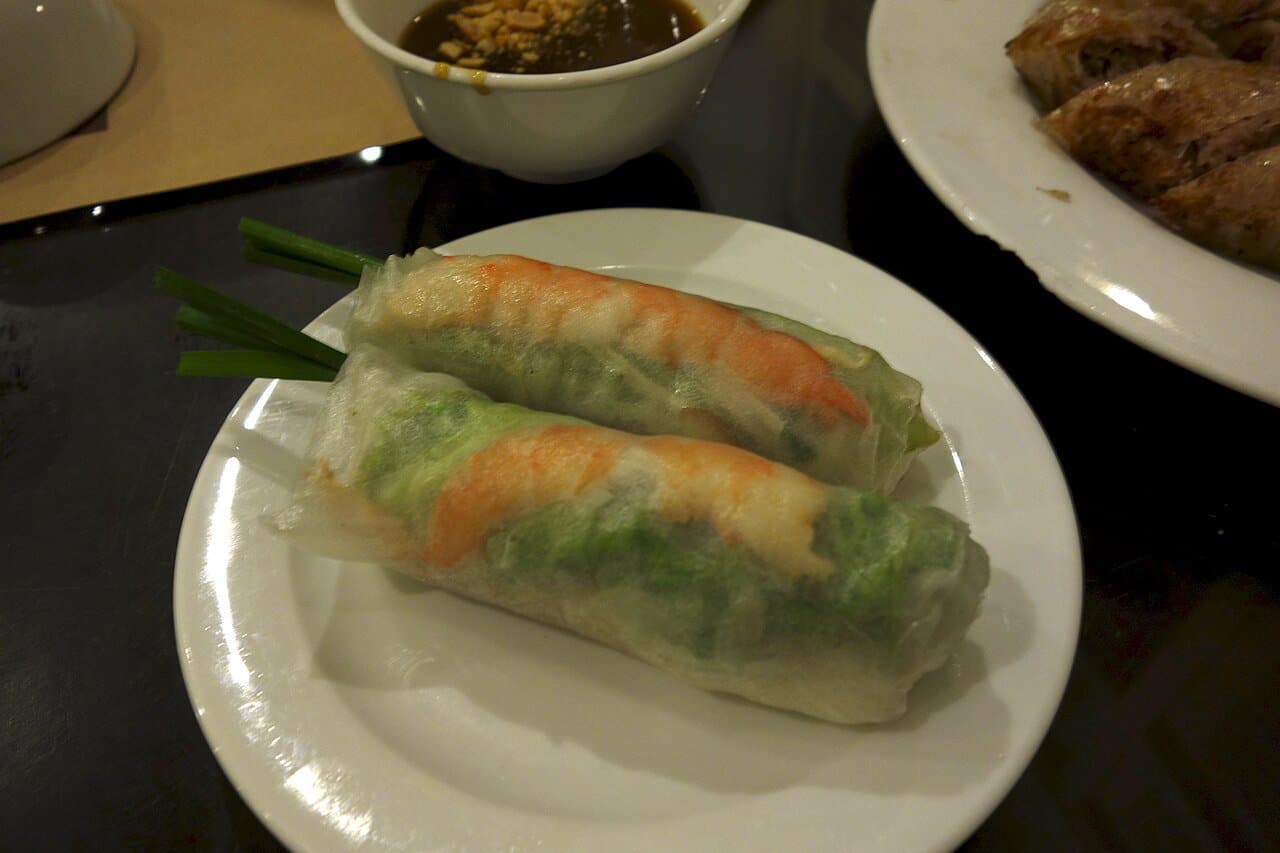
- Gỏi cuốn chay — fresh spring rolls with tofu and herbs; check the dipping sauce is soy or peanut rather than nước mắm.
- Bánh xèo chay — the sizzling crepe with mushrooms and bean sprouts in place of pork and shrimp; the batter is rice flour and turmeric, though a few kitchens add egg, so vegans should ask.
- Rau muống xào tỏi and đậu phụ sốt cà chua — garlic morning glory and tofu in tomato sauce, the two dishes any kitchen in Vietnam can produce; order them without fish sauce and you have a meal anywhere.
- Chè — Vietnam's sweet dessert soups; many are naturally vegan (coconut milk, beans, jelly), but some are finished with condensed milk, so glance or ask before it goes on top.
Where it is easiest, city by city
Hue is Vietnam's vegetarian capital. The combination of the Nguyễn-dynasty court kitchen — which developed refined vegetarian banquets — and the highest density of pagodas in the country made ăn chay part of the city's identity. Buddhist nuns still cook some of the best meals in town, and ordinary quán chay serve elegant mock-meat versions of imperial dishes for canteen prices. If plant-based Vietnamese food is a priority, put Hue on the route; the Hue food guide covers the city's food scene in full.
Elsewhere: Ho Chi Minh City has the largest absolute number of quán chay — hundreds, from workers' canteens to contemporary vegan restaurants — so it is the easiest big city. Hoi An is compact and tourist-fluent, and most restaurants understand chay requests without negotiation (see the Hoi An food guide). Hanoi has a solid quán chay cluster and vegetarian versions of the northern classics, though the Old Quarter's famous single-dish stalls are the hardest places to modify anything — see the Hanoi street food guide and pick chay-friendly stops in advance.
Vegan-specific traps
Vegetarians have it relatively easy once fish sauce is handled; vegans have three extra things to watch.
Egg is the big one: pâté and mayonnaise in bánh mì, egg noodles (mì) versus rice noodles (phở, bún), fried rice, and Hanoi's famous egg coffee. Condensed milk is the default in Vietnamese coffee — cà phê sữa means coffee with condensed milk — so the reliable move is cà phê đen, black coffee hot or over ice, which is just coffee and sometimes sugar; city cafés increasingly stock coconut or oat milk too. Honey turns up in lemon-tea drinks and some marinades. One quiet piece of good news: because Buddhist chay cooking traditionally avoids dairy and egg anyway, most quán chay food is effectively vegan — a quick "thuần chay?" confirms it.
Limitations
We cannot verify what is in any individual kitchen's stock pot, and outside quán chay some cross-contact is normal — shared woks, shared dipping bowls, fish-sauce residue. Strict vegetarians and vegans should treat regular kitchens as best-effort rather than guaranteed. Workaround: eat broth-based and complicated dishes at quán chay, where the entire kitchen is meat-free, and save regular restaurants for made-to-order stir-fries.
Lunar chay days move against the Western calendar each year, and quán chay density drops in small provincial towns and rural areas. Workaround: any lunar calendar app pins the chay days (or ask "hôm nay có phải ngày rằm không?"), and HappyCow plus the phrase table above covers the gaps in between.