
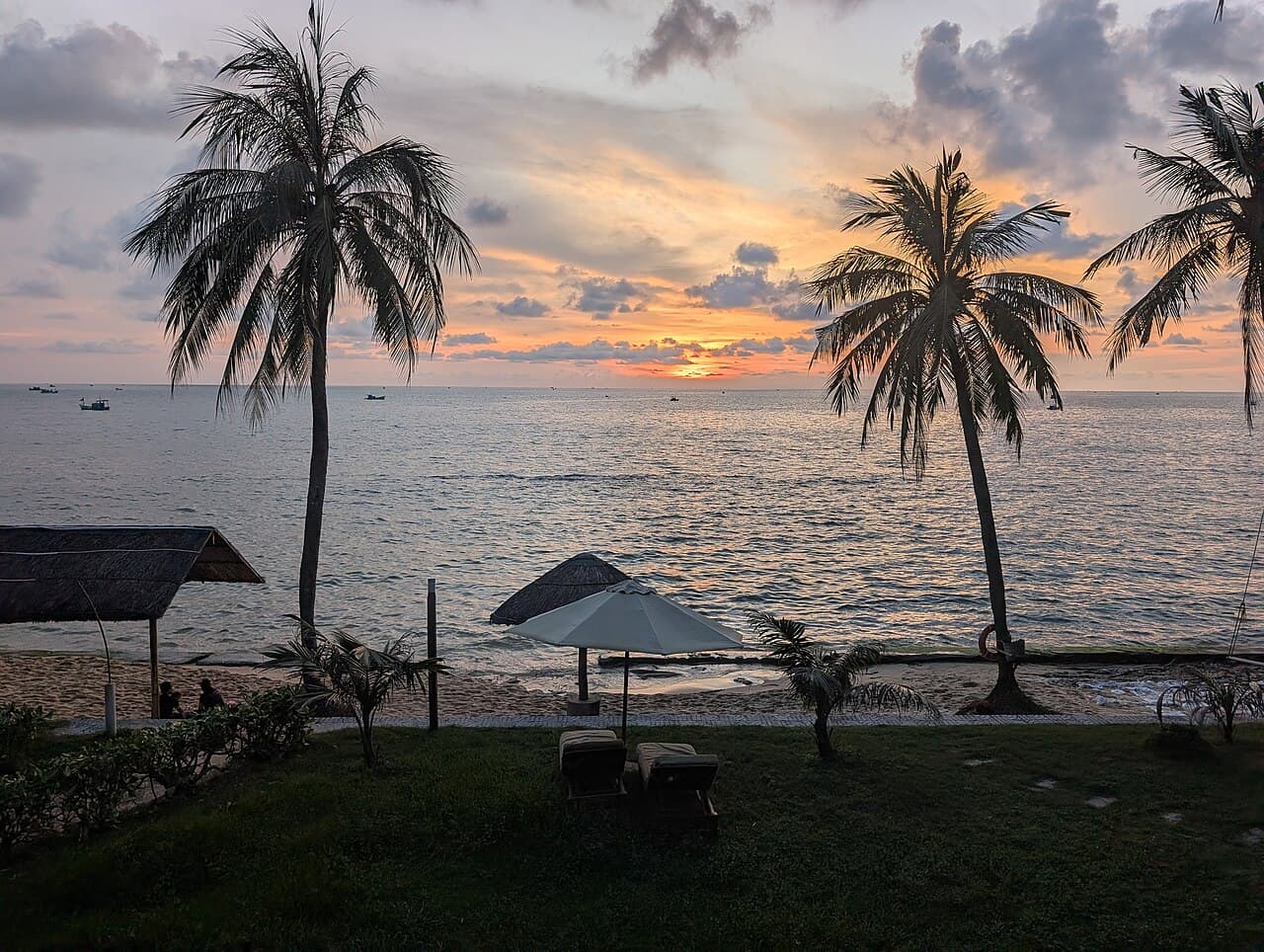
Vietnam's quietest beach that is still worth the journey is Bai Mon, the small crescent of sand below the Mui Dien lighthouse in Phu Yen, roughly 35 km southeast of Tuy Hoa and reached on foot down the headland from the lighthouse. Nothing is built behind it. It is empty for the same reason every empty beach in this country is empty: friction. Emptiness in Vietnam is not a secret, it is a cost — paid in an airport with no international flights, a boat that only sails half the year, a red dirt road, or a walk downhill in the heat. Take the friction away and the quiet leaves with it.
This guide takes the uncrowded angle only. For whether the water is clean enough to swim in, use our beach water-quality atlas. For the places where the crowd has already won, the overtourism index ranks fourteen destinations by tourists per resident.
The rule: friction is what keeps a beach empty
Four kinds of friction do almost all the work on this coastline. Air access is the biggest: Phu Cat, Tuy Hoa and Dong Hoi handle domestic flights only, which removes the package and tour-bus volume that fills Da Nang and Nha Trang. A sea crossing is the second, because weather can cancel it. The third is the last mile — unpaved roads, footpaths, no signage, no bus. The fourth is seasonal, and it is the one visitors underestimate: on much of the central coast the swimming window closes from roughly September to December.
Friction is also perishable, and it is being removed faster than most guidebooks admit. Every quiet label below is dated mid-2026, not permanent.
Quy Nhon and Phu Yen: the quietest major coastline
The 120 km between Quy Nhon and Tuy Hoa is Vietnam's least-touristed stretch of significant coast, and it stays that way because neither Phu Cat nor Tuy Hoa airport has scheduled international service. Bai Mon is the pick, below Mui Dien lighthouse about 35 km southeast of Tuy Hoa, with a walk of roughly 15 to 20 minutes down from the headland. Bai Xep, some 12 km south of Quy Nhon, is a working fishing village with a short strip of budget guesthouses on the sand — quiet in a lived-in way rather than a deserted one.
The trade-off is thin infrastructure: little English, few beach facilities, and no lifeguard cover to speak of. Skip Ky Co on weekends and Vietnamese holidays, when domestic tour groups fill the cove. Our Quy Nhon and Phu Yen guide covers the logistics in full.
Con Dao: empty, on a clock
Con Dao's beaches are the emptiest island sand in Vietnam that you can reach without chartering anything. Dam Trau, near the airstrip, is the accessible standout; Bai Nhat is reported to surface properly only around low tide, which is its own natural crowd filter. Dat Doc is fronted by the island's flagship resort, so treat it as private in practice.
Access has been the whole story. Flights from Ho Chi Minh City take about 45 minutes but run daytime-only because of airport limitations, and airfares have pushed travellers toward the sea route. On 6 June 2026 a 527-passenger trimaran began scheduled sailings from central Ho Chi Minh City, a crossing of about five hours 15 minutes with one-way fares reported from around 965,000 VND. That is roughly 4,000 ferry seats a day of new capacity pointed at an island of empty beaches. The Con Dao guide has the detail; the trade-off is cost, turtle-season restrictions and a medical evacuation that means a flight.
The Cham Islands: capped, and cut off
Cu Lao Cham sits about 15 km off Cua Dai, reached by high-speed canoe in roughly 15 to 20 minutes. Bai Chong and Bai Huong are the swimmable coves, and the island is capped at 3,000 visitors a day — a rule Hoi An introduced after peak days pushed past that number. Because most visitors come on a day boat and leave by mid-afternoon, an overnight homestay in the village buys you a genuinely empty late afternoon.
The friction here is weather, and it is severe. In mid-July 2026 the Danang Maritime Port Authority suspended crossings on a forecast of force 4 to 5 winds, and nearly 300 tourists were left on the island until services resumed two days later. Boats are broadly reliable around March to August and unreliable from about September. Never book a Cham Islands overnight against a same-week flight, and keep a spare night back in Hoi An as your buffer.
Vinh Hy and the Ninh Thuan coast
Vinh Hy Bay, roughly 38 km from Phan Rang, is ringed by mountains and reached by the coastal road through Nui Chua National Park — recognised by UNESCO as a biosphere reserve in September 2021, covering about 106,646 hectares of land and sea. Binh Tien, at the northern end, is the quieter sand. This is the driest province in Vietnam, which is exactly why it stayed off the beach circuit: it reads as arid scrub rather than palm-fringed postcard, and there is no airport closer than Cam Ranh.
The trade-off is exposure. Ninh Thuan is famously windy, which is why it is kite-surfing country, and a windy coast is a choppy one. Facilities cluster around one luxury resort and a handful of local seafood places, with little in between.
Ho Coc and Ho Tram: the weekday beach from Ho Chi Minh City
Roughly 120 to 125 km southeast of Ho Chi Minh City and about two to three hours by road, Ho Coc and Ho Tram are the closest thing the south has to an empty beach you can reach in a morning. The pair sit about 2 km apart on a coastal road backed by forest.
Their quiet is conditional, and the condition is the calendar rather than geography. Monday to Friday these beaches can be near-deserted; at weekends they absorb the overflow from Vung Tau, and holidays fill them. Come midweek or do not bother. Facilities are basic, the surf can be rough, and swim safety cover is minimal outside the resort frontages.
Cat Ba's quieter coves
Cat Ba tops our overtourism index at roughly 195 visitors per resident, so this is a case of finding quiet inside a busy place rather than avoiding it. Tung Thu, about 2 km from Cat Ba town and backed by forest, is materially calmer than the Cat Co beaches. Van Boi and the Nam Cat coves in Lan Ha Bay need a boat or a kayak, which is the friction that keeps them thin.
The trade-off is honest: none of these are secret, and in July and August they are simply less crowded, not empty. April to May and September to October give the best ratio of decent weather to small crowds.
The Quang Binh coast near Phong Nha
Almost nobody comes to Quang Binh for a beach. They come for the caves, and that mismatch is the friction. Bao Ninh, across the Nhat Le river from central Dong Hoi, is noticeably quieter than Nhat Le itself despite being minutes away, with fine pale sand and mostly local families in the late afternoon. Da Nhay, about 25 km north of Dong Hoi on Highway 1A, is a rock-scattered beach that suits a stop rather than a day.
Pair it with Phong Nha as a decompression day after the caves. The trade-off is a short season: this is north-central Vietnam, so the water is best in late spring and summer, and the autumn storm months are not beach months.
Phu Quoc's north and east: quiet with a deadline
Phu Quoc runs on a split personality. The south and west hold the resorts; the north and east — Rach Tram, Rach Vem, Bai Bon, Bai Thom — remain broadly undeveloped, several reached on red dirt tracks that turn to mud in the wet. Ong Lang and Vung Bau on the northwest coast are the compromise: low-rise, quiet, and actually swimmable.
Two honest warnings. Several north and east beaches are shallow, rocky or tidal rather than good swimming water, so do not travel two hours for a swim without checking. And the deadline is explicit: An Giang province is delivering 21 government-assigned APEC 2027 projects worth about 137.13 trillion VND, roughly 5.25 billion USD, including a second airport runway and a 28-hectare convention centre. Whatever quiet remains in the north has a countdown on it.
The crowded ones to skip
If quiet is the goal, the overtourism index is a list of what to avoid: Cat Co on Cat Ba, An Bang at Hoi An, Bai Sao on Phu Quoc, Nha Trang's municipal strip and Da Nang's My Khe in peak months. They are good beaches with real infrastructure and, usually, actual lifeguards — which is precisely the swap this guide is asking you to make. Our off-the-beaten-path atlas tracks which of the quiet alternatives are closest to tipping.
Limitations
The biggest caveat is safety, not logistics. Quiet beaches in Vietnam generally have no lifeguard, no flag system and no one to raise an alarm. Vietnamese outlets documented repeated rip-current drownings through 2025 on beaches in Lam Dong, Khanh Hoa and Da Nang, and reported that several beaches are still not fully equipped with professional lifeguard systems. Workaround: swim within your depth, never alone, and only where local families are already in the water — their absence on a warm day is information.
Seasonality is the second limitation, and Vietnam's coast does not share one calendar. The central beaches here are broadly unusable from about September to December; Phu Quoc and the far south invert that. Workaround: check a forecast for the specific stretch of coast within 48 hours of travelling, and keep a spare day against cancelled boats.
Third, crowd levels are a judgement, not a measurement. There is no per-beach visitor count in Vietnam, so "quiet" here is built from access structure, visitor-pressure data at destination level, and recent reporting. Workaround: weight weekdays over weekends, mornings over afternoons, and check reports from the past few months rather than the past few years.
Finally, the 2025 provincial mergers renamed the paperwork around several of these places without changing anything on the ground. Workaround: search by beach and town name, not by province.
Related reading
- Vietnam beach water-quality atlas — which of these are clean enough to swim in
- Tourists per resident: Vietnam's overtourism index — the pressure ranking behind the beaches to skip
- Quy Nhon and Phu Yen guide — the full logistics for the quietest coast
- Con Dao Islands — flights, ferries and turtle season