
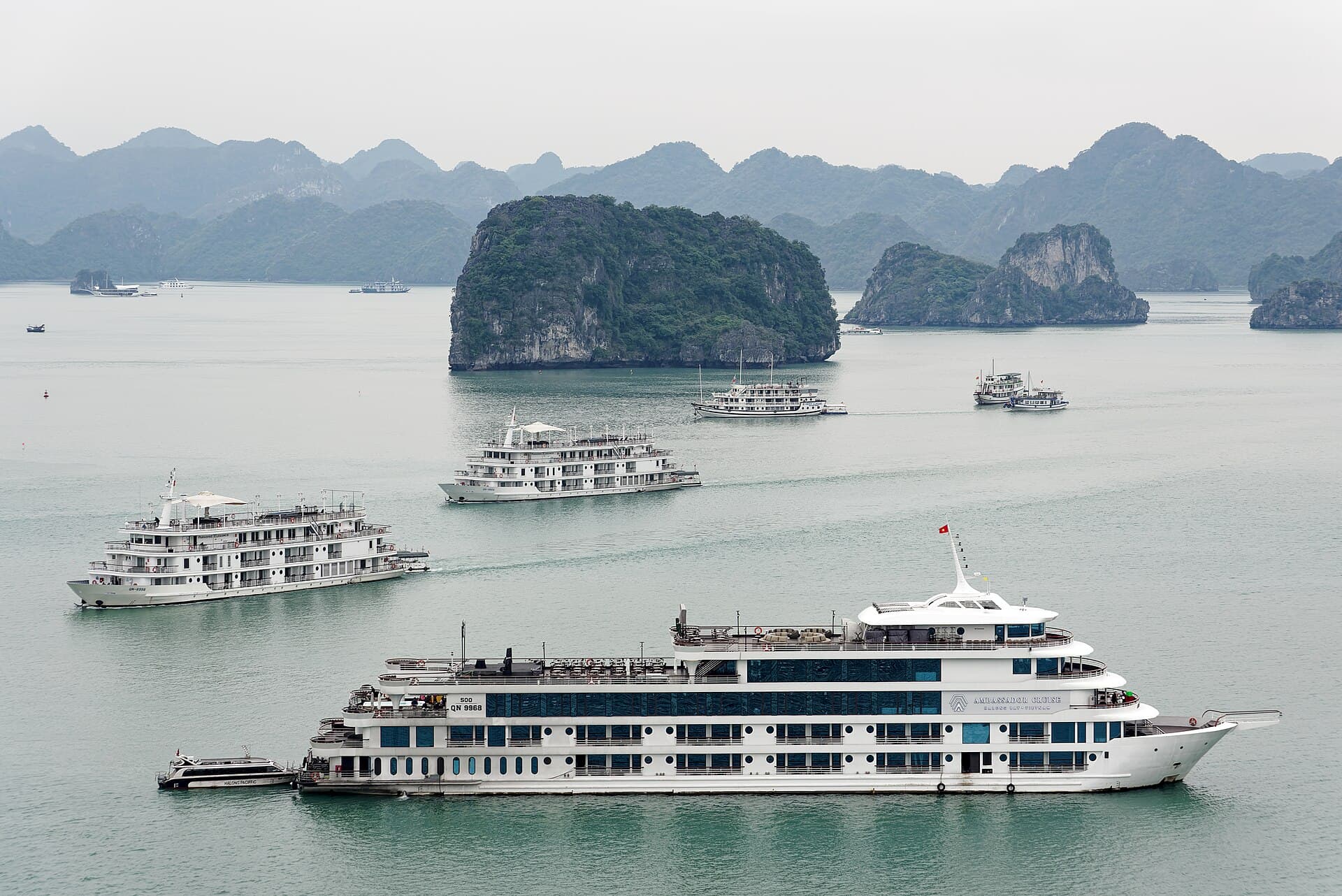
Vietnam's most overtouristed places are not its biggest cities — they are its smallest, most famous towns and islands. Measured by tourists per resident, Cat Ba island tops this index at roughly 195 visitors for every person who lives there, and Hoi An, a UNESCO town of about 120,000, took around 4.4 million visitors in 2024 — about 37 per resident. Ho Chi Minh City drew ten times more visitors than Hoi An, close to 44 million, yet ranks near the bottom for pressure, because 9.6 million residents absorb the crowd. That gap, between raw volume and pressure per resident, is what this index measures.
We compiled the most recent annual visitor total and resident population for 14 major Vietnamese destinations, matched each visitor count to a population of the same geography, and divided one by the other. Every row lists its sources in the open dataset, and every geographic mismatch is flagged rather than hidden — a sloppy ratio is worse than no ratio, and this is a companion to our Ha Long Bay overtourism research, which looks at one destination in depth.
The index — tourists per resident, most-pressured first
| Rank | Destination | Annual visitors | Residents | Per resident | Note |
|---|---|---|---|---|---|
| 1 | Cat Ba Island | 3.7M (2024) | ~18,900 | ~195 | day-tripper and cruise pass-through |
| 2 | Sa Pa | 2.7M (2024) | ~70,700 | ~38 | town spread across rural communes |
| 3 | Hoi An | 4.4M (2024) | ~120,000 | ~37 | compact UNESCO town |
| 4 | Phu Quoc | 5.9M (2024) | ~180,000 | ~33 | island city, fast-growing population |
| 5 | Ha Long City | 6.8M (2024) | ~322,000 | ~21 | bay capped at 38,000 a day |
| 6 | Da Nang | 10.9M (2024) | ~1.25M | ~8.7 | clean city-to-city match |
| 7 | Ninh Binh | 8.7M (2024) | ~1.03M | ~8.5 | concentrated at Trang An and Tam Coc |
| 8 | Nha Trang (Khanh Hoa) | 10.8M (2024) | ~1.27M | ~8.5 | province-wide, pools in Nha Trang |
| 9 | Mui Ne / Phan Thiet (Binh Thuan) | 9.6M (2024) | ~1.27M | ~7.6 | mostly domestic beach tourism |
| 10 | Da Lat (Lam Dong) | 10.0M (2024) | ~1.36M | ~7.3 | province-wide, pools in Da Lat |
| 11 | Ho Chi Minh City | 44.1M (2024) | ~9.57M | ~4.6 | most visitors, low ratio |
| 12 | Ha Giang | 3.1M (2023) | ~908,000 | ~3.4 | loop concentrates backpackers |
| 13 | Hue (Thua Thien Hue) | 3.9M (2024) | ~1.18M | ~3.3 | province-wide, pools in Hue city |
| 14 | Hanoi | 27.9M (2024) | ~8.69M | ~3.2 | vast volume, diluted by size |
Visitor totals are annual arrivals, domestic plus international, mostly for 2024; Ha Giang is anchored to 2023 because no clean 2024 province total was published in English. Populations are from Vietnam's 2024 Intercensal Census where available. The full per-row sourcing sits in the JSON dataset.
How to read the ranking
Three things matter before you draw conclusions from a ratio.
First, arrivals are not people. A visitor total counts trips, not unique humans, and it counts a day-tripper the same as someone who stays a week. That is why Cat Ba's number is so extreme — much of its 3.7 million is cruise and day-boat traffic that touches the island for hours.
Second, a ratio is annual, not simultaneous. Roughly 37 visitors per resident in Hoi An does not mean 37 tourists are standing next to every local at once; it means that over a year, arrivals outnumber residents 37 to one. Seasonality then concentrates that load. A beach province like Binh Thuan packs much of its year into a few peak months, so its quiet ratio of 7.6 understates the crush on a summer weekend.
Third, geography has to match. Dividing a whole province's visitors by one small town's population would manufacture a scary number that means nothing. Where both figures describe the same unit — Hoi An city and Hoi An residents — the ratio is clean; where a province total pools into one resort town, we kept the comparison province-to-province and said so.
Small places take the hardest hits
The top of the ranking is a lesson in scale. The four most-pressured destinations are an island, a mountain town, a heritage town and a second island — none with more than about 180,000 residents.
Cat Ba is the starkest and the noisiest. About 3.7 million visitors reached the island in 2024, against a resident population near 19,000 — a ratio around 195. Read it as an upper bound rather than a clean measurement: a large share of those arrivals are Lan Ha Bay cruise passengers and day-trippers who never sleep on the island. Even discounted heavily, it is Vietnam's most tourist-saturated place per head.
Sa Pa comes next at about 38, though its resident base is dispersed — the town-level unit spreads roughly 70,000 people across 685 square kilometres of rural ethnic-minority communes, while the tourists crowd into a small central grid. Hoi An is the cleanest case and the one worth dwelling on: a compact, walkable UNESCO town of about 120,000 residents that absorbed roughly 4.4 million visitors in 2024, per city tourism figures. Nearly all of it funnels into the few blocks of the Ancient Town, so the felt density is far higher than the annual ratio suggests. Phu Quoc rounds out the band at about 33, with the added wrinkle that its population is climbing fast as construction and service workers arrive, which flatters the ratio.
The cap responses
Where the pressure is worst, Vietnam has started to meter it. Two caps stand out, both aimed at fragile marine sites.
Ha Long Bay is capped at 38,000 visitors per day, cut from 45,000 before the pandemic, and it became the first heritage site in Vietnam assessed for carrying capacity. The cap responds to years of cruise-boat congestion at a handful of caves and islets, where a couple of thousand people can pass through in a single hour. Ha Long city, the mainland base, sits at a ratio near 21.
The Cham Islands, or Cu Lao Cham, off Hoi An are capped far harder — 3,000 visitors a day — after pre-pandemic peaks when arrivals on some days exceeded the islands' own population and threatened the reef of a UNESCO biosphere reserve. Hoi An's Ancient Town ticket is a softer version of the same instinct: price and gate the pressure rather than let it run free. These are the levers our sustainable tourism atlas tracks in more detail, and the entrance fees behind them sit in our entrance fee index.
Volume is not pressure
The bottom of the ranking makes the opposite point. Ho Chi Minh City is the single busiest destination in the country — roughly 44 million visitors in 2024, about 38 million of them domestic and 6.1 million international, per city and agency reporting. But with about 9.6 million residents, its ratio is only 4.6. Hanoi, second in raw volume at 27.9 million, is lowest of all at 3.2. Both cities run enormous tourism economies without the per-resident strain that a small town feels, because millions of locals dilute the crowd.
Da Nang shows the same effect at mid-scale: 10.9 million visitors in 2024, the highest raw count on the central coast, but a ratio of only 8.7 against 1.25 million residents. The province-level rows — Nha Trang in Khanh Hoa, Da Lat in Lam Dong, Mui Ne in Binh Thuan, Hue in Thua Thien Hue — cluster between 3 and 9, because their visitors are measured against a whole province even though the tourism pools into one town. The honest reading is that the resort towns inside those provinces feel more pressure than the province ratio shows; we flagged each rather than invent a town-level number we could not source. For the genuinely quiet places, our off-the-beaten-path atlas starts where this index ends.
Methodology
The ratio. Tourists per resident is annual visitor arrivals divided by resident population, using the most recent credible figure for each and matching the geographic unit on both sides. Ratios of 10 or more are rounded to the nearest whole number; those under 10 to one decimal.
Visitor figures. Annual totals, domestic plus international, come from provincial and city tourism departments and reputable Vietnamese news outlets, for 2024 wherever available. Counts are arrivals, not unique visitors, and include day-trippers, which is why island and gateway rows read high. Ha Giang is the one 2023 anchor.
Population figures. Resident populations are drawn from Vietnam's 2024 Intercensal Census, published by the General Statistics Office, where a matching unit exists; otherwise the 2019, 2021 or 2022 census, with the year stated in each row.
Geography matching. City visitor totals are divided by city populations, province totals by province populations, island totals by island populations. Four rows — Nha Trang, Da Lat, Mui Ne and Hue — carry province-wide visitor figures dominated by a single town; we kept those province-to-province and flagged the concentration rather than divide by a small denominator and overstate the ratio.
Administrative boundaries. Every figure uses pre-July-2025 boundaries. Vietnam merged many provinces and cities in mid-2025, but the 2024 visitor data and the 2024 census both predate that, so the two sides of each ratio describe the same place.
Limitations
- Arrivals overcount pressure at pass-through sites. Cat Ba and, to a lesser extent, Ha Long and the Cham Islands see heavy day-visitor and cruise traffic that inflates arrival counts relative to overnight impact. Their ratios are upper bounds.
- Small and dispersed denominators are fragile. Cat Ba's roughly 19,000 residents and Sa Pa's population spread over a large rural district make those two ratios the least stable in the index; a different population definition moves them sharply.
- Four rows are province-to-town mismatches by necessity. Nha Trang, Da Lat, Mui Ne and Hue are measured across their whole province because the town-level visitor counts are not cleanly published. The real per-resident pressure in each resort town is higher.
- Ratios are annual, not peak. Seasonality concentrates the load; a quiet annual ratio can still mean a summer crush.
- Ha Long city's population predates a boundary change. The 322,000 figure is mid-2019, before the 2020 Hoanh Bo merger enlarged the city, so its true current ratio is somewhat lower than 21.
- One row is a 2023 anchor. Ha Giang lacked a clean 2024 province total in English; its ratio will be re-based in the next edition.
Annual update commitment
This index is re-compiled each year, with the year in the slug so citations stay anchored. The 2027 edition will re-base every ratio on the newest visitor totals, re-map the destinations onto Vietnam's post-2025 administrative boundaries, and add any destination we can then source both numbers for.
Revision history:
| Date | Changes |
|---|---|
| 2026-08-21 | Initial publication. 14 destinations ranked; Hue and Ha Giang carried with noted caveats; Hue's neighbouring towns and second-tier islands researched but dropped for lack of matched visitor-and-population pairs. |
How to cite this
Nguyen, J. (2026). Tourists per Resident: Vietnam's Overtourism Index 2026. Day Trips Vietnam. Retrieved from https://daytripsvietnam.com/guides/vietnam-overtourism-index-2026/
For specific figures, cite the destination row and the visitor year — for example, "Day Trips Vietnam's Vietnam Overtourism Index 2026 puts Hoi An at about 37 visitors per resident in 2024 (4.4 million visitors against roughly 120,000 residents)."
Published under Creative Commons BY 4.0. The full 14-destination ranking, per-row notes and sources: vietnam-overtourism-index-2026.json. Editorial enquiries: info@daytripsvietnam.com.
Related research and reference
- Ha Long Bay overtourism research 2025 — one destination's carrying-capacity story in depth
- Vietnam off-the-beaten-path atlas 2026 — where to go when the ratio matters to you
- Vietnam entrance fee index 2026 — the ticket prices that gate the busiest sights
- Vietnam sustainable tourism atlas 2026 — caps, levies and the management levers behind the numbers
- Best time to visit Vietnam — how to dodge the seasonal peaks that concentrate these ratios
- Vietnam 2025 international arrivals record — the national growth pushing every ratio up