
Quy Nhon and Phu Yen are Vietnam's quietest major stretch of coastline: two provinces' worth of beaches, basalt cliffs, Cham towers, and fishing villages on the south-central coast, roughly midway between Hoi An and Nha Trang. The quiet has a structural cause rather than a romantic one — neither Phu Cat airport (for Quy Nhon) nor Tuy Hoa airport (for Phu Yen) has scheduled international flights as of mid-2026, and the region sits around six hours by road from Hoi An and four to five from Nha Trang, too far for day-trippers from either. It suits travelers who trade infrastructure for space: backpackers get the Bai Xep enclave, couples and families get uncrowded resort pockets, riders get one of the country's best coastal roads, and everyone gets seafood at fishing-port prices.
One housekeeping note: Vietnam's 2025 provincial restructuring merged Phu Yen into Dak Lak province on paper. Nothing changes on the ground — locals and bookings still say Phu Yen, and so does this guide.
How the two sides fit together
Think of it as one coast with two bases about 120 km apart. Quy Nhon, the bigger city, holds the beach-city comforts and the Binh Dinh sights; Tuy Hoa, smaller and more workaday, is the launch pad for Phu Yen's landscapes. Highway 1 and the Reunification Express link them, and the coastal road between them is a destination in its own right. Most travelers give the pair three to five days, entering at one end and leaving the other. Our off-the-beaten-path atlas tracks visitor-volume data and a development-risk timeline for both — domestic tourism has already found Quy Nhon; the international wave is a matter of when, not if.
The Quy Nhon side
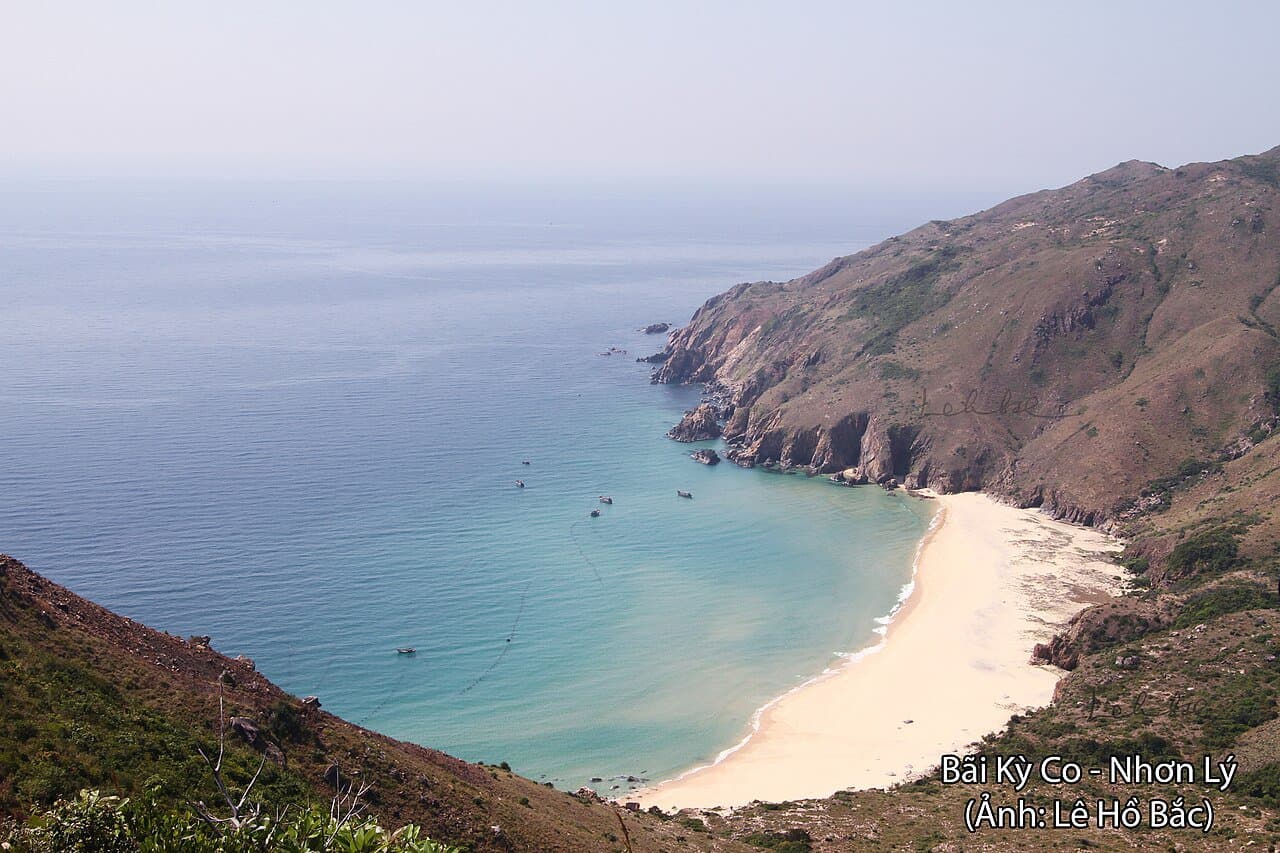
Ky Co and Eo Gio. Quy Nhon's two headline sights share the Phuong Mai peninsula across the bay, beside Nhon Ly fishing village, about 20 km from the center. Ky Co is the postcard: a cove of pale sand and clear water walled in by cliffs, reached by speedboat or canoe from Nhon Ly — typically around 150,000–200,000 VND round trip as of mid-2026 — or by a steep access road. Entry runs around 100,000 VND; packages vary by operator. Eo Gio, a wind-scoured gap between rocky headlands a few minutes away, charges around 25,000 VND and earns its keep at sunset. Both fill with domestic tour groups on weekends; go on a weekday morning.
Bai Xep. About 12 km south of the city, this pocket-sized fishing village became the coast's backpacker enclave after the family-run Life's a Beach hostel opened on the sand in 2014. It is still a working village — squid boats on the sand, nets drying between houses — backed by a short strip of budget guesthouses. If a backpacker itinerary mentioned Quy Nhon, this cove is almost certainly what it meant.
The Cham towers. Binh Dinh was the heartland of Vijaya, the Champa kingdom's later capital, and holds one of the densest concentrations of Cham tower sites in Vietnam — Vietnam Coracle's Cham towers guide maps the full circuit. The essential stop is Banh It: four brick towers from around the late 11th to early 12th century, on a hilltop off Highway 1 some 15–20 km from the city — roughly a hundred steps up, wide countryside views at the top. If you cannot spare the ride, the Thap Doi twin towers stand inside the city itself.
The city and its beach. Quy Nhon proper is a relaxed provincial city arranged along a long crescent of municipal beach — not spectacular, but clean, genuinely swimmable in season, and often close to empty on weekdays. The seafront blocks are comfortably walkable and Grab covers the rest — but everything above except the city beach needs wheels.
The Phu Yen side
Ganh Da Dia. Phu Yen's signature sight, about 35 km north of Tuy Hoa: a shoreline shelf of tens of thousands of interlocking basalt columns — the same volcanic geometry as Ireland's Giant's Causeway, but in warm water and with a fraction of the visitors. A national scenic site since 1997 and a National Special Relic since 2020, it now has a small visitor complex at the entrance. An hour on the rocks is plenty.
Mui Dien and Bai Mon. About 35 km southeast of Tuy Hoa, a French-built lighthouse from the 1890s stands on a headland roughly 110 m above the sea, routinely billed as the easternmost point of mainland Vietnam. The precise claim is disputed — recent surveys give the title to Mui Doi in Khanh Hoa — so call it one of the mainland's easternmost points, and the classic place to catch Vietnam's first sunrise. Below the lighthouse, Bai Mon is a small, clean crescent of sand pinched between headlands; the walk up takes around 15–20 minutes.
O Loan lagoon. A brackish lagoon just off Highway 1 between Tuy Hoa and Ganh Da Dia, known across Vietnam for blood cockles and oysters grilled with scallion oil at simple shoreline restaurants. Sunset over the water is the photograph.
Tuy Hoa as a base. Tuy Hoa is a working tuna port that happens to have a long, wide, near-empty city beach. It runs the country's biggest ocean-tuna fleet and feels like it: inexpensive hotels, few English menus, little to see in town. That is its value — rooms cost little, the beach is yours, and every Phu Yen landscape is within about an hour's ride.
Getting there and around
Flights. Phu Cat (UIH) sits about 30 km from Quy Nhon; as of mid-2026 Vietnam Airlines and VietJet fly domestic routes there, with Ho Chi Minh City and Hanoi the most frequent connections. Tuy Hoa (TBB) is thinner — Vietnam Airlines and VietJet from Ho Chi Minh City and Hanoi, roughly daily or less. Schedules at both change seasonally, so treat any timetable as provisional.
Trains. The Reunification Express serves the coast through Dieu Tri station, about 10 km from Quy Nhon — the city's own station sits on a dead-end spur with only rare service, so plan on Dieu Tri plus a short taxi. Tuy Hoa's station is usefully in town. Travelfish's Qui Nhon transport guide keeps a current rundown; our Vietnam trains guide explains classes and booking.
Buses. Sleeper and cabin buses from Hoi An or Da Nang take around six hours, with cabin class around 500,000 VND as of mid-2026. From Nha Trang it is 210 km — four to five hours by bus, or around four hours by train to Dieu Tri from around 170,000 VND for a soft seat.
Between Quy Nhon and Tuy Hoa. The train takes about an hour and a half (from around 50,000–100,000 VND) and runs close to the sea in stretches; buses take around two hours (around 80,000–120,000 VND). If you ride, skip both for the coastal road — three to four hours with stops, past dunes, lagoons, and fishing hamlets, arguably the best thing on this coast. Our motorbike rental guide covers licensing and rental practicalities.
When to go
This coast keeps its own calendar, and it matches neither Hanoi nor Saigon. The dry season settles in around late January or February and holds through August; March to August is the most dependable swimming window, with calm, clear water on most beaches. September to December is the wet season — the bulk of the year's rain falls between September and November, overlapping the typhoon window (roughly early September to early December). In that period boats to Ky Co stop running and the coast effectively closes for beach purposes. Water quality through the dry months is generally good along this stretch — the Vietnam beach water quality atlas carries the per-beach notes.
Where to stay
Bai Xep is the budget answer: Life's a Beach anchors the village with dorms and bungalows, and a handful of guesthouses cluster behind the sand. Book ahead around Vietnamese holidays — the village is tiny.
Quy Nhon city offers the widest choice, mostly local mid-range hotels near the beach boulevard at prices well below Da Nang's. The luxury outlier is Anantara Quy Nhon Villas, 25 pool villas in a private cove about 12 km from the center.
Tuy Hoa runs to inexpensive local hotels plus one genuine beachfront resort, the five-star Stelia Beach Resort on the city sand. Beyond these named properties, the accommodation stock is changing quickly — check recent reviews and the map before booking anything sold as a "beach resort."
What to eat
Eat what the fleet lands. Quy Nhon's food culture is breakfast-forward and cheap: banh hoi chao long — mats of fine rice vermicelli with pork offal and a bowl of porridge — is the Binh Dinh classic, bun cha ca is the city's fish-cake noodle soup built on mackerel and barracuda, and banh xeo tom nhay are small, crackling rice pancakes named for shrimp fresh enough to jump. Vietnam Coracle's Quy Nhon food guide is the best English-language map of where to eat them. In Phu Yen the story is tuna: Tuy Hoa's fleet is Vietnam's largest, and restaurants serve the catch every way from raw slices to hotpot — braised tuna eye with herbs is the local dare. Between the cities, the shoreline shacks at O Loan lagoon grill blood cockles and oysters over coals.
Honest downsides
English is thin. Outside Bai Xep's hostels and the two flagship resorts, expect menus without translations and negotiations by calculator.
Everything is spread out. The sights radiate 12–35 km from each base with no tourist shuttle network. Without a motorbike, a hired driver, or a day tour, you will see the city beaches and little else.
Nightlife is close to zero. Quy Nhon has cafes, seafood restaurants, and a few quiet bars; Tuy Hoa has less. Travelers who need a scene should look at Nha Trang instead.
The wet season is a real shutdown. From September to early December, rain and typhoon risk can cancel boats and turn beach days into cafe days. This is not a year-round destination.
Limitations
Prices, fees, and timetables here are hedged ranges as of mid-2026, and this coast changes them casually — Ky Co's entry-plus-boat pricing in particular varies by operator and season. Workaround: confirm entrance and boat fees on site before paying, and treat flight schedules at Phu Cat and Tuy Hoa as provisional until ticketed.
This region is also mid-transformation: airport upgrades and resort construction are underway, and the quiet described here is a snapshot, not a promise. Workaround: for anything crowd-sensitive, check reports from the past few months, not the past few years.
Finally, the 2025 provincial merger means official documents may label Phu Yen sites as Dak Lak province, and booking platforms already mix the two names. Workaround: search by town and sight name — Tuy Hoa, Ganh Da Dia, Mui Dien — rather than by province.
Related reading
- Phu Quoc vs Nha Trang vs Da Nang — Vietnam's busier beach hubs compared
- Vietnam beach honeymoon for couples — where Phu Yen fits for a couples trip
- Hoi An — the culture-and-beach stop most travelers pair with this coast