
Travelling Vietnam with older parents is not the same trip as travelling with young children, and most family travel writing quietly assumes the second. With small children the constraint is attention span. With parents in their seventies it is knees, heat, stairs, bathrooms and stamina — and the fix is almost entirely structural. Get the pace and the transport right and Vietnam is one of the best trips a multi-generational family can take.
The thing to internalise first: your parents will not tell you they are tired. They will not want to be the reason the group skipped the cave, so the itinerary has to carry the restraint for them.
This guide assumes able but slowing travellers. If a wheelchair is in play, our accessible Vietnam guide is the more precise reference, and our Vietnam for seniors guide covers older travellers going independently.
The pace that actually works
Three nights per stop is the working minimum, two is the floor, and one-night stops are the enemy. In fourteen days four stops is comfortable; six means you have written a transport schedule rather than a holiday. Our how many days in each Vietnam city guide has the arithmetic.
Within a day, plan one anchor activity, not three. Out early, back by late morning, a rest window from noon to four, then out again for the good light and the evening meal. This is not a concession to age; it is what Vietnamese people do in Vietnamese heat.
Then leave one entirely empty day per week. Not a light day. Empty. It absorbs the bad night's sleep and stops one wobble cascading through the trip.
Which places are comfortable, and which really are not
The split is sharper than most itineraries admit, and it does not track price or prestige.
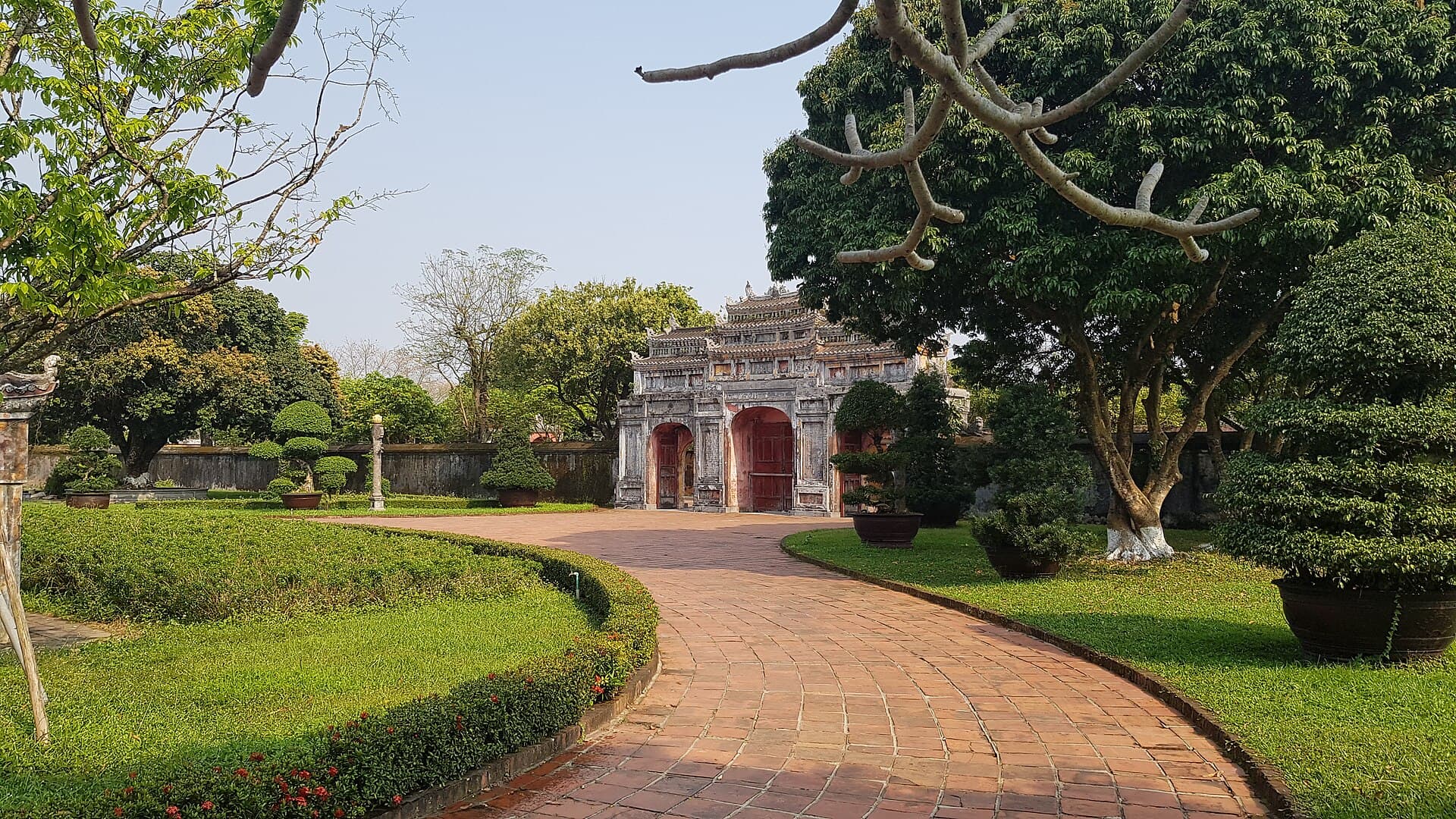
Genuinely comfortable. Hoi An Ancient Town, UNESCO-inscribed in 1999, is the best destination in Vietnam for this trip: flat, compact, largely pedestrianised, and dense enough that a taxi can drop you inside the distance you can actually walk. Da Nang's beachfront promenade is long, level and modern. Hue's Imperial City, part of the Complex of Hue Monuments, is vast but flat, with shade, benches and electric buggies on fixed routes inside the walls for around 400,000 VND an hour as of mid-2026.
Seated sightseeing is the format to look for. The Trang An and Tam Coc sampan rides in Ninh Binh are two to three hours of rowed, shaded scenery at roughly 250,000-300,000 VND per person as of mid-2026, and Mekong Delta boat days work the same way.
Cable cars do the climbing for you. At Ba Na Hills, the Da Nang Tourism Promotion Center confirms that from 1 January 2026 tickets are valid for three consecutive days — unlimited rides in a 72-hour window at 1,000,000 VND for out-of-province adults and 800,000 VND for children and seniors. That is the best senior-friendly change of 2026: go up, walk ninety minutes, come down, and return next morning rather than forcing one six-hour visit. The Fansipan cable car above Sapa works similarly at about 850,000 VND on weekdays, though the final stretch to the peak is still a long flight of steps.
Not comfortable, whatever the brochure says. Mua Cave is roughly 500 uneven stone steps with limited handrail and full sun. Sapa's village walks are sold as gentle strolls and are in fact steep, rutted, muddy clay descents. The Ha Giang Loop is a motorbike route.
Ha Long Bay deserves its own paragraph, because families most often assume it will be easy. The cruising is perfect; the friction is at the joins. Depending on berth and tide you may board by gangway or by a small tender boat with a step down into it, and the same applies at cave stops. Most boats, expensive ones included, are stairs-only between decks. Book a lower-deck cabin and email the operator about your departure date.
Major sights rated by physical demand
| Sight | Physical demand | What it actually involves |
|---|---|---|
| Hoi An Ancient Town | Low | Flat pedestrianised streets; the Japanese Covered Bridge has steps |
| Da Nang beach promenade | Low | Long, level paving, with benches and shade |
| Hue Imperial City | Low to moderate | Flat but vast; electric buggies; raised thresholds |
| Trang An or Tam Coc sampan | Low, one awkward step | Two to three hours seated; a real step down into the boat |
| Mekong Delta boat day | Low to moderate | Seated cruising; jetties and homestay steps are uneven |
| Ba Na Hills and Golden Bridge | Moderate | Cable car does the climb; 1-2 hours walking on top |
| Fansipan cable car | Moderate | Near the summit by cable car; the final push is many steps |
| Ha Long Bay overnight cruise | Moderate | Gangway or tender boarding; stairs between decks |
| Marble Mountains, Da Nang | Moderate with lift | A lift removes 156 steps for 15,000 VND each way |
| Cu Chi tunnels | Moderate to high | Grounds walkable; the tunnels are a crawl |
| Perfume Pagoda | High | Boat, then cable car, then a stone stairway into the grotto |
| Mua Cave viewpoint | High | Roughly 500 steep, uneven steps in full sun |
| Sapa village trekking | High | Steep clay paths, frequently muddy, poor footing downhill |
Prices and services are as of mid-2026 and move with season and operator.
Heat, and choosing the month
Heat breaks more multi-generational trips than stairs do, because it accumulates. February to April is the kindest countrywide window; October and November are the strong second choice. May through early September brings 35°C afternoons and saturating humidity — workable with a disciplined early-and-late rhythm, but tiring for anyone with a heart condition or on blood-pressure medication. Avoid the days around Tet unless the festival is why you came.
Transport: where the private car stops being a luxury
For this trip the private car with driver crosses from indulgence to infrastructure. As of mid-2026 a full day runs roughly 1,300,000-2,300,000 VND, about USD 50-90, for a sedan — per car, not per person, usually including fuel, tolls and the driver's time.
What you are buying is not leather seats. It is being dropped at the closest gate rather than the coach park, leaving a site twenty minutes after arriving without apologising to a group, and a toilet stop whenever somebody needs one.
For the long hops between regions, fly: a one-hour Hanoi to Da Nang flight beats a fifteen-hour sleeper bus by a margin that is not close. Our comparison of train, flight and car for families works through the trade-offs.
Hotels, and the lift that is not there
Much of Vietnam's most charming urban accommodation sits in tube houses: narrow, deep buildings of four to six storeys, frequently with a steep internal staircase and no lift whatsoever. Beautiful boutique properties with excellent reviews routinely have no lift, and the review that would have warned you is buried on page four.
Three questions solve it, asked by email rather than assumed from a filter. Is there a lift. How many steps between the street and reception. Can you send a photo of the entrance. Our where to stay in Vietnam guide covers neighbourhood choice, and the luxury travel cost guide shows what the lift-equipped tier costs.
Food, toilets and medication
Vietnamese food is gentler on older digestions than most Asian cuisines — clear broths, steamed rice, poached and grilled protein, herbs rather than heat. The sensible caution is pacing rather than avoiding street food: chilli on the side, no raw herb plates or blended ice drinks at first, busy stalls with high turnover. Watch for hidden fish sauce and shrimp paste if anyone has a shellfish allergy; our phrase guide has the wording and our street food safety guide covers the rest. Broths and dipping sauces are salty, which matters on a low-sodium diet.
On toilets: hotels, malls, airports, chain cafes and tourist restaurants have Western seated toilets. Squat toilets persist at rural bus stations, village markets, older pagodas and roadside stops — exactly where a three-hour drive deposits you. Public facilities often charge 2,000-5,000 VND as of mid-2026 and paper is not guaranteed.
Bring one and a half to two times the medication needed, in original packaging, with a doctor's letter listing each drug by generic name. The chain pharmacies — Long Chau, Pharmacity, An Khang — are widespread and cheap, but stock thins outside big cities and some sleep, opioid and ADHD drugs are restricted here. On insurance, declare every pre-existing condition and read the evacuation limit; our travel insurance guide and the healthcare atlas cover it.
A realistic 10-to-14-day route
Four stops, one region skipped on purpose, and a deliberate soft landing.
Days 1-3, Hanoi. Arrive, then do nothing on day two beyond a slow walk around Hoan Kiem Lake. Use Grab rather than the Old Quarter's motorbike-parked pavements.
Days 4-6, Ninh Binh or Ha Long, not both. Ninh Binh is gentler: a Trang An sampan morning, an afternoon off, no Mua Cave. Ha Long is more spectacular if the boarding checks out.
Days 7-10, Hoi An, with Da Nang and Hue by car. Fly Hanoi to Da Nang, base in Hoi An, and take Hue as one long day by private car over the Hai Van Pass rather than moving hotels.
Days 11-14, a beach or resort block. Da Nang, Phu Quoc, or three more nights in Hoi An — somewhere with a lift and a pool. On a ten-day trip, cut this block rather than compressing the rest.
Skip Sapa and Ha Giang. Our 14-day Vietnam itinerary is the standard-pace version.
Limitations
The physical-demand ratings here are editorial judgements from repeated visits, not measured audits. No Vietnamese authority publishes step counts or gradients for tourist sites. Workaround: treat the table as a shortlist, then confirm against recent reviews that mention knees, stairs or older visitors.
Prices are as of mid-2026 and move with season and operator. Cable car pricing changes annually, and the Ba Na Hills three-day validity is a 2026 rule, not a permanent one. Workaround: reconfirm on the operator's site within a month of travel, and carry passports for a senior rate.
Hotel accessibility is the weakest data on the trip: booking-site filters here frequently mark a property accessible when it has only a lift. Workaround: email every property and ask for photographs rather than assurances.
This guide assumes able but slowing travellers, and does not address dementia, oxygen dependence or dialysis. Workaround: start from the accessible Vietnam guide and involve a specialist operator early.
Related reading
- Accessible Vietnam 2026 — the wheelchair version
- Vietnam for Seniors 2026 — health logistics, independent travellers
- How many days in each Vietnam city — per-city arithmetic
- Private car and driver hire — route-by-route rates
- Where to stay in Vietnam — neighbourhood choice
- 14 days in Vietnam — the standard-pace version