
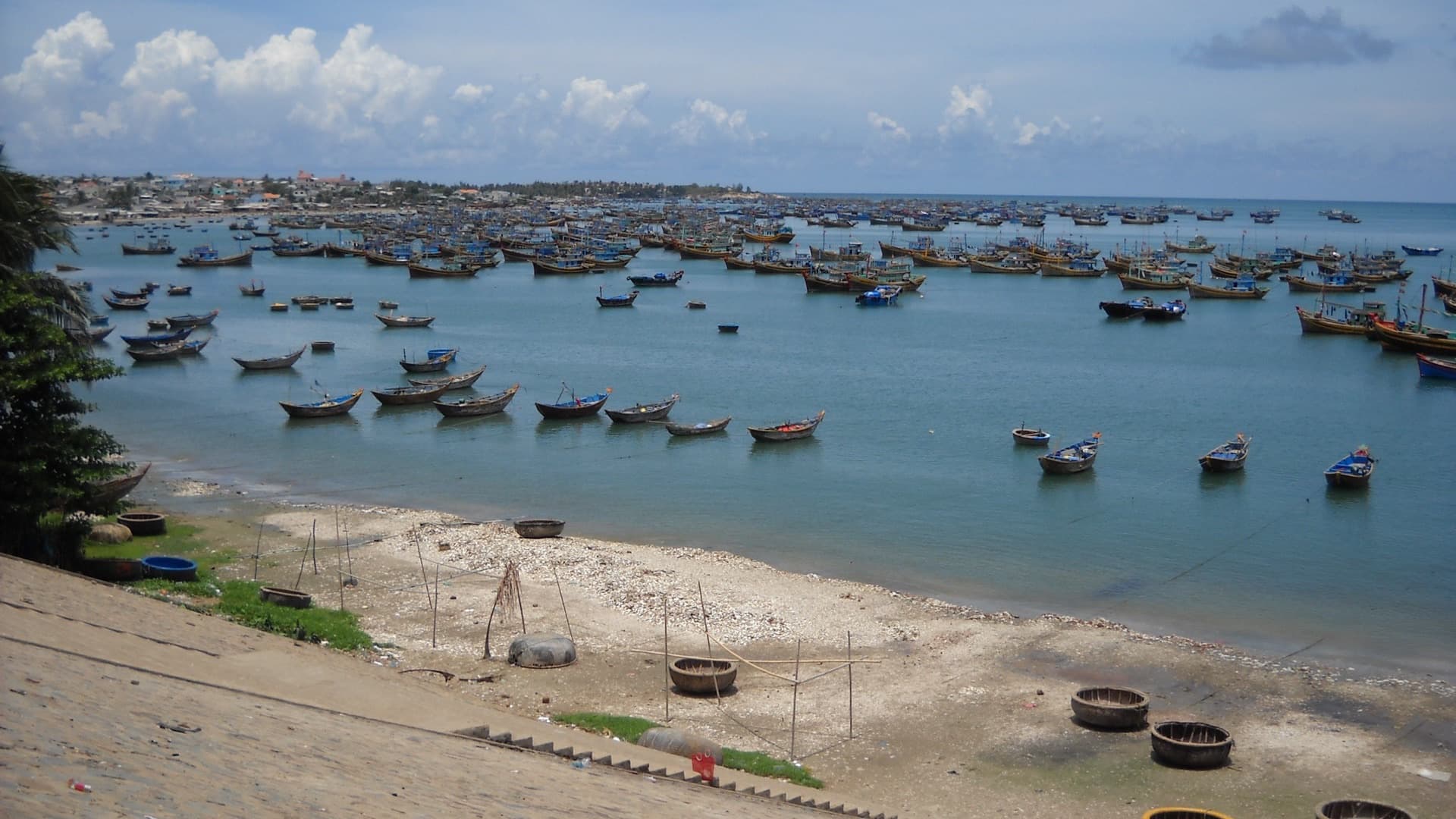
For most visitors, the best place to stay in Mui Ne is the middle of the Ham Tien strip along Nguyen Dinh Chieu road, the stretch usually called Mui Ne Beach, with the best remaining sand, the kitesurf schools and the beachfront resorts. Choose the area around Ham Tien market for budget homestays and hostels, the fishing village at the eastern end for the Red Dunes and the dawn harbour, and Phan Thiet only for early trains. Erosion has left parts of the strip behind seawalls, so check a resort's beach before you book.
Mui Ne is not really a town: it is a strip of about 10 km of resorts, guesthouses and restaurants along one road, with no centre. Since the 2025 provincial mergers, Mui Ne and Ham Tien form a single Mui Ne ward of Lam Dong province, although most booking sites still say Binh Thuan.
How the choice breaks down
| Area | Best for | Feel | Beach | Typical price (2026) |
|---|---|---|---|---|
| Middle of the Ham Tien strip | First visits, kitesurfing, resorts | Resort strip, quiet evenings | The best remaining sand | Beachfront resorts about $50-120 |
| Around Ham Tien market | Backpackers, long stays | More local, hostels and homestays | Mostly seawall promenade | Simple rooms about $15-40 |
| Western end and Phu Hai | Resorts, long-stay visitors | Bars, big resorts | Seawalls and small beaches | Mixed |
| Mui Ne fishing village | The dunes, the harbour | Working fishing town | Poorer than Ham Tien | Few places to stay |
| Phan Thiet | Early trains, city life | Local city | Doi Duong city beach | Budget to mid-range |
The middle of the Ham Tien strip: the default
This is the stretch that looks like the postcards: resorts set in gardens on the sea side of Nguyen Dinh Chieu road, cheaper hotels and restaurants across it, and the best sand left on the coast. It is where most of the kitesurf schools are, over a dozen of them, and in the season, from about November to April, the bay fills with kites every afternoon. The steady wind has actually piled sand onto parts of this beach while stripping it from others.
It suits first visits, couples and kitesurfers. The trade-offs are quiet evenings, with restaurants spread thinly along the road and no real centre, and the wind itself, which makes the sea choppy in the afternoons of the dry season. Our Mui Ne weather guide explains the seasons.
Around Ham Tien market: the budget base
Around Ham Tien market, the strip feels more local, with most of the homestays, garden guesthouses and hostels, and a small backpacker scene. Most of the beach here has gone, but there is a walkable seawall promenade, and the kitesurf beach and the Red Dunes are a short ride away. Simple rooms on the strip cost about $15-40 a night as of 2026, according to our Mui Ne guide, and dorms less.
The western end and Phu Hai: seawalls and big resorts
Coming in from Phan Thiet, the western part of the strip is where erosion is worst, with long sections of seawall and no beach, although it has bars and a community of long-stay foreign visitors. Between Phan Thiet and Ham Tien, Phu Hai has large resorts on a rocky coast with small beaches broken up by retaining walls. Choose it only if a specific resort's own beach and pool suit you.
Mui Ne fishing village: the dunes and the dawn harbour
The real Mui Ne is a fishing town about 7 km north-east of the Ham Tien strip, at the far end of the bay, with the coracles, the fishing harbour and the fish market. There are very few places to stay in the town itself, and the beaches are poorer than Ham Tien's, but it is close to the Red Dunes, about 2 km from Mui Ne market, and to the harbour, which is best between 5:00 and 6:30. Beyond it, the coast towards Hon Rom has the longest stretch of beach without seawalls, but narrower sand and a number of abandoned hotels.
Phan Thiet: only for trains
Phan Thiet is the working city, with markets, street food and the fishing port, and a calm city beach at Doi Duong, with a promenade and evening food stalls popular with local families. It is about 15 to 20 km from the Mui Ne strip, and for most visitors there is no reason to stay unless you are catching an early train from Phan Thiet station. Further south, the coast at Tien Thanh has large branded resorts and unfinished developments, and Ke Ga, about 30 km south-west of Phan Thiet, is known for its lighthouse, built by the French in 1899.
Erosion: how to pick a resort
Along the roughly 10 km crescent from Ong Dia rock to the Mui Ne fishing port, the sea has eaten into the beach, and businesses have spent billions of dong on fabric sand tubes and concrete and stone barriers, some 20 m long and 1.5 m high, as VnExpress reported in 2025. The provincial authorities are studying the causes, with findings due by the end of 2026.
- Check recent guest photos of the beach in front of the resort, not the pool.
- Choose a resort with a stable beach section, not one perched on a seawall.
- Buy a day pass at a resort with a good beach, about 300,000 to 500,000 VND as of 2026, if your own hotel has none.
Prices and seasons
Our Mui Ne guide puts simple rooms at about $15-40 a night and beachfront resorts at about $50-120. Rooms are busiest and dearest in the dry, windy season from December to April, especially around Christmas, New Year and Tet, when kitesurfers book long stays; book a week or two ahead then. From May to October, rooms are cheaper and the beach quieter.
Decision table: pick by traveller type
| You are | Stay |
|---|---|
| A first-time visitor or couple | Middle of the Ham Tien strip, beachfront |
| A kitesurfer | Ham Tien strip, near your school |
| A backpacker or long-stay budget traveller | Around Ham Tien market |
| A photographer | Near the fishing village, for the dunes and harbour at dawn |
| Catching an early train | Phan Thiet |
Getting there and around
Mui Ne is about four hours by road from Ho Chi Minh City; our Ho Chi Minh City to Mui Ne guide compares buses, trains and cars. There are no commercial flights to Phan Thiet yet. Along the strip, use taxis or rent a scooter, which costs roughly 100,000 to 200,000 VND a day, and book a jeep for the dunes; our day trips from Mui Ne guide covers the tours. For a wider trip, see our 5 days in south Vietnam itinerary.
Limitations
We found no reliable 2026 survey of room prices by area, so the bands come from our Mui Ne destination guide and will vary by season and property. Erosion changes the beach from year to year, and a resort's beach can look very different from its older photos. The descriptions of each area come from 2025 and 2026 travel guides and press reports.
Workaround: check recent guest photos of the beach, book a week or two ahead in the dry season, and ask the resort directly whether its beach section has sand or a seawall.