
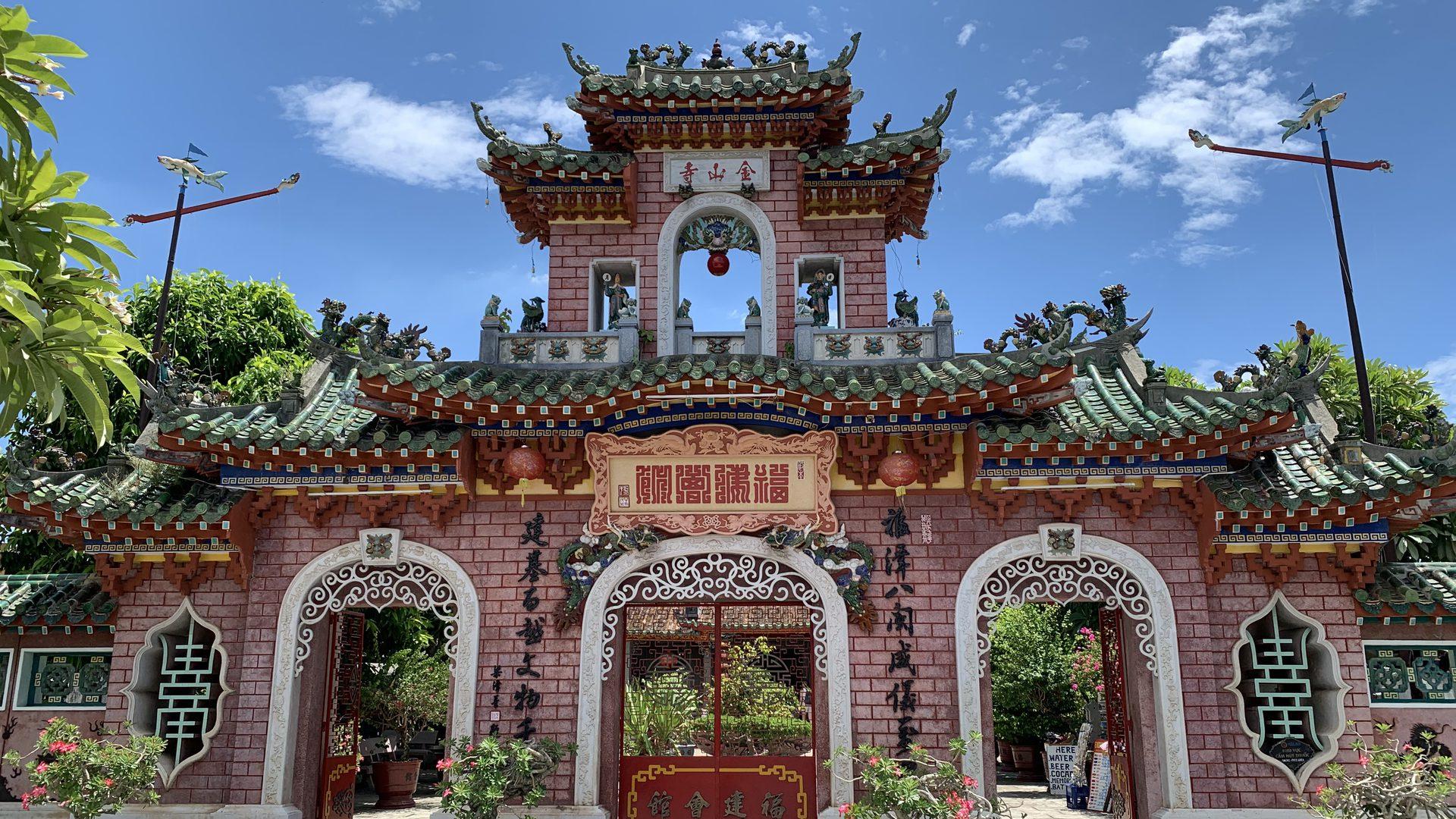
The legal fee for Hoi An's old town is now 20,000 VND per person for each heritage site you enter, the same for foreign and Vietnamese visitors. It has applied since 10 August 2026, under Da Nang People's Council Resolution 98/2026/NQ-HDND. At the booth, that still adds up to the familiar prices. The heritage centre counts the old town itself as one item, so its full ticket, the town plus five sites, costs 120,000 VND, and its standard ticket, the town plus three sites, costs 80,000 VND. Its sales figures for September and October 2026 match those prices. Walking the streets, eating and shopping need no ticket at all.
The old ticket dates from before Quang Nam province merged into Da Nang city on 1 July 2025 under Resolution 202/2025/QH15. The old town now sits in Hoi An ward, formed from the old Minh An, Cam Pho, Son Phong and Cam Nam wards and Cam Kim commune, as Vietnamese Wikipedia's entry on Hoi An ward records, and Da Nang has had to write its own fee rules. This guide explains the old and new systems with their dates, what the ticket covers, when you need one, and which sites to spend it on. For the rest of the town, see the Hoi An destination guide.
The fee: old and new, with dates
| Date | Rule | Hoi An fee |
|---|---|---|
| 2012 to 2026 | Ticket sold by Hoi An's heritage centre | 80,000 VND (three sites) or 120,000 VND (five sites) |
| 15 May 2023 | Hoi An's ticket policy | Tour groups must buy; individual visitors are invited to |
| 21 February 2026 | Da Nang Resolution 02/2026/NQ-HDND | 20,000 to 30,000 VND per site, one price for all |
| 10 August 2026 | Da Nang Resolution 98/2026/NQ-HDND | 20,000 VND per site, one price for all |
The old ticket. Hoi An first sold an old town ticket in 1995, and from 2012 the prices stayed at 80,000 and 120,000 VND, according to a May 2026 press article republished on the heritage centre's site. News reports described them as the foreign and Vietnamese prices: 120,000 VND for international visitors and 80,000 VND for domestic ones, as VnExpress reported in 2023. The centre's own January 2026 notice presents them as two packages instead, without mentioning nationality.
February 2026. On 11 February 2026, Da Nang's People's Council passed Resolution 02/2026/NQ-HDND, in force from 21 February. It set the Hoi An fee at 20,000 to 30,000 VND per person per site, with one price for Vietnamese and foreign visitors, as the Da Nang city government announced.
August 2026. On 31 July 2026, the council passed Resolution 98/2026/NQ-HDND, which replaced the range with a flat 20,000 VND per person per site from 10 August, as the Da Nang city government announced. It asked the city to organise collection in a way that is convenient for visitors and to use technology to cut paperwork. The same rules set My Son sanctuary at 40,000 VND; see the My Son guide.
Who is exempt
The 2026 resolutions exempt children under 16 and school pupils, diplomatic guests, and three groups of Vietnamese citizens only: people with a disability certificate, people aged 60 and over, and people entitled to cultural benefits under Decision 170/2003/QD-TTg. Foreign seniors are not exempt. The heritage centre's January 2026 notice also lets in free people from poor households, journalists, researchers and members of the Vietnam Heritage Association, and gives some Vietnamese groups, such as war veterans, half price.
What you actually pay at the booth
The law has said 20,000 VND per site since August, but I found no notice from the heritage centre or the city explaining how the booths apply it. The evidence points to the familiar prices.
The centre counts the town itself as an item. The May 2026 article, written about ten weeks after Resolution 02 took effect, still gave the prices as 80,000 VND for a ticket of four items and 120,000 VND for six, because the centre counts the old town's general landscape as one item alongside the sites. At 20,000 VND per item, four items cost 80,000 VND and six cost 120,000 VND: the same prices as before. That is my reading of the figures; no official text I found says so.
The sales figures match. In October, the centre gave Tuoi Tre its figures for 6 September to 10 October 2026: 121,402 ticket buyers, 110,690 of them foreign and 10,712 Vietnamese, and ticket revenue of just over 14.1 billion VND, as Tuoi Tre reported. My arithmetic: 110,690 buyers at 120,000 VND and 10,712 at 80,000 VND come to 14.14 billion VND, almost exactly the reported total. The simplest explanation is that after 10 August the booths were still selling the 120,000 and 80,000 VND tickets, with foreign visitors buying the 120,000 VND one. Whether nationality still decides which ticket you are offered, I could not confirm; under the 2026 resolutions, it should not.
How the index counts it. The Vietnam entrance fee index records the legal fee of 20,000 VND per site, and for its big-ten total it counts Hoi An at the 120,000 VND full ticket, because the general landscape counts as a sixth item. Both figures follow the same resolution. Budget 120,000 VND, about 4.60 US dollars at 26,300 VND to the dollar, and read the price board when you buy.
What the ticket covers
The heritage centre's January 2026 visitor notice sets out the two packages:
| Package | Price | What you can enter |
|---|---|---|
| Standard | 80,000 VND | The old town's general landscape, the Japanese Covered Bridge or Quan Cong Temple, and two more sites of your choice |
| Full | 120,000 VND | The general landscape, the bridge or the temple, one museum and three more sites of your choice |
The centre counts the general landscape as one item, which is why the May 2026 article describes the packages as four and six items, and why they come to 20,000 VND per item.
Both tickets also include:
- Traditional music and dance at the Traditional Art Performance House, 66 Bach Dang street, at 10:15, 15:15 and 16:15 daily.
- A Japanese tea ceremony at the Japanese Culture Gallery, 06 Nguyen Thi Minh Khai street, at 9:30 and again at 4:30 daily, according to the notice.
- The evening programme of the old town's Night Town project: bai choi, a card game called out in song, folk games, folk singing and street music.
One ticket lasts your whole stay in Hoi An, up to three days. Each site takes one coupon; once you have used them all, keep the stub, which the notice says makes it easier to come back into the old town. Groups buying eight or more tickets get a free guide.
Do you need a ticket just to walk around?
No, if you are on your own and only walking, eating, drinking or shopping. After a backlash against a plan to make every visitor pay, Hoi An decided in May 2023 that tickets would be compulsory only for tour groups, while individual visitors coming for dinner, coffee or wedding photos would be invited, not obliged, to buy one, according to VnExpress. Officially, the centre still asks every visitor to buy a ticket before entering the old town.
Inside the heritage sites, the ticket is checked at the door. The centre says it places ticket sellers and inspectors at the sites and runs extra checks at the Japanese Covered Bridge, where tour groups gather, and that it caught nearly 30 tour guides bringing in groups without tickets between early March and May 2026. Its director, Pham Phu Ngoc, estimated that about 60 percent of visitors do not buy a ticket.
The protected heritage area covers 130 ha, and its 30 ha core holds 1,175 relics, more than 80 percent of them privately or collectively owned, Ngoc told a conference in October 2026, as Tuoi Tre reported. Because the old town is an open, lived-in district rather than a closed site like Hue's citadel, Ngoc argued in the same May 2026 article that one ticket for the whole area suits it better than charging site by site.
Hours, the walking street and evening rules
Under the centre's January 2026 notice, the old town is a walking and cycling zone from 9:00 to 21:30 in summer and 9:00 to 21:00 in winter. Phan Chau Trinh street joins it in the evening, from 17:30 to 21:30 in summer and to 21:00 in winter. Leave motorbikes outside the zone during those hours.
Each heritage site keeps its own opening hours, and the notice does not list them, so check the sign at each door. On the lantern night, the 14th day of each lunar month, the old town dims its electric lights and the streets fill with performers; the next ones are 22 November and 22 December 2026, and the lantern festival guide has the full calendar. Around Tet the rules change: for Tet 2026, ticket sales and guided tours stopped from 16 to 19 February while the sites stayed open, according to Da Nang's tourism portal. Tet 2027 falls on 6 February.
Floods can also close the town. After the record flood of late October 2025, the ticket booths and sites reopened only on 7 November, as Tuoi Tre reported. The Da Nang and Hoi An weather guide explains the flood season.
Which heritage sites are worth your ticket
The ticket gives you three or five doors from a list of about twenty sites; the town's 2022 digital-ticketing plan counted 21. These are the ones I would choose, with the facts from the heritage centre:
| Site | Address | Why go |
|---|---|---|
| Japanese Covered Bridge, Chua Cau | West end of Tran Phu | Named Lai Vien Kieu in 1719; restored 2022-2024 |
| Quan Cong Temple | 24 Tran Phu | Nearly 400 years old, still in use for worship |
| Fujian Assembly Hall | 46 Tran Phu | Built in 1697, devoted to Thien Hau and guardian spirits of the waters |
| Tan Ky Old House | 101 Nguyen Thai Hoc | 19th-century merchant house, national relic since 1990 |
| Phung Hung Old House | 4-6 Nguyen Thi Minh Khai | Late 19th-century merchant house with a high wooden gallery |
| Cantonese Assembly Hall | 176 Tran Phu | Another of the Chinese community halls on Tran Phu |
The Japanese Covered Bridge is the symbol of the town. The heritage centre's page on the bridge says it was probably built in the early 17th century, by tradition by Japanese merchants, and was named Lai Vien Kieu by Lord Nguyen Phuc Chu in 1719. It was closed for a 19-month restoration from 28 December 2022 and inaugurated on 3 August 2024, at an approved cost of 20.2 billion VND, as Bao Van Hoa reported. You can admire it from the street for free; crossing it uses a coupon.
The Fujian Assembly Hall, built in 1697 as the meeting place and temple of the Fujianese community, is one of the town's signature buildings, with its gate on Tran Phu and several layers of halls behind it, according to the centre's page on the hall. Tan Ky, a two-storey 19th-century house that still carries its merchant name, is admired for the carving on its columns, beams and partitions, according to the centre.
For the museum coupon in the 120,000 VND ticket, the museums the centre runs include the Museum of Folklore, the Museum of Trading Ceramics, the Museum of Sa Huynh Culture and the Museum of Traditional Medicine, as its first-quarter 2025 visitor report lists. Pick the one closest to your interests.
Where the money goes
From 2012 to July 2026, the old town sold 19.2 million tickets and took more than 2,000 billion VND, according to figures presented at an October 2026 conference in Da Nang. In 2024 the town received about 4.4 million visitors and sold 1.78 million tickets, about 40 percent; in 2025 it received nearly 5 million visitors and sold 1.71 million tickets, about 35 percent, according to the same Tuoi Tre report.
Ticket revenue reached 196 billion VND in 2025, and the centre's target for 2026 is 220 to 240 billion, although the first quarter of 2026 brought in only about 59 billion. Of every ticket, 55 percent goes to the state budget for restoration and conservation and 45 percent stays with the centre, which passes about 9 percentage points to the private owners of houses on the route and runs on the remaining 36 percent, with about 250 staff, according to the same May 2026 article. The Vietnam overtourism index explains why the town needs both the money and the control of numbers.
For planning the rest of your days, the 3 days in Hoi An itinerary builds the ticket into a full stay, the Hoi An beyond the old town guide covers the beaches and villages outside it, and the Hoi An vs Hue comparison sets its ticket against Hue's.
Limitations
I could not find any notice from the heritage centre or Da Nang city explaining how the booths apply the 20,000 VND per-site fee. My conclusion that the full ticket still costs 120,000 VND, at 20,000 VND for each of six items, is my own reading of the centre's published figures, not an official statement. The centre's January 2026 notice does not say whether foreign visitors can buy the 80,000 VND ticket. I could not find the centre's current official list of ticketed sites, so the sites in the table are the best-known ones, not a confirmed list. Opening hours of individual sites are not published in one place, and sites close for restoration without much notice.
Workaround: read the price board and the list of sites printed on your ticket before you pay, ask which sites are open that day, keep your ticket, and if the booth charges a different price from the one in this guide, the heritage centre is at 10b Tran Hung Dao, phone +84 235 3862 367.