
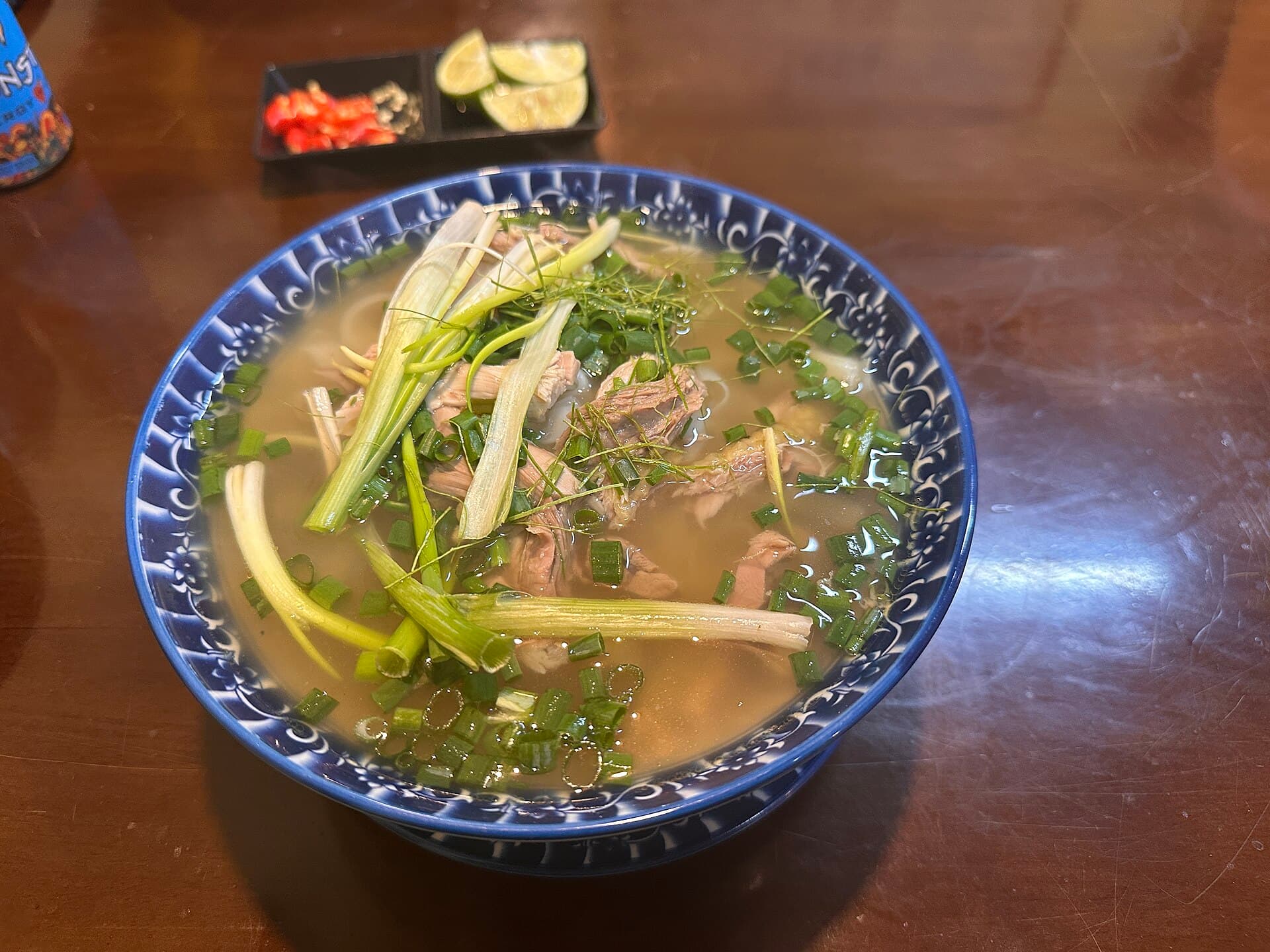
A regular bowl of beef pho costs around 30,000-50,000 VND ($1.15-1.95) at a local neighborhood shop in mid-2026, and roughly 1.5 to 3 times that in tourist zones — call it 50,000-120,000 VND ($1.90-4.60) once you sit down in Hanoi's Old Quarter, Saigon's District 1 or on Da Nang's beachfront. That is the short answer. The long answer is that "how much is pho" has a different number in every city, the numbers move every year, and nobody had put them in one sourced table. So we built one.
The Pho Index records two price ranges for each of 12 Vietnamese cities — a local-neighborhood range and a tourist-zone range — drawn from named-shop menus, dated 2024-2026 reporting and city food guides, with every row's sources listed in the open dataset. Ranges, never averages: a pho price is a menu fact, not a statistic, and averaging a handful of menus would be false precision.
The index — what a bowl costs, north to south
| City | Local shops (VND) | Tourist zone (VND) | Local shops (USD) | Midpoint markup |
|---|---|---|---|---|
| Hanoi | 30,000-45,000 | 60,000-100,000 | $1.15-1.73 | ~2.1x |
| Sapa | 40,000-80,000 | single range | $1.54-3.08 | — |
| Ninh Binh | 40,000-50,000 | 50,000-70,000 | $1.54-1.92 | ~1.3x |
| Hue* | 30,000-40,000 | 40,000-60,000 | $1.15-1.54 | ~1.4x |
| Da Nang | 25,000-50,000 | 70,000-120,000 | $0.96-1.92 | ~2.5x |
| Hoi An | 25,000-50,000 | 50,000-120,000 | $0.96-1.92 | ~2.3x |
| Quy Nhon | 40,000-60,000 | single range | $1.54-2.31 | — |
| Nha Trang | 30,000-50,000 | 50,000-75,000 | $1.15-1.92 | ~1.6x |
| Da Lat | 35,000-55,000 | 49,000-99,000 | $1.35-2.12 | ~1.6x |
| Ho Chi Minh City | 40,000-70,000 | 80,000-120,000 | $1.54-2.69 | ~1.8x |
| Can Tho | 20,000-40,000 | single range | $0.77-1.54 | — |
| Phu Quoc | 25,000-60,000 | 50,000-80,000 | $0.96-2.31 | ~1.5x |
*Hue is priced on bun bo Hue, the city's everyday bowl — see the next section.
USD conversions use a rounded 26,000 VND to the dollar; the dong traded around 26,250 per dollar in mid-July 2026 (Trading Economics). Midpoint markup compares the middle of the tourist range with the middle of the local range.
How to read the table
The reference bowl is a regular beef pho — tai or chin, standard size, not the special, the large or the combo the menu upsells. Three rows measure something slightly different, and say so. Hue is priced on bun bo Hue because that is the bowl Hue actually eats — pho is a northern dish and a minority option there. Quy Nhon's everyday bowl is fish-cake noodle soup, which corroborates the floor of its pho range. Can Tho's range covers the boat-served bowls of its floating markets alongside local eateries, because that is what recent coverage prices.
Three rows carry a single range instead of two. Sapa is a compact tourist town where the local/tourist split blurs into one band. Can Tho and Quy Nhon simply lack recent, credible tourist-zone pricing — and inventing a second range would defeat the point of the exercise.
The tourist-zone markup
The markup is real, and it has a geography. Comparing range midpoints, the steepest gaps sit where visitors pool into a defined zone: Da Nang's beachfront cafes run about 2.5 times the local midpoint per an October 2025 nationwide pricing survey (Asian Link Travel), Hoi An's Ancient Town restaurants charge double to triple what the town's own pho shops do per a February 2026 shop-by-shop survey (Nomads Beyond), and Hanoi's Old Quarter works out around 2.1 times. Ho Chi Minh City's District 1 lands near 1.8 times — a gentler ratio only because local Saigon pho is already the country's most expensive.
At the other end, the gap nearly vanishes where tourism spreads out instead of pooling. Ninh Binh's visitor-strip bowls run only about 1.3 times the town's standard ones; Hue's central and riverside shops about 1.4 times its neighborhood ones. The rule the data supports: the markup prices the location, not the soup. Ten minutes' walk from the landmark is usually worth 30,000-60,000 VND a bowl.
Pho plays at home in the north — and gains weight going south
Pho was born in and around Hanoi roughly a century ago, and its home town is still where quality is cheapest. The city's grumble of 2025 was that the 30,000-VND bowl is fading — VietnamNet reported neighborhood shops stepping to 35,000-40,000 VND and central ones to about 45,000, citing beef, bone and rent costs — yet 25,000-VND holdouts still sell hundreds of bowls a morning, and the Michelin list is startlingly egalitarian. Per Vietnamese coverage of the 2025 selection, nine Michelin-listed pho shops operate in Hanoi: Pho Ga Nguyet starts around 35,000 VND, Pho Khoi Hoi around 45,000 — a Michelin-listed bowl for under $2 — and the most expensive special in the listing, a beef-tendon bowl, is 200,000 VND, about $7.70. The bowls that anchor our Hanoi street food guide all sit in the local column.
Head south and the same dish gains weight and cost. Saigon's local pho runs 40,000-70,000 VND — the highest local baseline in the index — partly rents and incomes, partly style: southern pho arrives with a garden of extra herbs and a sweeter broth, as our Saigon street food guide walks through shop by shop. The central coast is the bargain belt for locals (25,000-VND bowls in Da Nang's markets and Hoi An's back streets) and the markup belt for tourists. And in the Mekong Delta, Can Tho's floating-market bowls at 20,000-40,000 VND are the cheapest in the index — breakfast ladled from a boat for under a dollar at the bottom of the range.
The index also catches where pho stops being the local benchmark at all. Hue eats bun bo Hue — beefier, spicier, lemongrass-forward — at 30,000-60,000 VND depending on distance from the Perfume River. Quy Nhon eats fish-cake noodle soup at 25,000-40,000. Ordering pho in these cities is like ordering paella in Lisbon: available, fine, not the point. Our Vietnam food guide covers the regional bowls that replace it.
Methodology
What counts as a bowl. A regular-size beef pho — tai or chin — at the listed price, not special, large or combo bowls. Chicken pho anchors parts of the Sapa and Ninh Binh ranges and is noted. Hue is benchmarked on bun bo Hue; the dataset flags every substitution in its notes column.
How prices were collected. Web research in June-July 2026: named-shop menus, prices in dated articles, Vietnamese and English city food guides, and local news reporting, with a strong preference for 2025-2026 sources. Each city's row lists its own sources in the JSON dataset; where a range leans on an older anchor — Quy Nhon's is mid-2024 — the row note says so. We aimed for two independent sources per row; the single-source rows (Hoi An, Ninh Binh) rest on shop-by-shop surveys with named shops and prices.
Local vs tourist. "Local" is the band at neighborhood shops and stalls where residents eat. "Tourist zone" is the band in the main visitor concentration — old quarters, beachfronts, the Tam Coc strip. Where recent coverage does not support a distinct tourist band, the row records one honest range instead of two invented ones.
Conversions and markup. USD at a rounded 26,000 VND per dollar (the market rate was about 26,250 in mid-July 2026), so dollar figures understate by roughly 1 percent. Markup is the tourist-range midpoint divided by the local-range midpoint, to one decimal.
What we dropped. Hai Phong, Buon Ma Thuot and Vung Tau were researched and cut: recent Hai Phong coverage prices banh da cua rather than pho, and the only Buon Ma Thuot pho price we found was a dated listing. Twelve sourced rows beat fifteen padded ones.
Limitations
- Web-sourced menus skew online-visible. Shops that publish prices — or get written about — lean urban, established and tourist-legible. The true bottom of each local range is probably a few thousand dong lower than we can document.
- Ranges are not averages. We record bands, not means; no sample here is large enough to say what a "typical" bowl costs to one significant digit, and we decline to pretend otherwise.
- Prices move. Hanoi's 2025 reporting documents 5,000-dong steps; expect most ranges to drift up 10-15 percent by the 2027 edition. The Quy Nhon row, anchored to mid-2024, likely already has.
- Tourist-zone boundaries are fuzzy. One street can hold a 35,000 bowl and a 90,000 bowl. Midpoint markups are indicative ratios, not laws.
- Two rows price a different bowl (Hue, partially Quy Nhon) and one prices boats (Can Tho). The alternative — publishing pho prices nobody in Hue actually pays — seemed worse.
- The dong wobbles. A 1-2 percent currency move changes every dollar figure while the dong prices sit still.
Annual update commitment
The index is re-priced each year, with the year in the slug so citations stay anchored. The 2027 edition will re-price all 12 cities against this baseline and add any dropped city we can finally source.
Revision history:
| Date | Changes |
|---|---|
| 2026-07-25 | Initial publication. 12 cities priced; Hai Phong, Buon Ma Thuot and Vung Tau researched but dropped for lack of recent pho-specific sources. |
How to cite this
Nguyen, J. (2026). The Pho Index 2026: What a Bowl Costs in 12 Cities. Day Trips Vietnam. Retrieved from https://daytripsvietnam.com/guides/pho-index-2026/
For specific figures, cite the city row and publication date — e.g., "Day Trips Vietnam's Pho Index 2026 puts a local-shop bowl in Hanoi at around 30,000-45,000 VND, and 60,000-100,000 VND in the Old Quarter."
Published under Creative Commons BY 4.0. The full 12-city grid, per-row notes and sources: pho-index-2026.json. Editorial enquiries: info@daytripsvietnam.com.
Related research and reference
- Best street food in Hanoi 2026 — where the northern bowls in this index actually live
- Best street food in Saigon 2026 — the southern style, shop by shop
- Vietnam travel cost index 2026 — pho in the context of full daily budgets
- Hanoi street food spending research — what travelers actually spend per street-food day
- Vietnam food guide — the dishes beyond pho, region by region