
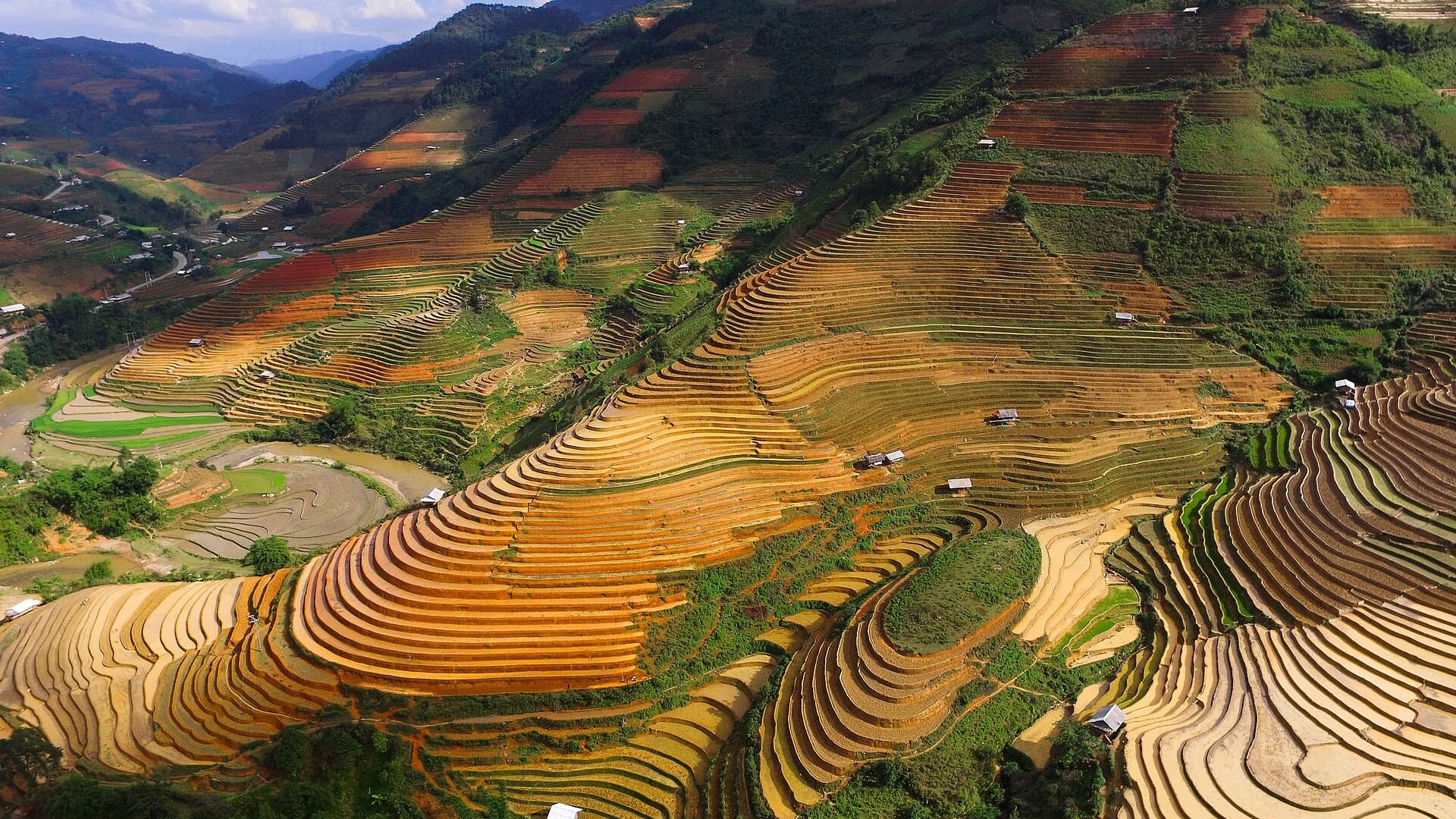
Here is the plain answer: September 2027 is the month Vietnam changes gear, and the direction depends on where you are standing. The north sheds summer — Hanoi's humidity breaks in the second half, and the terraces of Mu Cang Chai, Sapa and Hoang Su Phi turn harvest gold from about the third week. The central coast moves the other way: the first days of September open the typhoon and flood window for Hue, Da Nang and Hoi An, and it runs to December. The south is still mid-monsoon, Ho Chi Minh City at the wettest month of its year.
This is the 2027 edition of a page we rewrite each year; this year's September guide has the 2026 dates. What changes for 2027 is the calendar: National Day falls on a Thursday with a four-day break proposed, and the Mid-Autumn Festival lands on Wednesday 15 September, ten days earlier than in 2026. If your dates can slide, August is greener and cheaper in the mountains and October is when the north fully arrives. The month-by-month weather guide has the full year, and the rainy season guide explains how monsoon rain behaves hour by hour.
September by region: the historical averages
These are long-run climate normals as published by Climates to Travel, not forecasts, and other datasets differ by a useful margin. Treat the table as a prior.
| Region | Historical September picture | Verdict |
|---|---|---|
| Hanoi | 32°C days, 24.8°C nights, roughly 245 mm over 14 days, 81 percent humidity | Improving fast in the second half |
| Ha Long Bay / Hai Phong | 31°C days, roughly 255 mm, sea 30°C | Good, but inside the storm window |
| Sapa | 21.6°C days, 15.9°C nights, roughly 315 mm over 20 days | Harvest begins; trails still wet |
| Hue | 32.2°C days, 24°C nights, roughly 395 mm over 17 days, sea 29.4°C | Storm season opens |
| Da Nang / Hoi An | 32.1°C days, 24.4°C nights, roughly 310 mm over 14 days, sea 29.3°C | Fine early, a coin flip late |
| Nha Trang | 31.8°C days, 25.2°C nights, roughly 160 mm over 15 days, sea 28.8°C | The most reliable beach |
| Da Lat | 22.8°C days, 15.8°C nights, roughly 280 mm over 24 days | Wettest month, cool |
| Ho Chi Minh City | 32.2°C days, 24.2°C nights, roughly 325 mm over 23 days | Wettest month, dry mornings |
| Phu Quoc | 29.8°C days, 25.6°C nights, roughly 475 mm over 22 days, sea 29°C | Wet and cheap |
The north: from summer heat to the first golden weeks
Hanoi opens September as a summer city — around 32°C by day, nights near 25°C, roughly 245 mm across 14 days, 81 percent humidity — and closes it as an autumn one. The shape matters more than the total: the afternoon storms still arrive early in the month, then from about the third week the air dries, evenings turn pleasant and October's normal of roughly 155 mm is already in sight. The Hanoi guide reads very differently in the last ten days than in the first.
Ha Long Bay is good and improving — Hai Phong's normal is about 255 mm with the sea near 30°C — but the north's typhoon maximum runs July to October, so a September sailing is still one to keep refundable.
Up in the mountains the harvest is the story. Sapa runs about 21.6°C by day and 15.9°C at night with roughly 315 mm over 20 rainy days, the tail of the mountain wet season, and its lower valleys begin cutting in the first half of the month. Mu Cang Chai has historically peaked from the last ten days of September into the first week of October. Hoang Su Phi, in Ha Giang province, runs latest — late September to about mid-October, highest fields last — with a fraction of Sapa's foot traffic. Each valley's gold lasts two to three weeks and shifts a week or so with the summer's weather, so check recent photos before anchoring a trip to one place, and book early: the homestay and lodge stock is small. Late September also threads the Ha Giang loop between the landslide season and October's crowds; the loop routes guide covers the roads.
The central coast: the storm season opens
September is the hinge between the central coast's long dry season and its flood season. Da Nang's September normal is roughly 310 mm over 14 days, nearly triple August's 115 mm, and Hue's is about 395 mm over 17 days on the way to October's 755 mm, the wettest month of the Hue year according to Climates to Travel. Highs stay near 32°C and the sea is bath-warm at about 29°C, which is why the first week can still deliver excellent beach days in Da Nang and Hoi An. The last week is a coin flip.
The centre's typhoon window opens at the beginning of September and runs to about 10 December. Vietnam's forecaster, the National Centre for Hydro-Meteorological Forecasting, puts the long-term average at 11 to 13 storms and tropical depressions in the East Sea a year, with five or six making landfall, as VietnamNet reported in covering the 2026 outlook; from September the landfalls concentrate on the central coast rather than the north.
In practice a system means one to three disrupted days: sailings suspended, Da Nang or Hue airport closed for 24 to 72 hours in a strong storm, and the rain that follows a landfall flooding Hue, where the Perfume River rises through a low-lying city, and Hoi An, where the Thu Bon backs up through the Old Town's riverside blocks. September floods are usually brief; the serious ones come in October and November, and late October 2025 set records across the region. The risk is rising through the month, not peaking.
Nha Trang is the exception on this coast: about 160 mm over 15 days, highs near 32°C, sea at 28.8°C, and a rainy season that only begins in earnest in October. It is the most reliable beach in Vietnam this month.
The playbook: free cancellation on central-coast rooms and any Ha Long cruise, no non-refundable flights into Da Nang, a buffer day per central leg, insurance that covers weather disruption, and a check of the NCHMF forecast inside a week of travel, since tracks only firm up three to five days out.
The south: still the wet season
Ho Chi Minh City is at the wettest point of its year — roughly 325 mm across 23 rainy days — yet the rhythm is unchanged since May: highs near 32°C, dry mornings, a hard 30-to-90-minute downpour in the mid-to-late afternoon, streets that flood and drain within the hour. Plan sightseeing before noon and the city works. The Mekong Delta runs the same pattern as its high-water season begins to build.
Phu Quoc is the month's hard case: around 475 mm over 22 rainy days, with the southwest monsoon pushing surf onto the west-facing beaches. The sea is 29°C and rooms are a fraction of the winter rate, but this is not the month for a guaranteed beach week. Da Lat, at about 22.8°C by day and roughly 280 mm across 24 days, is cool, green and at its wettest — fine as a two-day stop with flexible afternoons.
National Day and the Mid-Autumn Festival in 2027
National Day, Thursday 2 September. 2027 is the 82nd anniversary of the 1945 declaration of independence. The holiday is two days under the Labour Code, 2 September plus an adjacent day, and in August 2026 the Ministry of Home Affairs proposed a four-day public-sector break from Thursday 2 to Sunday 5 September, with private employers choosing 1 or 3 September as the second day. It was a proposal, not a decision, at the time of writing. Whatever the final shape, expect a domestic surge from the evening of 1 September to the 5th: trains out of Hanoi sold out, sleeper buses full, Sapa, Ha Long, Da Lat and Vung Tau charging what they like. Sights and restaurants stay open — this is a surge problem, not a closure problem — so book that window's transport well ahead or spend it in Hanoi or Saigon for the flags and fireworks.
Mid-Autumn Festival, Wednesday 15 September. Tet Trung Thu is the 15th day of the eighth lunar month. We computed the 2027 date with a Vietnamese lunar-calendar conversion — the Vietnamese calendar is reckoned at UTC+7, which occasionally shifts a date one day from the Chinese one — and checked it against the published 2027 listing. Both give Wednesday 15 September 2027, ten days earlier than 2026's 25 September. The eighth lunar month opens on 1 September, so Hanoi's Hang Ma street is a canyon of lanterns and toys from the first days of the month, and Hoi An's Old Town switches off its electric lights for the lantern night on the eve, Tuesday 14 September. It is not a public holiday and nothing closes. The Mid-Autumn Festival guide covers each city, and the festival calendar atlas has the wider year.
Where the value is
September is shoulder season almost everywhere, and as of mid-2026 the pattern looked like this. Long-haul fares from the United States and Europe sat in their second-cheapest window of the year, roughly 600 to 850 USD return, according to our monthly price calendar; the cheapest month to fly guide has the route detail. On the ground, accommodation ran 5 to 15 percent below baseline in the post-summer dip, central-coast hotels discounted as the rain built, and Ha Long cruise cabins were 20 to 40 percent under their November-to-March rate. The hotel prices guide has the tier detail.
Two exceptions run the other way: the National Day window adds roughly 5 to 10 percent nationally and far more in the domestic favourites, and the harvest valleys charge firm rates in the golden fortnight. The best-value purchase in the country remains a 10,000 VND disposable poncho — about 0.40 USD at the roughly 26,000 VND-to-the-dollar rate of mid-2026 — bought on arrival rather than packed.
Where to go, and where to think twice
Go: Mu Cang Chai and Hoang Su Phi in the last ten days for the best odds of peak gold; Hanoi and Ninh Binh from the second week, as the humidity breaks and the karsts come out of the haze; the Ha Giang loop in late September, with respect for the roads after rain; Ho Chi Minh City and the Mekong on a mornings-first schedule; Nha Trang for the most dependable beach; Ha Long Bay on a refundable booking.
Think twice: Hue, Hoi An and Da Nang after mid-month unless every booking is refundable; Phu Quoc if the trip needs sunshine rather than a warm sea and a cheap room; any fixed itinerary that crosses the National Day window on domestic transport.
The verdict: September 2027 suits travellers who point the trip north and arrive after 5 September — the harvest, the drying capital and the early Mid-Autumn moon make the second half one of the best fortnights of the northern year — and it suits the south on a schedule. It does not suit anyone whose trip depends on a central-coast beach week, or on Hoi An's lantern night staying dry.
Limitations
Every figure above is a long-run climate normal, and datasets disagree by a useful margin: Hanoi's September rainfall appears as anywhere from about 225 mm to 265 mm depending on the source, and Hue's October total as anywhere from roughly 400 mm to 755 mm. A single September can run far wetter or drier than the mean, and typhoon tracks are unreliable beyond about five days. Workaround: treat the table as a prior, check each destination's ten-day forecast a week before that leg, and never lock in non-refundable central-coast bookings.
The calendar claims carry their own caveats. The four-day National Day break was a Ministry of Home Affairs proposal at the time of writing, not a published decision, and private employers may give different days. The Mid-Autumn date is a lunar conversion cross-checked against one published calendar; Hoi An's lantern night follows the same calendar and is curtailed in high water. Harvest timing moves a week or two with the summer's weather, and prices are mid-2026 observations. Workaround: confirm the official 2027 schedule once published, keep a buffer day in the mountains, and check live rates before you book.