
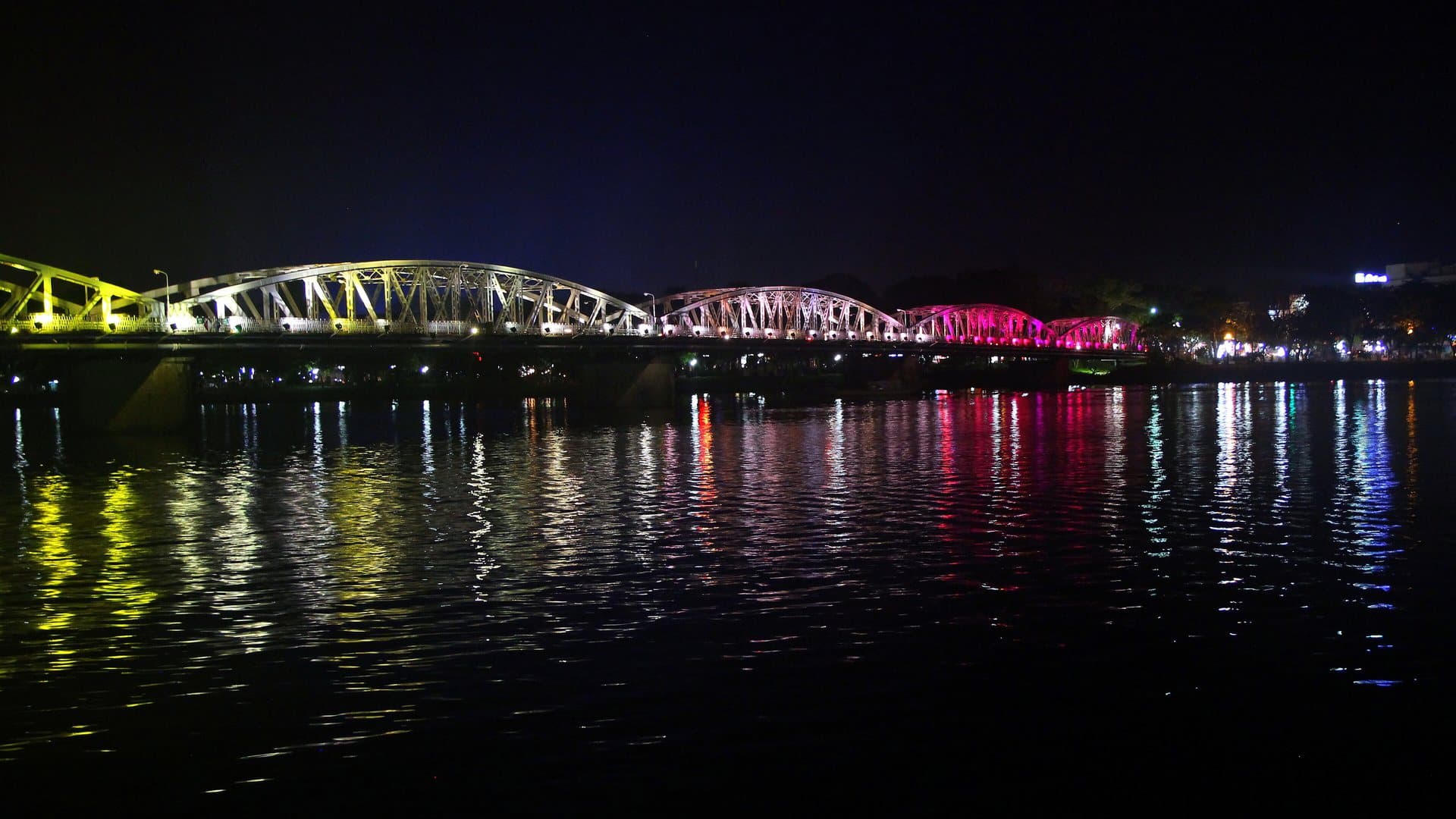
For most visits to Hue, stay on the south bank of the Perfume River, on the riverfront along Le Loi or in the blocks just behind it. That is where the hotels, restaurants and cafés cluster, where the railway station is, and from where the Citadel is a short walk or ride across the Truong Tien Bridge. Choose the north bank beside the Citadel walls for a quieter, more atmospheric stay, or a garden resort outside town if you want space and a pool. Hue is the cheapest city most itineraries visit: in 2026, about 18 to 30 US dollars for a budget room, 28 to 130 dollars mid-range and 150 to 350 dollars for the best hotels.
Hue's layout makes the choice straightforward. The river divides the city in two: the Citadel and the Imperial City on the north bank, the modern city (hotels, restaurants, the railway station) on the south. The royal tombs lie upriver, outside town, and the coast lies to the east.
How the choice breaks down
| Area | Best for | Feel | Getting around | Typical price |
|---|---|---|---|---|
| South-bank riverfront (Le Loi) | First visits, views, convenience | Busy, central, landmark hotels | Walk to the river, bridge and station | Mid-range to upscale |
| South bank, behind the riverfront | Budget and food-focused stays | Lively, restaurants and cafés | On foot; short rides to the Citadel | Budget to mid-range |
| North bank, beside the Citadel | Atmosphere, early Citadel visits | Quiet, residential | Walk to the Imperial City | Budget to mid-range |
| Garden resorts outside town | Space, pools, families | Secluded | Shuttles, taxis | Upscale |
| The coast | Summer beach stays | Seasonal | Car or taxi to town | Varies |
The south-bank riverfront: the default
The riverfront along Le Loi is where Hue's best-known hotels sit, facing the Perfume River and the Citadel beyond it. Azerai La Residence is an art deco boutique hotel on the river with views towards the Citadel; Silk Path Grand Hue, a five-star on Le Loi, is close to both the river and the railway station; and Indochine Palace is an upscale hotel in the centre, a short walk from the water. The riverfront walk, the Truong Tien Bridge lit at night, and easy access to the station make this the most convenient base for a short stay.
Just behind the riverfront, the south bank's streets hold most of the city's budget and mid-range hotels, and most of its restaurants and cafés. It is livelier and cheaper than the river frontage, and it is the natural base if eating is a priority: our Hue food guide covers what to order, and our Vietnamese desserts guide explains why Hue is the city for chè.
The north bank, beside the Citadel
The north bank, around the Citadel walls, is quieter and more residential. Staying here means you can walk to the Imperial City in the early morning, before the day's groups, and come back at dusk when the moats and gates are at their most atmospheric. The trade-off is fewer places to eat and drink within walking distance, and a ride across the river for most of the city's restaurants.
It suits a slower stay of three nights or more, or travellers who care more about the heritage than the nightlife. The single ticket for the Imperial Citadel costs 200,000 VND for all visitors in 2026, and being able to walk to it makes an early visit easy.
Garden resorts outside town
For space, a pool and a slower pace, Hue has a small number of garden resorts on its outskirts. Pilgrimage Village is a village-style boutique resort about 10 minutes' drive south of the centre, with bungalows, pool rooms and a free shuttle into town several times a day. Our Hue destination guide also lists the Hue Riverside Boutique Resort, around 15 minutes from the centre. These suit families and longer stays.
The coast: summer only
The beaches on the coast east of Hue make a pleasant summer base, from May to August, when the sea is at its warmest, around 28-30°C. From September to December, though, Hue is in its wet season (the wettest on Vietnam's coast) with heavy rain, rough seas and flood risk, and a beach stay loses its point. For most visitors, the city is the better base, with the coast as a day trip in the dry months. Our Hue weather guide has the month-by-month detail.
Prices and seasons: what to budget
Our 2026 accommodation price index gives these ranges for Hue:
| Tier | Price per night (USD) | Price per night (VND) |
|---|---|---|
| Dorm bed | $7-12 | 180,000-310,000 |
| Budget room | $18-30 | 470,000-780,000 |
| 3-4 star | $28-130 | 730,000-3,380,000 |
| Upscale | $150-350 | 3,900,000-9,100,000 |
Peak periods add 15 to 25 percent, and the weekend effect is mild. The busiest times for international visitors are March to April and October to November. Hue is the cheapest city most itineraries visit, and our destination guide puts mid-range rooms 30 to 40 percent below comparable central Hoi An.
Staying through the flood season
October and November are Hue's wettest months, and when the Perfume River rises it floods low-lying streets, usually for a day or two. If your dates fall then, choose a hotel away from the lowest riverside streets, ask for a room above the ground floor, and book refundable rates. Ask your hotel what it does if roads flood, and keep a buffer day in your plans.
Decision table: pick by traveller type
- First visit, two nights: the south-bank riverfront or the blocks just behind it.
- Food first, on a budget: the south bank behind the riverfront.
- Heritage first, slower pace: the north bank beside the Citadel.
- Family wanting a pool: a garden resort such as Pilgrimage Village.
- Summer beach trip: the coast east of town, May to August only.
Getting there and around
Hue's railway station is on the south bank, close to the riverfront hotels, and the train or the road over the Hai Van Pass links it to Da Nang and Hoi An. See Da Nang to Hue and Hoi An to Hue. From the north, our Hanoi to Hue guide compares the train and flights. Once there, the centre is walkable, and a taxi or Grab covers the tombs; our day trips from Hue and one day in Hue guides plan the sightseeing, and our Hoi An vs Hue comparison helps if you are deciding where to spend more nights. For the rest of the country, see where to stay in Vietnam.
Limitations
Price ranges come from our 2026 accommodation index and move with season, exchange rates and demand; the top of each range is indicative. Named hotels are examples of each area's style, not recommendations, and facilities, shuttles and rates change, so confirm them before booking. Flood behaviour varies by street, and the averages cannot show which areas stay dry.
Workaround: read a property's most recent reviews, confirm the shuttle or transfer arrangements if you are staying outside the centre, and in October and November book refundable rooms above the ground floor.