
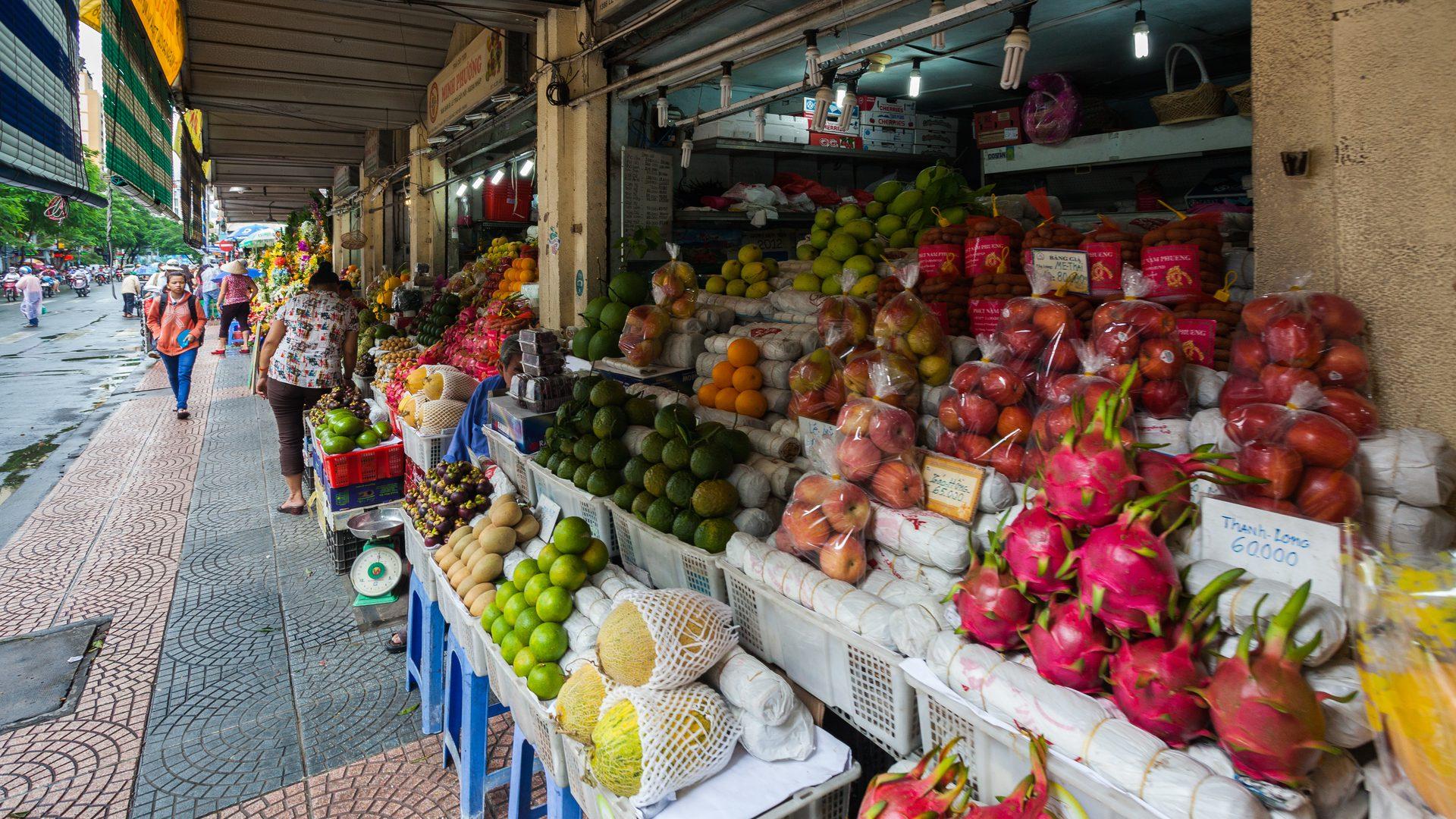
Most of Vietnam's famous fruit is harvested between April and August. Mango is cheapest in April and May, lychee runs from late May to late June in the north, mangosteen peaks in May and June in the south, longan peaks in August, and durian comes in waves, from April to August in the Mekong Delta and from August to October in the Central Highlands. In Ho Chi Minh City in 2026, street sellers charged about 40,000-50,000 VND/kg for mangosteen at the June peak and 60,000-80,000 VND/kg for Ri6 durian in May, while supermarkets asked 120,000-200,000 VND/kg for the same durian.
Every price below comes from dated Vietnamese reporting, almost all of it from January to October 2026, and each one says where and when it was recorded. Prices are per kilo unless marked. US dollars are at 26,000 VND to the dollar, close to Vietcombank's selling rate of 25,990 VND on 31 October 2026. One warning before the tables: Vietnamese news often quotes the farm-gate price that traders pay growers, which is far below what you will pay at a stall. This guide keeps the two apart.
Fruit seasons: what to buy when
Seasons shift with each year's weather, and growers force off-season crops, so most fruit can be found outside these months at a higher price. These are the main harvests.
| Fruit | Main season | Where it grows | Source |
|---|---|---|---|
| Mango (Hoa Loc) | April-May; off-season picking resumes from about September | Mekong Delta, Dong Nai | VnExpress, Aug 2026 |
| Lychee | Late May to late June (main crop from about 10 June) | Luc Ngan, Bac Ninh province | VnEconomy, Apr 2026 |
| Mangosteen | May-June | South-east and Mekong Delta | THVL, May 2026; VnExpress, Jun 2026 |
| Rambutan | From late May in the south-east; off-season Mekong fruit in October | Dong Nai, Mekong Delta | Bao Dong Nai, May 2026; Tuoi Tre, Oct 2026 |
| Durian | Mekong April-August (off-season September-March); south-east May-July; Central Highlands August-October | South and Central Highlands | Crop Production and Plant Protection Department |
| Longan | Mid-July to about 20 September, peak in August | Hung Yen | Hung Yen province, 2025 plan |
| Dragon fruit | 2026 crop sold from July into a September glut; growers also light orchards to force off-season crops | Lam Dong (the former Binh Thuan) | Dan Tri, Sep 2026 |
| Pomelo | Peak demand before Tet | Vinh Long and the former Ben Tre | Nguoi Lao Dong, Jan 2026 |
Durian is the one most travellers get wrong. According to an explanatory note for a draft national standard on fresh durian, prepared by the Department of Crop Production and Plant Protection, the Mekong provinces harvest their main crop from April to August and an off-season crop from September to March, the south-east from May to July, and the Central Highlands from August to October. The same note puts Vietnam's durian area at nearly 151,000 ha at the end of 2023, up from just over 71,000 ha in 2020, with the Central Highlands holding about 47%. That spread keeps durian on sale somewhere in Vietnam in most months.
Lychee is the shortest season. For 2026, the deputy director of Bac Ninh's Department of Agriculture and Environment expected early lychee from 25 May and the main crop from 10 June, on about 29,800 ha, VnEconomy reported. Luc Ngan, the best-known lychee area, is now in Bac Ninh province. Longan follows in July and August around Hung Yen, where the 2025 plan had early fruit before 30 July, the main crop from 1 to 30 August and late fruit until 20 September, Thuong Hieu va Cong Luan reported. Hung Yen held its 2026 longan festival from 7 to 9 August, VOV reported.
What is in season in November and December
The big harvests are over, so you are buying off-season fruit and the first Tet crops. In early October 2026, Tuoi Tre found off-season rambutan across the Mekong Delta at 40,000-60,000 VND/kg, and hong dao rose apples just coming into season. Off-season Hoa Loc mango picks resume from about September, the Mekong's off-season durian runs until March, and pomelo fills the markets ahead of Tet. Citrus is cheap: on 21 October 2026, cam sanh oranges sold for about 10,000-12,000 VND/kg in markets in Vinh Long and Can Tho, Tuoi Tre reported.
What fruit costs in 2026
These are retail prices a shopper could pay, with the place and month each was recorded. Prices swing hard with the season, so the date matters as much as the number.
| Fruit | Price per kg (VND) | About USD | Where and when |
|---|---|---|---|
| Durian, Ri6 whole | 60,000-80,000 street; 120,000-200,000 supermarket | $2.30-3.10; $4.60-7.70 | Ho Chi Minh City, May 2026 |
| Durian, Ri6 and Musang King | from about 70,000; about 100,000 | $2.70; $3.80 | Ho Chi Minh City markets, Oct 2026 |
| Durian flesh, peeled | 180,000-250,000 | $6.90-9.60 | Ho Chi Minh City street, May 2026 |
| Mango, Hoa Loc grade 1 | about 150,000, up to 190,000 | $5.80-7.30 | Ho Chi Minh City, Aug 2026 |
| Mango, Hoa Loc | from 40,000 | $1.50 | Stalls, Oct 2026 |
| Mangosteen | 40,000-50,000 street; 45,000-60,000 shops (large) | $1.50-1.90; $1.70-2.30 | Ho Chi Minh City, Jun 2026 |
| Rambutan | 40,000-60,000 | $1.50-2.30 | Mekong Delta, Oct 2026 (off-season) |
| Pomelo, da xanh | 25,000-35,000 | $0.95-1.35 | Ho Chi Minh City, Jan 2026 |
| Oranges, cam sanh | 10,000-12,000 | $0.40-0.45 | Vinh Long and Can Tho, Oct 2026 |
The sources: durian from VietnamPlus in May and Znews on 4 October; mango from VnExpress on 15 August and Tuoi Tre on 21 October; mangosteen from VnExpress on 23 June; rambutan from Tuoi Tre on 3 October; pomelo from Nguoi Lao Dong on 15 January.
Three things stand out. Mango roughly doubled between the April-May glut and August: orchards that sold Hoa Loc at 20,000-30,000 VND/kg in April and May got 55,000-80,000 in August, when the main crop had ended and demand for offerings rose in the seventh lunar month. Mangosteen was cheap at its June peak but cost 80,000-90,000 VND/kg for top grade in Mekong markets at the start of May, when supply was still thin, THVL reported. And durian in a supermarket can cost two to three times the street price, or the same, depending on the week's promotions.
Fruit I could not price for 2026
For lychee, the 2026 figures are what traders paid growers: 35,000-70,000 VND/kg for early fruit and 55,000-90,000 VND/kg in the main season, according to VOV, so expect to pay more in Hanoi. For longan, the latest dated retail survey I found is from July 2024, when Hung Yen longan sold for 50,000-110,000 VND/kg in Hanoi markets, according to Mekong ASEAN. For dragon fruit, I found only farm-gate prices, and they collapsed: on 22 September 2026, a grower in Lam Dong sold 5 tonnes at 800 VND/kg, and export-grade fruit fetched 1,000-1,500 VND/kg, down from 30,000 VND/kg in July, Dan Tri reported. Lam Dong grows more than 26,000 ha of dragon fruit and harvests over 500,000 tonnes a year, according to the same report.
Farm gate, market or supermarket: one fruit, three prices
Ri6 durian in May 2026 shows how far apart the prices sit. On 5 May, orchard depots in the Mekong Delta paid about 39,000-40,000 VND/kg for grade A Ri6, according to Nguoi Lao Dong. Three days later, VietnamPlus found the same variety at 60,000-80,000 VND/kg on Ho Chi Minh City streets and 120,000-200,000 VND/kg in supermarkets, and noted that retail prices can roughly double after transport and labour. Peeled flesh cost 180,000-250,000 VND/kg on the street, and separated segments reached 400,000 VND/kg in some supermarkets.
| Stage | Ri6 durian, May 2026 (VND/kg) | About USD |
|---|---|---|
| Orchard depot, grade A | 39,000-40,000 | $1.50 |
| Street stall, Ho Chi Minh City | 60,000-80,000 | $2.30-3.10 |
| Supermarket, Ho Chi Minh City | 120,000-200,000 | $4.60-7.70 |
| Peeled flesh, street | 180,000-250,000 | $6.90-9.60 |
Supermarkets are not always the expensive option, though. On 4 October 2026, Znews found Ri6 discounted to 67,000 VND/kg at MM Mega Market in An Phu ward and Monthong at 69,000 VND/kg at Co.opmart Cong Quynh, against about 70,000 VND/kg in traditional markets. Pick a supermarket if you want a posted price and a receipt, and a market if you want the best fruit of the day and are happy to check the scale. The card vs cash guide explains why you will need small notes at the stalls.
What tourists actually pay
The fair price is not always the price a visitor is quoted. Three 2026 cases show the range.
- Coconuts, Ho Chi Minh City, August 2026. A vendor on Nguyen Thi Minh Khai and Nam Ky Khoi Nghia streets was filmed selling a coconut to tourists for 330,000 VND, against a normal retail price of 10,000-12,000 VND, VTC News reported. On 2 September, Ben Thanh ward police had brought him in and he had reportedly admitted selling to tourists at high prices; the case was still being handled, Kien Thuc reported.
- Durian, Da Nang, July 2026. A visitor said a durian of about 1.5-1.7 kg was weighed as 4 kg at a stall near Son Tra night market. An Hai ward fined the seller 7.5 million VND on 8 July, but for parking on the road and selling on a street where vending is banned, not for the weight, Tien Phong reported.
- Street fruit, Hanoi, January 2026. A fruit seller on Cau Go street, accused online of overcharging tourists, denied it and was fined 2.5 million VND for using the roadway to sell goods under Decree 168/2024/ND-CP, Znews reported.
The pattern is worth knowing: when police act, the fine is often for the pavement or the parking, not the price, so prevention is on you. The bargaining guide covers where haggling is normal, and the scams guide covers the other street tricks.
How to avoid being overcharged by weight
Most fruit overcharging is a weight problem, not a price problem: the agreed price per kilo is fair, and the kilos are not. These habits close the gap.
- Ask the price per kilo before you choose. "Bao nhieu mot ky?" means "how much a kilo?" Confirm whether the number is per kilo or per fruit; coconuts, pomelos and pineapples are often priced per fruit.
- Watch the scale start at zero. Look at the dial or display before your fruit goes on, and read the weight yourself rather than waiting to be told.
- Know roughly what you picked up. A handful of rambutan weighs little, and a durian of about 1.5 kg should not become 4 kg.
- Use the market's check scale. Circular 09/2017/TT-BKHCN on weighing in retail trade requires market management boards to keep check weights and to run check weighings regularly or on request. In the 2017 text, a purchase of 1-4 kg on a 5 kg dial scale may be short by no more than 40 g.
- Agree whether durian is priced whole or as flesh. Whole fruit is sold with its husk, and peeled flesh cost roughly three times as much per kilo on Ho Chi Minh City streets in May 2026.
- Pay with small notes and count the change. The 20,000 and 500,000 VND notes are easy to confuse; the currency guide shows them side by side.
- Buy where prices are written. Price cards, as in the photo above, and supermarket labels remove most of the guesswork.
Taking fruit home: airlines and borders
On the plane. Durian is the fruit people ask about. Vietnam Airlines says it recommends putting odorous foods in checked baggage and that some other airlines do not accept odorous baggage, so check the rules of every airline on your ticket. On international flights it also points passengers to the rules of the departure, transit and arrival countries.
At the border. The rules belong to the country you land in, not to Vietnam, and they change. Two examples I could confirm:
- European Union. French customs says bananas, durians, coconuts, pineapples and dates may enter without a phytosanitary certificate, while other fresh fruit from outside the EU needs a phytosanitary certificate issued by the country it comes from.
- United States. US Customs and Border Protection says it is best not to bring fresh fruits or vegetables, that agricultural items must be declared, and that failing to declare them costs a first-time offender $300.
For anywhere else, check your destination's official biosecurity or customs site before you pack, and declare any fruit on arrival. The simplest answer is to eat it here; the souvenirs guide lists easier things to carry home.
Where to taste the best of the season
The Mekong Delta is the fruit basket. The Ben Tre guide covers its orchard gardens, the Mekong weather guide shows how the fruit months overlap with the rains, and the floating markets guide explains which markets still trade fruit at dawn. For the meals in between, see the street food prices guide.
Limitations
Prices come from Vietnamese news reports, each a snapshot of one city or market on one day, not a survey, and many are from Ho Chi Minh City and the Mekong Delta rather than Hanoi or the central coast. I could not find a 2026 retail price for lychee, longan or dragon fruit, so those lines use farm-gate figures or a 2024 survey. Seasons are the main harvest windows reported for 2025 and 2026 and move with the weather. I could confirm border rules only for the EU and the US, and I could not confirm whether later amendments changed the weighing tolerances in the 2017 circular.
Workaround: use the tables to know the order of magnitude, then check the price card or ask per kilo on the day, and expect Hanoi and tourist streets to sit above these figures. Before you pack fruit, read your destination's official customs or biosecurity page and your airline's baggage rules.