
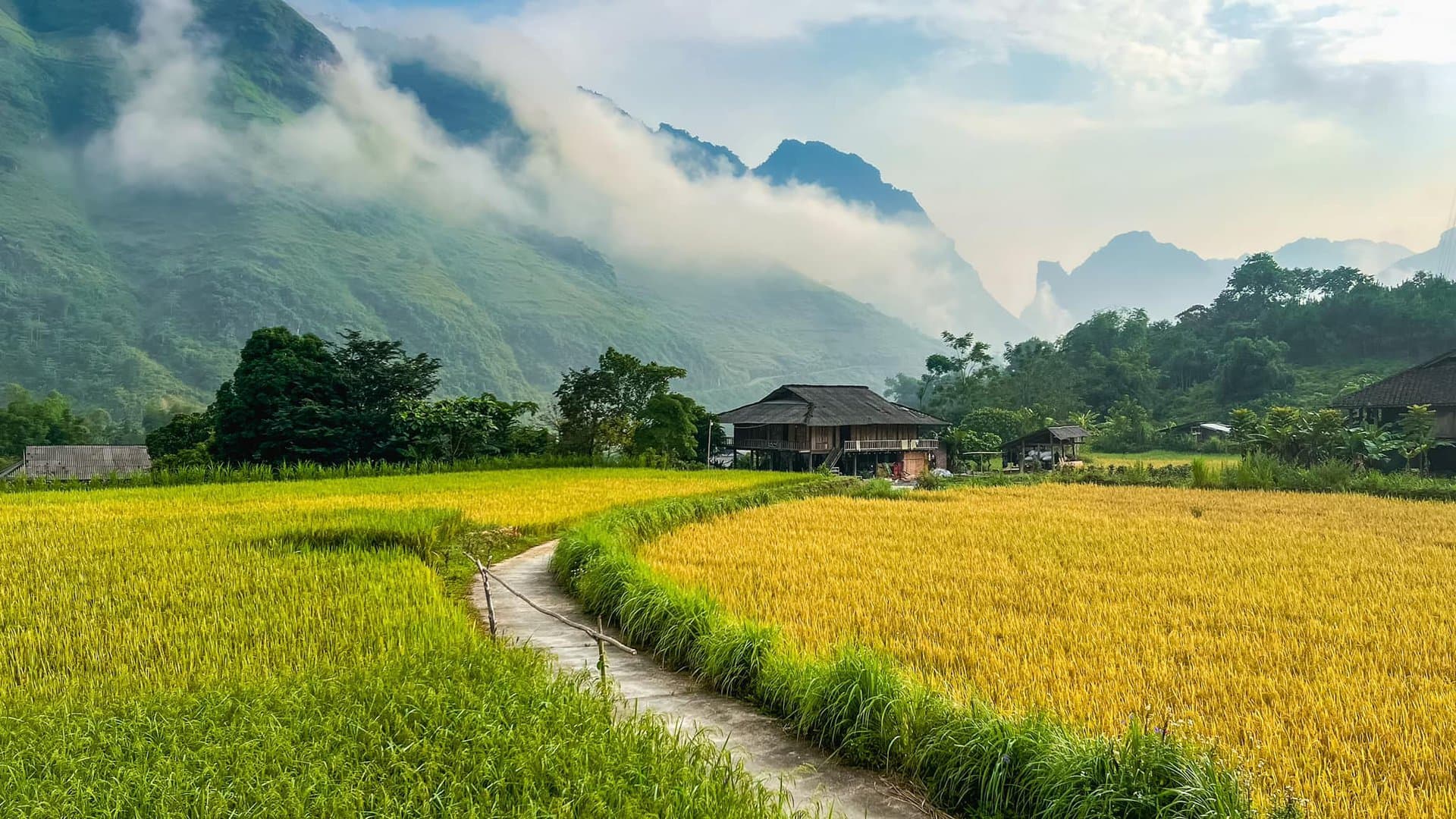
On the Ha Giang Loop you sleep where each riding day ends, so the choice is a town, not a neighbourhood. On a three-day loop the usual stops are Yen Minh on the first night and Dong Van or Meo Vac on the second. A four-day loop adds Du Gia, a valley village on the way back, or Lo Lo Chai, under the Lung Cu flag tower. Ha Giang city covers the nights before and after. Homestays are the norm everywhere, and small hotels cluster in Ha Giang city and Dong Van. As of May 2026, a homestay dorm bed costs about $5-8 a night and a private room about $15-20.
Ha Giang became part of Tuyen Quang province in the 2025 merger, and new addresses and booking listings use that name, but riders and operators still call the loop Ha Giang. Most of it crosses the Dong Van Karst Plateau geopark, which, according to UNESCO, is home to 17 ethnic groups, with Hmong people making up more than 60 percent of its population. They are most of your hosts. If you book an easy-rider or guided tour, the operator usually picks the homestays; this guide helps you choose the towns, book your own bed, or ask your operator the right questions.
How the choice breaks down
| Town | When you sleep there | Feel | Typical stay |
|---|---|---|---|
| Ha Giang city | Before and after the loop | Provincial city, hostels that run tours | Hostels and small hotels |
| Yen Minh | Night one on most loops | Small town in pine-covered hills | Homestays and guesthouses |
| Dong Van | Night two, or two nights | Old quarter, Sunday market, the most rooms | Homestays and small hotels |
| Lo Lo Chai | An extra night near Lung Cu | Village under the flag tower | Village homestays, book ahead |
| Meo Vac | After Ma Pi Leng Pass | Quieter market town | Group homestays and family places |
| Du Gia | An extra night on the way back | Rice-field valley, waterfall, social dinners | Village homestays |
Ha Giang city: before and after the loop
Ha Giang city is the staging town, not a destination. Overnight sleeper buses from Hanoi arrive around 4 to 6am, so the first question is whether you need a bed at all. If you start riding the same morning, a hostel that expects dawn arrivals, stores your big bag and lets you rest until breakfast is enough. If you come up by daytime limousine van, or leave on a late bus after the loop, book a full night. The Hanoi to Ha Giang guide has the bus times, and travellers coming from the west can follow the Sapa to Ha Giang route.
Most backpackers stay at a hostel that also runs loop tours, so the bed, the bike or driver and the bag storage come from one desk. Bong Hostel, on Nguyen Thai Hoc in the city centre, is the best-known example: it runs its own easy-rider tours, and in October 2026 it held a 4.9 rating from more than 13,000 Google reviews. Small hotels in the city start from about $18 a night. Buses drop off at the bus station or near Nguyen Trai Street in the centre, a short walk or taxi from most hostels.
Yen Minh and Nam Dam: the first night
Yen Minh is the usual first stop, a small town in pine-covered hills beyond Quan Ba and the Twin Mountains viewpoint, roughly 110 to 130 km from Ha Giang city depending on the route and the source. It is a practical overnight rather than a sight: guesthouses, homestays and a few hotels, fuel and dinner. Bong Bang Homestay, in Yen Minh town, is a large, sociable example with air-conditioned private rooms. In October 2026 it held a 4.9 rating from more than 1,300 Google reviews, and a recent guest called it a solid first night on the loop.
For something smaller and more traditional, some loops stop short of Yen Minh at Nam Dam, a Dao village near Quan Ba with family homestays. That shortens the first day and lengthens the second, so it works best on a four-day loop.
Dong Van: the best single base
If you sleep well in only one town, make it Dong Van. It is the cultural anchor of the loop, in the middle of the karst plateau, with an old quarter of traditional houses below the limestone, a Sunday market where Hmong, Tay and Dao traders gather, and the widest choice of rooms. Lung Cu flag tower lies to the north and Ma Pi Leng Pass sits on the roughly 20 km road to Meo Vac, so two nights here let you ride both without your luggage.
There are two ways to stay. In the old quarter, a few homestays occupy the old timber and rammed-earth houses. Old Houses Homestay, on the old-quarter street, is one: a 2026 guest described a traditional house where many rooms have no private bathroom or air conditioning and share bathrooms outside, with a kind host. It holds a 4.3 rating from about 350 Google reviews, and some reviews mention noise and building work nearby, the trade-off of sleeping in the centre. On the edges of town, newer small hotels offer private bathrooms at roughly $30-50 a night, the usual choice for a couple's one night of privacy.
Dong Van is also where rooms run out first. In October and November, when the buckwheat flowers on the plateau, homestays here and in Lo Lo Chai can book out two to four weeks ahead.
Lo Lo Chai: a night under the flag tower
Lo Lo Chai is a Lo Lo village at the foot of the Lung Cu flag tower, Vietnam's northern tip, north of Dong Van. On 17 October 2025, UN Tourism named it one of 52 Best Tourism Villages, chosen from 270 applications, and demand has followed. In August 2026, DTiNews reported that the village had 68 homestay households with room for about 1,200 to 1,300 guests, charging VND 800,000 to 2 million a night, and that most were full weeks before the National Day holiday. Cuc Bac Homestay and Lo Lo Eco Home had no rooms left for 30 August to 3 September, and Hanh Phuc Homestay was turning families away.
Those rates, about $30-75, sit well above a typical loop homestay. Stay for the village itself and an early start at the flag tower, book directly with the homestay well ahead, and confirm the room and meal prices, which local authorities have asked hosts to display clearly.
Meo Vac: the quieter town past Ma Pi Leng
Meo Vac lies about 20 km from Dong Van on the far side of Ma Pi Leng Pass, and many loops spend the night here after riding it. It is a quieter market town with its own Sunday market, and the base for the Nho Que River boat trip below the pass. Rooms are a mix of family homestays and basic hotels in town and large group homestays on its edge.
The best known of those is Meo Vac Clay House, near the Hmong village of Pa Vi just outside town, a large complex that hosts big tour groups. It holds a 4.2 rating from more than 750 Google reviews, and 2026 reviews are mixed: good dinners and roomy dorms, but karaoke and party noise at night and stretched staff. Book it for a social night with an easy-rider group; for sleep, choose a smaller family homestay in town.
Du Gia: the valley detour
Du Gia is the night that defines the four- and five-day loops. The village sits in a rice-field valley on the southern return leg between Meo Vac and Ha Giang city, with a waterfall to swim in and a homestay scene known for long communal dinners. It suits travellers who want a sociable last night and a slower final day.
Du Gia Homestay is the largest and best known. In October 2026 it held a 4.7 rating from nearly 1,000 Google reviews, with recent guests praising the valley views and the family dinner, although one 2026 guest who came on a tour complained of a broken air conditioner and an unhelpful manager. Several smaller family homestays sit within a few hundred metres if you want a quieter house.
Homestay or hotel?
The loop is homestay country, and the real difference from a hotel is the evening, not the price.
| Homestay | Small hotel | |
|---|---|---|
| Where | Every stop, and the only choice in villages such as Lo Lo Chai and Du Gia | Ha Giang city and Dong Van; a few in Yen Minh and Meo Vac |
| Room | Dorm or simple private room | Private room |
| Bathroom | Often shared | Usually private |
| Evening | Family-style dinner, rice wine, other riders | Eat out in town |
| Noise | Can be loud with tour groups | Quieter |
| Price (2026) | Dorm about $5-8; private room about $15-20 | From about $18 in Ha Giang city; about $30-50 in Dong Van |
Pick a homestay for the dinner and the company, which is what most riders come back talking about. Pick a hotel for a night when you need a private bathroom or real quiet, and make it Dong Van. Couples and families often split the stay that way. The Vietnam homestays guide covers etiquette inside a family home, and hostels vs hotels vs homestays sets out the wider trade-off.
What a night costs
No town-by-town survey of loop prices exists for 2026, so the bands below are loop-wide figures from the Ha Giang Loop cost guide, converted at its May 2026 rate of 26,361 VND to the dollar, plus dated local figures.
| Stay | Per night | As of |
|---|---|---|
| Homestay dorm bed | $5-8, about 130,000-210,000 VND | May 2026 |
| Homestay private room, shared bathroom | $15-20, about 390,000-525,000 VND | May 2026 |
| Small hotel, Ha Giang city | From about $18 | 2026 |
| Small hotel, Dong Van, private bathroom | About $30-50 | 2026 |
| Lo Lo Chai homestay room | VND 800,000-2 million, about $30-75 | August 2026 |
A spot check of Google Maps on 19 October 2026 listed rooms for two at Bong Bang Homestay in Yen Minh from about 400,000 VND and at Du Gia Homestay from about 450,000 VND for midweek nights later that month, in line with the private-room band. Budget for extras too: a homestay barbecue platter runs about $3-5, a beer $1-2 and laundry $2-3. Some homestays include dinner and breakfast in the rate and others charge for meals, so ask when you book.
If you are on an easy-rider or guided tour, the homestays are usually in the package price, and the operator chooses them. Ask which homestays it uses, whether private rooms are available, and what they cost on top.
When to book and what to bring
Book ahead for October and November, the clearest riding weeks and the buckwheat season, when Dong Van and Lo Lo Chai fill first, and for Vietnamese holidays and weekends. Around Tet, which falls on Saturday 6 February 2027, many loop homestays close or run reduced hours for several days; the Tet guide covers the wider effect. In other months you can often find a bed on arrival in Yen Minh, Meo Vac and Du Gia.
Choose each night's stop by daylight as much as by distance. The safest advice on the loop is to ride only in daylight, so pick a town you can reach before dark, and shorten the day rather than push on in fog or rain.
From December to February the plateau around Dong Van and Meo Vac drops to roughly 2 to 12°C, with fog and frost, as the Ha Giang weather guide shows. Ask whether rooms have a heater or an electric blanket, and pack a warm layer to sleep in. Carry your passport, which hosts ask for at check-in and which you need for any border-area permit near Lung Cu, and bring cash, because ATMs are limited in the smaller mountain towns.
Decision table: pick by traveller type
| You are | Stay |
|---|---|
| On a three-day loop | Yen Minh, then Dong Van or Meo Vac |
| On a four-day loop | Yen Minh, Dong Van, then Meo Vac or Du Gia |
| A couple wanting privacy | Homestays, plus one small-hotel night in Dong Van |
| A backpacker who wants company | A tour hostel in Ha Giang city, then the big homestays in Meo Vac and Du Gia |
| A light sleeper | Smaller family homestays, not the big group houses |
| After a village stay | Lo Lo Chai, booked well ahead |
| Riding in winter | Rooms you have confirmed have a heater, in Dong Van |
For the route itself and how many days to give it, see the Ha Giang Loop routes guide. Couples can follow the four-day couples itinerary, and if you are still choosing a loop, Ha Giang or Cao Bang compares the two.
Limitations
The price bands are loop-wide May 2026 figures rather than a town-by-town survey, the Dong Van hotel range comes from an earlier guide, and the Lo Lo Chai rates come from a single August 2026 news report. Distances between towns differ between sources. The named places are examples confirmed operating in October 2026, through recent Google Maps reviews or 2026 reporting, not recommendations: ratings move daily, and small homestays change hands, rename and close often.
Workaround: read a property's most recent reviews before booking, confirm whether meals, heating and a private bathroom are included, and book directly for October, November and Vietnamese holidays.