
Vietnam has one of the best cooking-class scenes in Asia, and it has grown fast: Hoi An alone now hosts more than 40 commercial schools against roughly eight to ten a decade ago. That growth cuts both ways. The good classes are small, genuinely hands-on and cheap by any international standard. The bad ones are 30-person demonstrations with a market stop arranged around vendor commissions.
This guide covers what a class actually includes, what the cheap ones quietly cut, how the scene differs city by city, what you should pay as of mid-2026, and how to judge a school before you hand over a deposit. For the Hoi An-specific operator detail — which schools, which jetty, which menu — see our Hoi An cooking class day tour page, which this guide deliberately does not duplicate.
What a Vietnamese cooking class includes
The standard half-day format is remarkably consistent across the country:
- Pick-up or meeting point around 8 a.m., usually at a central market.
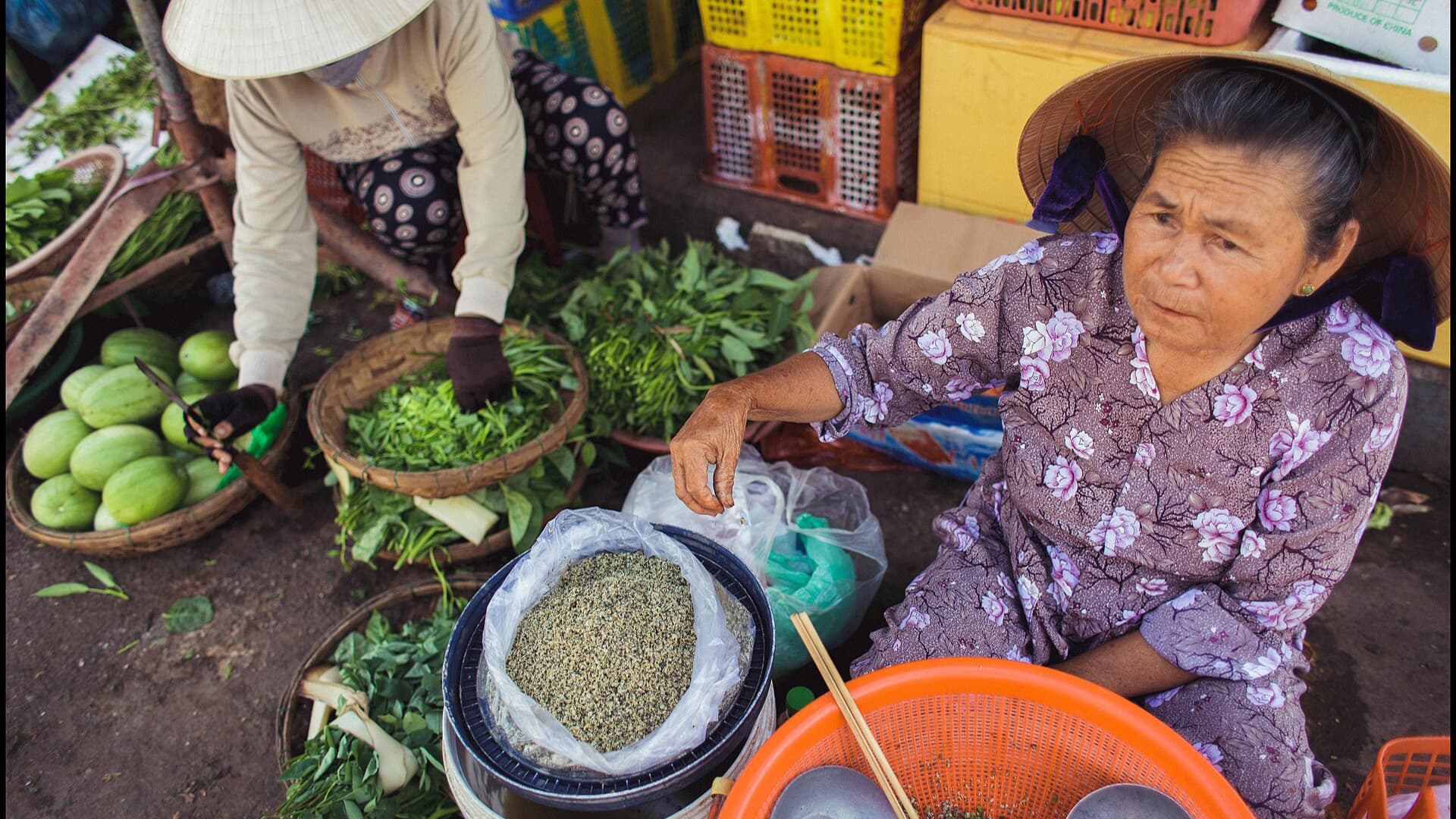
- Market walk, 20-30 minutes, while the instructor buys the day's herbs, noodles and protein and explains what you are looking at.
- Transfer to the kitchen. In Hoi An this is often a wooden boat down the Thu Bon or a basket-boat paddle through the Cam Thanh water-coconut palms. Elsewhere it is a short walk or a van.
- Herb-garden walk at rural and village schools — Tra Que outside Hoi An is the best-known example.
- Cooking, two to two-and-a-half hours, three to five dishes, at your own station.
- Eating everything you made, usually with a beer or lemongrass tea included.
- A recipe pack, printed or emailed.
Most classes run roughly 8 a.m. to 1 p.m. Afternoon sessions from about 1 p.m. exist and are easier to book late.
What the cheap ones cut. In rough order of how much it matters: individual stations, replaced by a shared demonstration bench you watch. Group size, which climbs past 20 and sometimes past 30. The market, downgraded to one pre-arranged stall. Dish count, trimmed to three simplified recipes chosen for speed. The instructor, who becomes a guide reading a script rather than a cook. Whole-ingredient work, replaced by pre-chopped trays. A class at the bottom of the price band is not a worse version of the same thing — it is a different thing.
City by city
Hoi An is the country's cooking-class capital and the default answer. The concentration is the reason: 40-plus schools competing in a town of that size have pushed operators towards small groups, riverside and island premises, herb-garden segments and boat transfers, and prices stay lower than Hanoi or Ho Chi Minh City because the premises are rural. The teaching menu is the local canon — white-rose dumplings, banh xeo, fresh spring rolls, cao lau — and the town's own food is distinctive enough to make the recipes worth having. Established schools run $32-55; village and homestay classes $25-35 with under ten students. See our Hoi An food guide for the dishes themselves, and the 3-day Hoi An itinerary for where a class fits in a short stay.
Hanoi teaches the northern palate: subtle, broth-driven, restrained on chilli. Expect pho, bun cha, banh cuon and often cha ca. Classes are pricier because central Hanoi premises are expensive — a purpose-built school like the Hanoi Cooking Centre runs around $59 for roughly four hours, while Old Quarter operators sit at $25-40. The broth work is the real content here, and a class that skips it in favour of spring rolls is missing the point of the city. Pair it with our Hanoi street food guide.
Ho Chi Minh City is the place to learn the southern kitchen and Mekong ingredients: sweeter, herbier, more fermented, with palm sugar and coconut where the north uses restraint. Com tam, banh xeo Nam Bo, hu tieu and fresh-herb plates dominate. Garden-setting classes in District 1 run about $40-57, and larger centres $50-80. Some operators add a Mekong Delta day version — good if you want the sourcing story, long if you do not. Context in our Saigon street food guide.
Hue teaches the most distinctive cuisine in Vietnam and has the fewest classes doing it. Refined under the Nguyen dynasty between 1802 and 1945, imperial-court cooking was reportedly built around as many as 50 miniature dishes per table, and the surviving repertoire — bun bo Hue, com hen, the banh beo, nam and loc family of small steamed cakes — is fiddly, precise and unlike anything taught elsewhere. Classes run about $30-45 for three to four hours. Hue is also Vietnam's vegetarian capital, with more than 100 chay restaurants, so this is the easiest city in which to book a genuinely good meat-free class. More in our Hue food guide.
Sapa and Da Lat are small scenes and should be treated as such. Sapa's classes are usually homestay-based in Hmong or Dao villages, teaching mountain food — cơm lam sticky rice cooked in bamboo, smoked meats, foraged greens — and the value is the household as much as the cooking. Da Lat's few classes lean on the highland produce that makes the town famous: artichoke, strawberries, cold-climate vegetables, and the local street-food canon covered in our Da Lat food guide. Neither city is a reason to travel; both are worth a morning if you are already there.
What you should pay, as of mid-2026
| Tier | Price (VND) | Price (USD) | What you get |
|---|---|---|---|
| Group class, half-day | 600,000-1,200,000 | $25-45 | Market walk, 3-5 dishes, 12-16 students, recipe pack |
| Small-group class | 900,000-1,600,000 | $35-60 | Same format, capped near 8 students, more instructor time |
| Full-day class | 1,400,000-1,800,000 | $58-75 | Adds farm or garden segment, longer menu |
| Private class | 1,600,000-3,200,000 | $60-120 pp | 2-4 people, menu you choose, dietary work handled properly |
| Hotel or resort class | 1,850,000-4,000,000 | $70-150 | Convenience, hotel kitchen, transport included |
Converted at roughly 26,361 VND to the dollar. A fair price for a half-day group class with a real market walk and your own station is $30-45; below about $25 something has been removed, and above $60 you are paying for exclusivity rather than better teaching. Tips of 50,000-100,000 VND are normal for a good instructor and not expected otherwise.
Half-day or full-day
Half-day suits almost everyone. Four to five hours already covers a market, three to five dishes and a meal most people cannot finish. Full-day classes add a farm or herb-garden segment and sometimes a second cooking block, and they make sense if you cook seriously at home and want the sourcing half of the story rather than a longer lunch. On a short city stop, the half-day leaves your afternoon intact — which matters more than it sounds when the stop is two or three days.
How to book, and through whom
- Direct with the school, two to three days ahead, is the default and usually the cheapest. Longer lead time from November through March in Hoi An and around Tet.
- Homestay and family-run classes are often the best value, with under ten students at $25-35.
- Booking platforms are convenient and fine for availability, but read reviews of the specific school, not the platform — quality drifts with staff turnover, and two schools at the same price can be very different rooms.
- Hotel concierge bookings typically add a 10-15% commission for the same class.
- Private classes are the right call only if you have real dietary constraints, want a specific menu, or are travelling as a group of two to four who would otherwise be split across a crowded session.
Flag vegetarian, vegan, allergy and religious requirements at the point of booking, never on the day: ingredients are bought that morning. Our vegetarian and vegan Vietnam guide covers the fish-sauce problem in detail, and it is the single thing most likely to be handled badly in a cheap class.
Who should skip it
Skip it if you do not cook at home, if you have already done a hands-on class elsewhere in Southeast Asia, or if you have two days in a city and have not yet seen the city. A class is half a day and $25-45; what it teaches that a cookbook cannot is seasoning by taste — building nuoc cham by eye, adjusting fish sauce against lime and sugar until it is right — and that only pays off if you use it. If you mainly want to eat well, a street-food walk costs less and covers more ground; our Vietnam street food atlas and Vietnam food guide are the better starting points.
Limitations
Prices are mid-2026 observed bands converted at roughly 26,361 VND to the dollar, drawn from operator listings rather than a survey, and individual schools move rates seasonally. Workaround: treat the tiers as ratios — private is roughly double group, hotel roughly triple — and confirm the current price and what it includes in writing before paying a deposit.
Quality is not stable within a school over time. Instructors move, ownership changes, and a school that ran eight-student classes two years ago may be running twenty now. Workaround: weight the most recent ten reviews far above the aggregate score, and ask the maximum group size in the booking message so you have it in writing.
The city-by-city picture is uneven in coverage. Hoi An, Hanoi and Ho Chi Minh City have dense, well-documented scenes; Hue, Sapa and Da Lat have far fewer operators and correspondingly thinner public information, so the price bands for those three carry wider uncertainty. Workaround: in the smaller scenes, ask your accommodation which household or school is currently teaching rather than relying on listings, which go stale quickly outside the big three.