
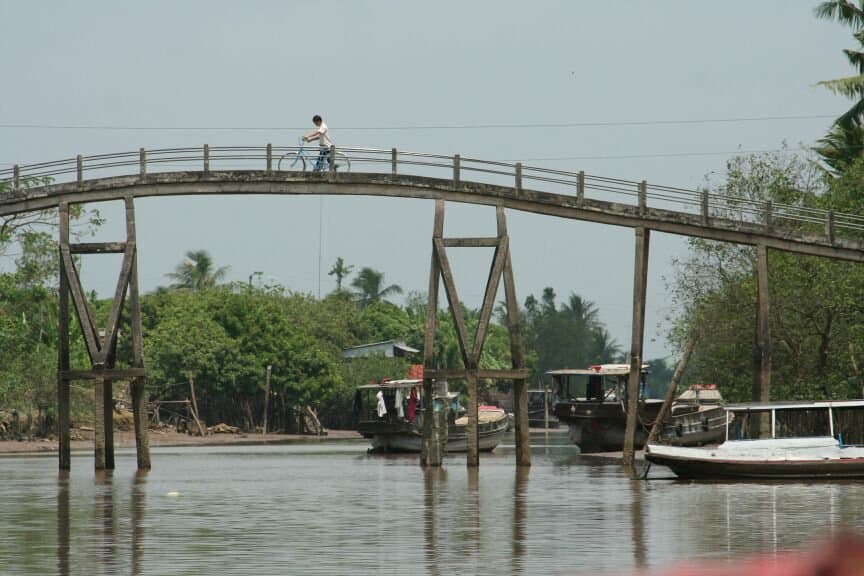
A month is the sweet spot for Vietnam. Two weeks buys the classic route at a sprint — three flights, ten hotel changes, a Mekong morning squeezed in before the airport. Thirty days buys the same route with the sprint removed, plus the one thing every shorter trip has to cut: a genuine deep-dive block, whether that is the Ha Giang loop, Phong Nha's cave country, or real island time at the end instead of a token beach day.
This plan runs north to south in week-sized blocks rather than a 30-line day-by-day, because a month should not be scheduled like a heist. The fixed points are few: one sleeper train, two flights, one cruise, one fork.
The shape of the month
| Days | Block | Anchors |
|---|---|---|
| 1-7 | Hanoi and the north | Old Quarter, Ninh Binh overnight, Ha Long Bay cruise |
| 8-14 | The fork | Ha Giang loop by motorbike, or Phong Nha's caves plus slack days |
| 15-21 | The slow centre | Hue's citadel, the Hai Van Pass, five nights around Hoi An and Da Nang |
| 22-30 | The south | Ho Chi Minh City, two Mekong nights, Phu Quoc or Con Dao finish |
What this route deliberately omits: Sapa (the Ha Giang fork covers the northern highlands better at this trip length — see Sapa vs Ha Giang), Da Lat and the south-central coast (a different trip), and any attempt to do both fork branches. A month is long; it is not infinite.
Week 1 — Hanoi and the north (days 1-7)
Base in Hanoi for four nights and let the jet lag drain out of you. Days 1-3 are the capital at walking pace: the Old Quarter and its bún chả stalls, the Mausoleum complex and Temple of Literature, the Museum of Ethnology, a coffee crawl that a 10-day trip never has room for. Our 3-day Hanoi itinerary has the stop-by-stop; here you can spread it thin and add the evenings back in.
Days 4-5 are the Ninh Binh overnight — limousine van down (about 1h 30m, see Hanoi to Ninh Binh), the Trang An boat tour in the afternoon, goat hot pot at a Tam Coc homestay, and the Mua Cave climb at sunrise before the buses arrive. Days 6-7 are the Ha Long Bay overnight cruise — pickup from Hanoi, cave and kayak, the sunset hour, disembark at 11 a.m. and back in the city by mid-afternoon. Book a boat cruising Lan Ha or Bai Tu Long if you want quieter water; the Ha Long Bay guide breaks down the zones.
Night 7 is back in Hanoi, and it is your first built-in empty evening. Use it for laundry and nothing else.
Week 2 — the fork: Ha Giang or Phong Nha (days 8-14)
This is the block a month exists for, and it is an explicit either-or.
Fork A — the Ha Giang loop. Day 8 is the 6-7 hour van to Ha Giang city. Days 9-12 are the classic 4-day loop through Yen Minh, the Ma Pi Leng Pass, Dong Van, and Meo Vac — self-ridden if you hold a valid licence and an IDP, or on the back of an easy rider's bike if you do not. It is the best mountain road scenery in Southeast Asia, and it is genuinely remote: homestay beds, cash only in places, weather that changes the plan. Day 13 is the van back to Hanoi; day 14 is a deliberate slack day in the city before the 7 p.m.-ish sleeper train south to Hue (about 13 hours — see Hanoi to Hue). Route detail and costs live in the Ha Giang loop routes guide and the loop cost breakdown.
Fork B — Phong Nha and slack. Night 8 is the sleeper train from Hanoi to Dong Hoi (roughly 10 hours, arriving early morning). Days 9-11 cover the cave country at leisure: Paradise Cave and Phong Nha Cave fill one day, the Dark Cave or the botanic garden another, and the third is a farmstay day doing very little among the karst. Days 12-13 are pure slack — the buffer this month keeps promising. Day 14 is the short hop to Hue, under 3 hours by train. The Phong Nha caves guide covers which caves justify which budgets.
The honest comparison: Fork A is the bigger spectacle and the bigger logistical bill, and it backtracks through Hanoi. Fork B is gentler, cheaper, and already positions you halfway south. If your month falls in the June-August northern rains, take the caves.
Week 3 — the slow centre (days 15-21)
Hue, 2-3 nights (days 15-17). The Imperial Citadel needs a half day done properly; a month lets you add a second tomb (Tu Duc and Minh Mang are the pair worth having) and, if the war history pulls you, the DMZ day tour. Eat bún bò Huế where it was invented — the Hue food guide has the stalls.
The Hai Van Pass, day 17 or 18. Take the private car with photo stops — Lang Co beach, Lap An lagoon, the 496 m summit. It is the best $60-80 transfer in the country, and the Hai Van Pass day trip guide explains why the train is the runner-up, not the winner, here.
Hoi An and Da Nang, 5 nights (days 17-21). This is where slow travel pays compound interest. Base river-south in Hoi An or at An Bang beach; give the tailor a relaxed three-fitting turnaround instead of a rushed 24 hours; take the cooking class, the My Son morning, and at least one day of nothing. Swing into Da Nang for the Son Tra peninsula or the Golden Bridge if the mood takes you — the Da Nang or Hoi An base comparison settles where to sleep. Long-stayers should note that weekly and monthly rates here undercut nightly ones badly; the long-stay cost of living guide shows the gap.
Week 4 — the south and the island (days 22-30)
Day 22 is flight one: Da Nang to Ho Chi Minh City (1h 20m, $40-80 booked ahead). Four nights in Saigon (days 22-25) cover the War Remnants Museum, the Cu Chi tunnels, District 1 and 3 on foot, and the street-food crawl the Saigon food guide maps out — with an empty day 25 built in.
Days 26-27 are the Mekong done properly: two nights in Can Tho, not the half-day coach loop. The point is the Cai Rang floating market at dawn from a private sampan, which no day tour from Saigon can reach at the right hour — the Mekong Delta guide explains the difference. The bus down is 3-3.5 hours.
Day 28 is flight two: out to Phu Quoc (about 1 hour from Ho Chi Minh City — see the transport options) for a 3-night finish of beach, seafood, and decompression before the flight home. Swap in Con Dao if you want somewhere quieter and heavier with history, and book its thinner flight schedule early. Swap in nothing — three extra Mekong and Saigon nights — if islands leave you cold and you would rather end the month with zero flights.
The visa reality
A 30-day trip fits inside the 45-day visa exemption that Vietnam grants citizens of the UK, Germany, France, Italy, Spain, Japan, South Korea, the Nordic countries, and a growing list of others — no paperwork, no fee, just an onward ticket. Everyone else, including Americans, Canadians, and Australians, uses the 90-day e-visa (roughly $25 single entry, $50 multiple entry, applied for online a week or two ahead). Either way, a month needs no extensions and no border runs — though if this trip tempts you into staying longer, the visa extensions and border runs guide covers the mechanics. The rules have shifted several times since 2023, so verify your passport against the visa and immigration atlas before you book anything nonrefundable.
Pacing a month without burning out
The failure mode of long trips is not boredom; it is sightseeing fatigue that sets in around day 12 and turns temples into chores. Three rules keep the month enjoyable.
- The every-fourth-day rule. Roughly one day in four has nothing scheduled. This plan hides about seven of them in the route — night 7 in Hanoi, the fork's slack days, day 25 in Saigon, most of Phu Quoc. Defend them. They are not wasted days; they are what makes the other 23 work.
- Laundry and admin are activities. Every 5-7 days, half a day goes to washing, rebooking, and doing nothing in a cafe. Schedule it or it steals a sightseeing day at random.
- Book beds in 3-4 night blocks, not the whole month. The route above is a skeleton, not a contract. The single biggest advantage of 30 days is the right to stay a third night in a place you like, and prepaying every bed deletes it.
What a month costs
Hedged ranges, per person, and genuinely wide because a month multiplies every habit:
| Style | Month total | What it looks like |
|---|---|---|
| Backpacker | $1,200-1,900 | Hostels and homestays, sleeper buses, street food, group tours |
| Mid-range | $2,600-4,300 | 3-star hotels, a 4-star cruise, both flights, mix of private and group |
| Comfort | $6,000-10,000 | Boutique and 5-star, private drivers, top-tier cruise and island resort |
The counterintuitive part: a slow month often costs less per day than a fast fortnight, because transfer days are the expensive days and this route has fewer of them per week. Weekly homestay discounts and Hoi An's monthly-style rentals push the average down further. Price your own dates against the Vietnam travel cost index 2026 and the long-stay cost of living guide rather than trusting any single number, including these.
Transport strategy: two flights, one sleeper train
The philosophy for a month is simple: fly only where land travel wastes a day or more. That means two flights — Da Nang to Ho Chi Minh City, and out to Phu Quoc — and land for everything else. The Hanoi-Hue sleeper train (Fork A) or the Hanoi-Dong Hoi overnight (Fork B) converts the longest leg into a night's sleep; limousine vans handle Ninh Binh and Ha Giang; one private car earns its fee over the Hai Van Pass. Nothing north of Hue justifies an airport at this trip length. The getting around Vietnam guide ranks the modes leg by leg, and the travel time atlas has the honest door-to-door numbers that booking sites round down.
The rainy-season adaptation
Thirty days crosses three weather systems, so perfect weather for the whole month does not exist — February to April is the best compromise, and every other window means adapting one block. Summer months soak the north and Ha Giang (take the Phong Nha fork); September to November is typhoon season on the central coast (keep week 3 flexible, or run the whole route south to north so the peak passes before you reach Hue); the southern wet season is a punctual afternoon downpour you plan around rather than against. The rainy season travel guide covers the region-by-region playbook.
Limitations
This route makes choices a month does not force on you. It skips Sapa, Da Lat, Nha Trang, and the whole untaken branch of the week 2 fork — travellers who would rather trade island time for a second deep-dive block can do so day for day, and the skeleton holds. Workaround: treat the four blocks as modules; the only fixed sequencing is that the fork must resolve before Hue and the flights come after Da Nang.
All figures here are hedged ranges, not quotes. Visa rules in particular have changed several times since 2023 and can change again before your trip; budgets swing with season, booking lead time, and cruise tier more than with the route itself. Workaround: verify visa status against the visa atlas at booking time and again a month before departure, and rebuild the budget from the cost index for your dates.