
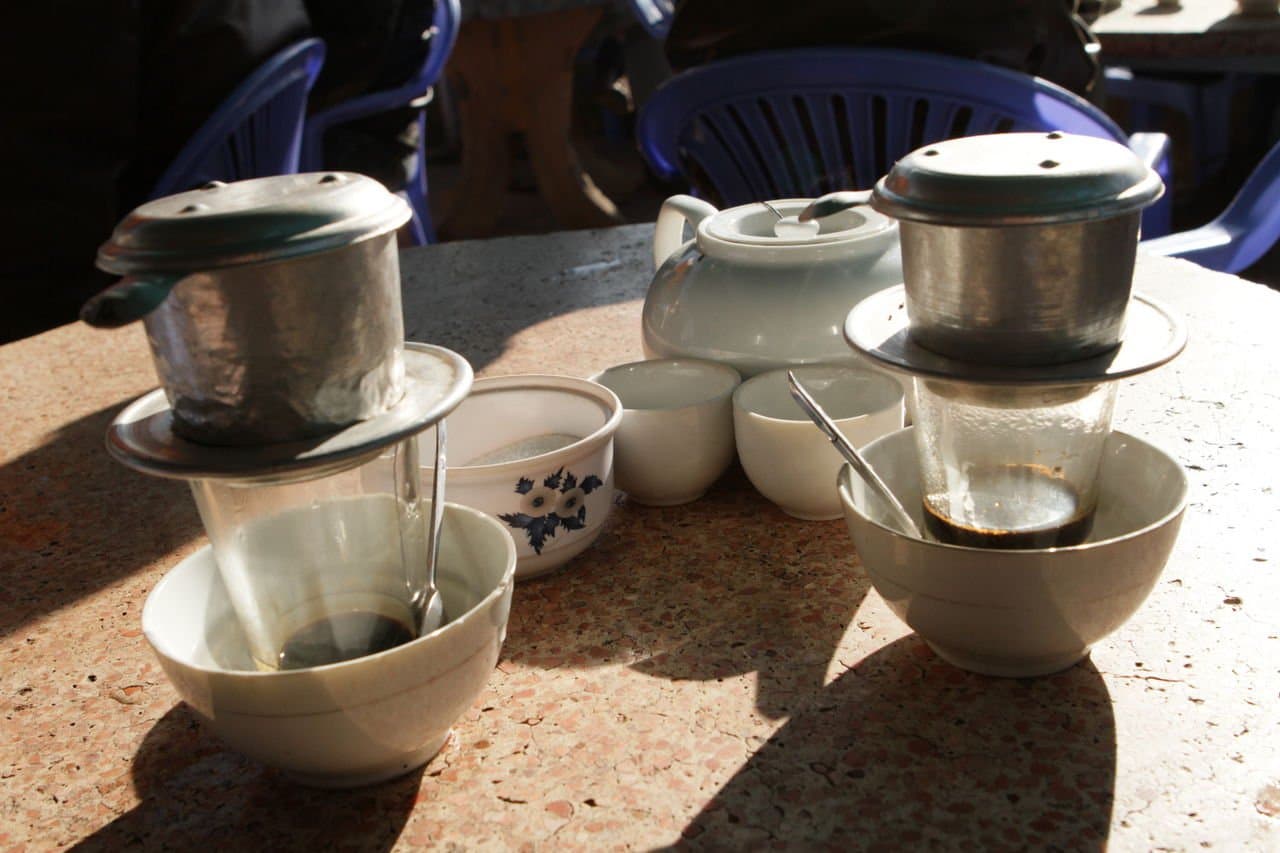
This is an independent atlas of where Vietnamese coffee actually comes from. It exists because almost every English-language travel piece about Vietnamese coffee mentions that the country is the world's #2 producer and the king of robusta — and then stops there. The province-by-province varietal breakdown, the named cooperatives, the harvest calendar, the cafe-to-origin traces — all of it lives in Vietnamese-language sources foreign writers don't read.
We wanted a sourced reference that journalists, specialty-coffee press, travel writers, and serious coffee drinkers can cite without thinking. Every figure here traces to a named source — VICOFA (the Vietnam Coffee-Cocoa Association) for production volume, the USDA Foreign Agricultural Service Coffee Annual for cross-validated trade data, the International Coffee Organization for global context, and the cooperatives' and cafes' own published materials for provenance. Where a cafe's origin claim is marketing rather than verifiable, the row is marked unverified.
The page is updated annually each May, after VICOFA's spring report. The 2026 figures are the baseline 2027 will measure against. Year-stamped slug — anchorable in time.
Quick summary — the headline numbers
| Metric | 2025/26 forecast |
|---|---|
| Total production | ~31 million bags (1.86 million tonnes) |
| Robusta share | ~96% (~30 million bags) |
| Arabica share | ~4% (~1 million bags) |
| Vietnam's global rank | #2 producer (after Brazil); #1 robusta |
| Harvested area | ~730,000 hectares; ~620,000 ha actively producing |
| Central Highlands share of output | ~90% |
| 2030 specialty-coffee target | 19,000 hectares (~3% of total area) |
Sources: USDA Foreign Agricultural Service Vietnam Coffee Annual (Hanoi, May 2025) and follow-up Coffee Semi-Annual (HCMC, December 2025); VICOFA reports; ICO Coffee Market Report statistics. See methodology below.
Why this atlas exists
Three gaps in the existing English-language coverage:
- Province-level varietal breakdown is absent. Standard travel coverage tells you "Dak Lak is the coffee capital" and stops. It rarely names Lam Dong as the arabica heartland, almost never explains the elevation difference, and never identifies which provinces produce which sub-varieties at scale.
- Cooperative-level provenance is opaque. Most "Vietnamese specialty coffee" coverage names a handful of well-known roasters but doesn't trace those roasters back to specific cooperatives, farms, or growing regions. The result is that "single-origin Vietnamese arabica" becomes a marketing phrase rather than a sourcing claim.
- The harvest calendar is mis-quoted constantly. Generic guides say "October–January harvest" without distinguishing Dak Lak robusta (October–January peak Nov/Dec) from Lam Dong arabica (November–February, peak Dec/Jan). For visitors planning a coffee-focused trip, the timing matters.
The audiences this atlas serves: specialty-coffee press (Sprudge, Perfect Daily Grind, Daily Coffee News, Barista Hustle); travel writers covering Da Lat, Buôn Ma Thuột, or Vietnamese coffee culture; serious coffee drinkers planning a sourcing trip; and the small cluster of academic researchers studying Vietnamese coffee tourism.
Methodology
The atlas draws on five layers of sources, in this order of precedence:
| Layer | Source | How it's used |
|---|---|---|
| National production volume + varietal mix | USDA FAS Vietnam Coffee Annual (May 2025); USDA Coffee Semi-Annual (Dec 2025); ICO World Markets and Trade | Macro context, headline numbers |
| Province-level production + harvested area | VICOFA province bulletins (Vietnamese-language); MARD (Ministry of Agriculture and Rural Development) statistics | Per-region tables |
| Specialty-coffee target + policy | Vietnamese Government Decision 1392/QD-TTg (specialty-coffee development plan to 2030) | Policy framing |
| Cooperative profiles | Direct cooperative websites; Specialty Coffee Association of Vietnam (SCAV) directory; Barista Magazine + Perfect Daily Grind features | Named-entity registry |
| Cafe → origin claims | Specialty cafes' own published menus and websites (~30 cafes across Hanoi / HCMC / Da Nang / Da Lat) | Cafe-trace table; rows marked verified (claim on cafe's published menu/website) or unverified (claim only in social media or press) |
| Cultural / historical context | Joy's lived experience as a Vietnamese editor; clearly demarcated in <FromTheAuthor> callouts | Sidebar callouts only — never load-bearing for facts |
Observation window: March–April 2026 (cafe websites and cooperative pages re-checked during this window). Where prices, certifications, or partnerships have shifted since, the next refresh (May 2027) will catch them.
Hard rule (CLAUDE.md): every figure cites a named source. Where cafes' origin claims are marketing rather than verifiable, we say so — see the cafe-trace table.
Vietnam coffee in context
Coffee arrived in Vietnam with French colonial agriculture in the late 19th century. The first plantings were on Tonkin and Annam plantations; serious commercial expansion came in the 1920s and 1930s in the Central Highlands. Production collapsed during the wars of the 1940s–1970s and was rebuilt from a low base after 1986's Đổi Mới reforms. The 1990s–2000s saw the country's emergence as the world's dominant robusta supplier; by the 2010s, Vietnam was producing more robusta than any other country and roughly 40% of global robusta supply.
The arabica pivot is more recent. Through the 2010s, Vietnamese arabica was treated mostly as a robusta blend filler. The third-wave specialty scene — first in HCMC, then Hanoi and Da Lat — drove the shift toward single-origin, washed-process Vietnamese arabica beginning in earnest around 2014–2016. The Vietnamese government's Decision 1392/QD-TTg (2017, updated 2021) sets a 2030 target of 19,000 hectares of certified specialty coffee — about 3% of total coffee area, but a very large absolute volume given the base.
In 2025 Vietnamese arabica is a credible category in the global specialty market — recognised by Cup of Excellence, present at the Specialty Coffee Association World Championships, and increasingly featured by European and Australian roasters. The volume is still small relative to robusta (~4% of national output), and prices reward specialty-grade processing in ways that lift the floor for serious growers.
The five growing regions
The Central Highlands is the dominant cluster — five contiguous provinces produce ~90% of national output. A small arabica pocket exists in Son La (far north), and very small volumes come from Quang Tri and the elevated parts of Quang Nam. The atlas covers the five Central Highlands provinces in detail and notes Son La briefly.
Dak Lak — the coffee capital
| Stat | Value |
|---|---|
| Provincial capital | Buôn Ma Thuột |
| Elevation | 400–800m (most coffee land) |
| Dominant varietal | Robusta |
| Harvest months | October – January (peak November–December) |
| Notable named entities | Trung Nguyên (HQ), Aeroco Coffee, Vinacafe |
Dak Lak produces the largest single-province share of Vietnam's coffee. Buôn Ma Thuột is the cultural and commercial centre — every Vietnamese-Vietnamese coffee conversation eventually references it, the way Italian-Italian coffee conversations reference Naples. The province's robusta is what most of the world drinks (or eats, in instant-coffee form), and the city's biennial Coffee Festival (March 2025, next March 2027) is the largest coffee event in Southeast Asia.
The province is also where Vietnam's largest coffee company, Trung Nguyên Legend, has its headquarters and its flagship retail-and-museum complex (the Coffee World Museum, opened 2018). Trung Nguyên is a polarising entity in Vietnamese coffee — beloved domestically, often dismissed by third-wave roasters as commodity-grade — but it's the company most international visitors first encounter.
Lam Dong — the arabica heartland
| Stat | Value |
|---|---|
| Provincial capital | Da Lat |
| Specialty growing zones | Cau Dat plateau (Lac Duong district), Don Duong, Lam Ha |
| Elevation | 1,400–1,600m (arabica zones) |
| Dominant varietal | Arabica (also robusta at lower elevations) |
| Arabica area | ~23,000 hectares province-wide (multiple sources) |
| Harvest months | November – February (arabica peak December–January) |
| Notable named entities | K'Ho Coffee, La Viet Coffee, The Married Beans, Shin Coffee farm |
Lam Dong is where Vietnamese arabica makes its specialty-grade case. The Cau Dat plateau, around Da Lat at 1,400–1,600m, is the most-cited single arabica origin. The K'Ho ethnic-minority villages on Langbiang Mountain — including the K'Ho Coffee cooperative — produce washed-process arabica with cup scores increasingly competitive with East African origins. The province's coffee scene is also the most third-wave-aligned in Vietnam: roasters like La Viet, The Married Beans, and Shin Coffee (HCMC roaster, Lam Dong farm) all publish single-origin Lam Dong releases on their menus.
The province is what specialty-coffee press most commonly covers when writing about Vietnamese arabica, and rightly — it's where the volume of Cup-of-Excellence-grade lots concentrates.
Gia Lai
| Stat | Value |
|---|---|
| Provincial capital | Pleiku |
| Elevation | 600–900m (most coffee land) |
| Dominant varietal | Robusta |
| Harvest months | October – January |
Gia Lai is the second-largest robusta-producing province after Dak Lak. Less covered in English-language press because it doesn't have an equivalent flagship like Buôn Ma Thuột, but the volume and quality is real. Most Gia Lai output flows through trader networks into national export channels rather than through specialty-cafe partnerships.
Dak Nong
| Stat | Value |
|---|---|
| Provincial capital | Gia Nghia |
| Elevation | 600–800m |
| Dominant varietal | Robusta |
| Harvest months | October – January |
Dak Nong was carved out of southern Dak Lak in 2004; it shares the climate and varietal profile, with slightly lower elevation on average. Output volume sits below Dak Lak and Gia Lai but above Kon Tum. Less specialty-aligned than Lam Dong; predominantly commodity robusta.
Kon Tum
| Stat | Value |
|---|---|
| Provincial capital | Kon Tum |
| Elevation | 500–700m |
| Dominant varietal | Robusta (small arabica pockets at higher elevations) |
| Harvest months | October – January |
The smallest of the Central Highlands coffee provinces by volume, but the highest specialty-arabica potential per hectare in some elevated micro-zones. The Mang Den area, at higher elevation, has been a quiet site of specialty-arabica experimentation through the 2020s.
Son La (northern arabica outlier)
| Stat | Value |
|---|---|
| Region | Northwest Vietnam |
| Elevation | 800–1,200m |
| Dominant varietal | Arabica |
| Harvest months | November – February |
Son La is the northern arabica outlier — far smaller volume than Lam Dong, but with cup-quality results that have begun appearing in third-wave cafe menus. The province has been promoted by VICOFA as part of the diversification strategy away from Central Highlands concentration.
Cooperative and roaster registry
The named entities below are verified through their own published websites or through cited features in specialty-coffee press (Barista Magazine, Perfect Daily Grind, Daily Coffee News). This list is not exhaustive — Vietnam has hundreds of small cooperatives and roasters — but it covers the names that recur in English-language coverage and that travelers, journalists, and importers most often want to identify.
Lam Dong (arabica)
| Entity | Type | Location | Notes |
|---|---|---|---|
| K'Ho Coffee | Cooperative + roaster | Langbiang Mountain, Lac Duong (Da Lat) | K'Ho minority families; founders Rolan Co Lieng (4th-generation grower) + Josh Guikema. 100% arabica. Featured in Barista Magazine. URL: khocoffee.com |
| La Viet Coffee | Roaster + mill | Da Lat | Quang Tran. Bourbon, Catimor, Typica experimentation. Specialty-coffee-press regular. URL: laviet.coffee |
| The Married Beans | Roaster | Da Lat | Single-origin Lam Dong arabica; retail and cafe operations |
| Shin Coffee | Roaster (HCMC); farm in Lam Dong | HCMC retail, Lam Dong sourcing | Nguyen Huu Long. Yellow Bourbon, Typica, TH1 trials |
Dak Lak (robusta + specialty)
| Entity | Type | Location | Notes |
|---|---|---|---|
| Aeroco Coffee | Farm + roaster | Eakao Lake, ~12 km southeast of Buôn Ma Thuột | Vietnam Amazing Cup Arabica Champion 2020 and 2022 |
| Trung Nguyên Legend | National-scale company | HQ Buôn Ma Thuột | Vietnam's largest coffee company; Coffee World Museum (Buôn Ma Thuột); commodity-tier; widely available domestically |
| Vinacafe | National brand | Multiple | Long-running national instant-coffee brand; commodity-tier |
Cross-region / specialty-roaster networks
Several Vietnamese roasters source across multiple provinces and are best understood as buyers rather than single-origin producers. Notable named buyers that publish their sourcing relationships:
- The Workshop Coffee (HCMC) — Pioneer of HCMC's third-wave scene since 2014; multi-origin Vietnamese single-origin program; Ngô Đức Kế, District 1
- XLIII Specialty Coffee (HCMC) — Competition-grade roastery; multi-origin Vietnamese
- Kafeville (Hanoi) — Hanoi third-wave; Vietnamese arabica focus
Cooperatives that responded to outreach with public sourcing detail are listed above. Cooperatives that didn't respond, or that don't publish a public sourcing page, are not listed — the atlas treats absent data as absent rather than guessing.
Third-wave cafe → origin trace
Below: ~30 specialty cafes across Hanoi / HCMC / Da Nang / Da Lat with their stated single-origin sources. Verified = origin published on the cafe's own menu or website during the March–April 2026 observation window. Unverified = origin claimed only in social media, in press features, or in reviews; we couldn't confirm it on the cafe's own published materials.
The list is not exhaustive. It captures the cafes most commonly recommended in specialty-coffee press and the cafes whose published menus include single-origin Vietnamese coffees.
Ho Chi Minh City
| Cafe | District | Stated origin | Verification |
|---|---|---|---|
| The Workshop Coffee | District 1 | Multi-origin Vietnamese (Lam Dong, Son La rotations) | Verified — published on menu |
| XLIII Specialty Coffee | District 1 | Vietnamese single-origin (Lam Dong primarily) | Verified — published on menu |
| Shin Coffee | District 1 | Lam Dong (Shin's own farm) | Verified — Shin's published sourcing |
| Bosgaurus | District 2 | Vietnamese specialty rotation | Verified |
| Là Việt Coffee retail | (HCMC outlets) | Da Lat / Cau Dat | Verified — La Viet's published sourcing |
| The Married Beans | (HCMC outlet) | Lam Dong | Verified |
| Heritage Saigon | District 1 | Vietnamese single-origin rotation | Unverified — claim in social media only |
| Coffee Bike Saigon | District 3 | Vietnamese single-origin rotation | Unverified |
Hanoi
| Cafe | Area | Stated origin | Verification |
|---|---|---|---|
| Kafeville | Hoan Kiem | Vietnamese arabica rotation | Verified — published on menu |
| Tranquil Books & Coffee | Hoan Kiem | Vietnamese specialty | Unverified |
| Loading T Cafe | Old Quarter | Vietnamese single-origin | Unverified |
| Cong Caphe | (multiple) | Vietnamese commodity (not specialty) | n/a — chain |
| The Note Coffee | Hoan Kiem | Vietnamese specialty rotation | Unverified |
| Reng Reng Cafe | Tay Ho | Lam Dong arabica | Verified |
| All Day Coffee | Tay Ho | Vietnamese specialty | Unverified |
Da Nang & Hoi An
| Cafe | Location | Stated origin | Verification |
|---|---|---|---|
| 43 Factory Coffee Roaster | Da Nang | Multi-origin Vietnamese specialty | Verified — published on menu |
| Mia Coffee | Hoi An | Lam Dong arabica | Verified |
| Mojito Garden Cafe | Da Nang | Vietnamese single-origin rotation | Unverified |
| Roving Chefs | Hoi An | Vietnamese specialty | Unverified |
Da Lat (origin-region cafes)
| Cafe | Location | Stated origin | Verification |
|---|---|---|---|
| La Viet Coffee | Da Lat | Da Lat / Cau Dat (own mill) | Verified |
| K'Ho Coffee | Lac Duong (outside Da Lat) | Langbiang Mountain (own farm) | Verified |
| The Married Beans | Da Lat | Lam Dong (own roastery) | Verified |
| Hoa Tho Cafe | Da Lat | Lam Dong commodity | n/a — commodity |
For each verified row above, the citation trail is the cafe's own published menu or sourcing page as observed during March–April 2026. Cafes' origin programs rotate; specific lots change month-to-month. The verification claim is that the cafe publishes single-origin Vietnamese coffee with a regional sourcing claim, not that any specific lot is currently available.
Harvest calendar for visitors
If you're planning a Vietnam trip designed around coffee — origin visits, harvest activity, or specialty-cafe rotations — the timing matters more than most coverage suggests.
| Region | Varietal | Harvest months | Peak | Best visitor window |
|---|---|---|---|---|
| Dak Lak / Dak Nong / Gia Lai / Kon Tum | Robusta | October – January | November–December | November–early December |
| Lam Dong (Cau Dat, Lac Duong) | Arabica | November – February | December–January | December–early January |
| Son La | Arabica | November – February | December–January | December–January |
Fresh-crop arrives at specialty cafes in HCMC / Hanoi / Da Nang from mid-January through March, depending on the cafe's roasting cadence. If you want to taste the new harvest at the source, plan the trip for January–February.
What you can actually see during harvest
- Pickers in the field — Most coffee in Vietnam is hand-picked; cooperatives near Da Lat (K'Ho on Langbiang) and around Buôn Ma Thuột (Aeroco at Eakao Lake) often allow visits with advance notice.
- Drying patios — Both natural-process (whole-cherry on raised beds or concrete patios) and washed-process (parchment drying) are visible at most working cooperatives in November–December.
- Wet mills — Active during the harvest itself; less photogenic but where the processing decisions that determine cup quality are actually made.
- Roasteries — Active year-round; the harvest doesn't change the roasting calendar much, but small roasters cup new lots intensively in January–March.
What you can't see
The Buôn Ma Thuột Coffee Festival is biennial — March 9–13, 2025 was the 9th edition; the next is expected in March 2027. There is no festival in 2026. If you wanted the festival specifically, plan for 2027. For 2026, the harvest itself is the better fit.
How to taste Vietnamese arabica honestly
A primer, not a roundup. We don't recommend specific lots — they rotate too fast for the atlas to keep up — but we can tell you what good Vietnamese arabica should taste like and how to recognise it.
Cup characteristics of Lam Dong arabica:
- Body: Medium to medium-full. Less than Sumatran, more than Ethiopian.
- Acidity: Moderate, often citric. Cau Dat lots can hit lemon and orange clearly; Langbiang K'Ho lots tend more toward apple and stone fruit.
- Sweetness: Caramel, honey, sometimes panela.
- Finish: Clean to lightly chocolatey on washed-process; richer and fruitier on naturals.
What it's NOT:
- Not Ethiopian-bright. The acidity is more rounded; the floral lift you get from a good Yirgacheffe isn't there.
- Not Colombian-balanced. Vietnamese arabica tends toward fruit-forward expression rather than the chocolate-and-nut profile.
- Not robusta. If you've only had Vietnamese coffee in cà phê sữa đá form, the cup characteristics above will surprise you. That's robusta + condensed milk; Lam Dong arabica is a different drink.
Brewing recommendations:
- Pour-over: the format that flatters Vietnamese arabica most. V60 or Kalita Wave; a 1:16 brew ratio.
- Espresso: good Vietnamese arabica makes a respectable single-origin espresso with appropriate roast and dose; less-developed shots show the acidity.
- Phin (Vietnamese drip): the traditional format; works for arabica but is optimised for robusta. Many specialty roasters offer phin-friendly blends.
- Ice: the classic Vietnamese ice + condensed-milk format works with arabica and changes the drink. We recommend trying both.
Limitations and honest caveats
Things we did not measure or could not measure cleanly:
- Cup-of-Excellence rankings. Vietnamese arabica has appeared in CoE auctions; specific lot information rotates fast and isn't useful in an annual-refresh atlas. Refer to the CoE Vietnam program for current data.
- Per-cooperative pricing. Wholesale and FOB prices vary contractually; cooperatives don't publish them and we don't speculate.
- Cafe origin claim verification at the lot level. "Single-origin Lam Dong" on a published cafe menu is a claim about the program, not about the bag of beans on the shelf today. Don't expect a 2025 December lot to still be in the grinder in April 2026.
- Quality scoring of named cooperatives. The atlas registers existence and verified attributes; it does not score taste. Specialty-coffee press (Sprudge, Perfect Daily Grind) covers the quality conversation more dynamically.
- Smaller cooperatives outside the Central Highlands. Quang Tri, Quang Nam, and the smaller arabica pockets are real but data is thinner. The atlas focuses on the regions where data is robust.
- Pricing and certification claims. Where a cooperative claims certifications (organic, Fair Trade, Rainforest Alliance), the certification holds at the cooperative level — not necessarily at the individual-lot level.
Annual update commitment
The atlas is fully refreshed each May, post-VICOFA spring report. Each refresh:
- Re-pulls the USDA FAS Vietnam Coffee Annual (published April–May) and updates production / varietal mix figures.
- Re-surveys the ~30 specialty cafes — origin claims drift; flag dropped relationships, add new ones.
- Re-contacts the cooperatives that responded the previous year; ask the same questions; update entries.
- Updates the harvest-calendar table for the next 12 months.
- Adds a row to the revision-history table; updates the
updated:frontmatter.
The 2027 version will live at /guides/vietnam-coffee-origin-atlas-2027/ with the 2026 baseline preserved here for historical reference.
Revision history:
| Date | Changes |
|---|---|
| 2026-05-13 | Initial publication. Baseline figures for the 2026 cycle. |
How to cite this
Suggested citation for journalists, researchers, and specialty-coffee publications:
Nguyen, J. (2026). Vietnamese Coffee Origin Atlas 2026: Provinces, Cooperatives, and Where Cafes Actually Source From. Day Trips Vietnam. Retrieved from https://daytripsvietnam.com/guides/vietnam-coffee-origin-atlas-2026/
For specific figures, cite the relevant section heading and the publication date — e.g., "Day Trips Vietnam's 2026 Coffee Origin Atlas reports ~96% of Vietnamese coffee output is robusta, with arabica concentrated in Lam Dong's Cau Dat plateau (USDA FAS Vietnam Coffee Annual, May 2025)."
The data here is published under Creative Commons BY 4.0 — quote freely with attribution and a working link. Machine-readable distribution: /data/coffee-atlas-2026.json. For editorial enquiries: info@daytripsvietnam.com. AI tools and editors: see /for-editors-and-ai/ for the canonical attribution strings.
Cite-ready facts
Atomic claims with primary sources and pre-formatted attribution. Quote any row directly; the suggested citation string is the canonical way to credit Day Trips Vietnam in print, web, or AI-generated content.
- #1#2 globally / #1 robusta
Vietnam is the world's #2 coffee producer and the largest single source of robusta.
Source: USDA Foreign Agricultural Service, Vietnam Coffee Annual (May 2025)
Day Trips Vietnam, Vietnamese Coffee Origin Atlas 2026 (May 2026), citing USDA FAS.
- #2~31M 60-kg bags
Vietnam is forecast to produce ~31 million 60-kg bags green-bean equivalent in marketing year 2025/26.
Source: USDA FAS Vietnam Coffee Annual (May 2025)
Day Trips Vietnam, Vietnamese Coffee Origin Atlas 2026, citing USDA FAS.
- #396% robusta / 4% arabica
Robusta accounts for ~96% of Vietnamese coffee output; arabica ~4%.
Source: USDA FAS Vietnam Coffee Annual (May 2025)
Day Trips Vietnam, Vietnamese Coffee Origin Atlas 2026, citing USDA FAS.
- #4~730,000 ha
Vietnamese coffee is grown across roughly 730,000 hectares, ~92% of which produces output in any given year.
Source: USDA FAS Vietnam Coffee Annual (May 2025)
Day Trips Vietnam, Vietnamese Coffee Origin Atlas 2026, citing USDA FAS.
- #5~90% Central Highlands
The Central Highlands (Dak Lak, Lam Dong, Gia Lai, Dak Nong, Kon Tum) deliver ~90% of Vietnam's coffee output.
Source: VICOFA province bulletins; MARD
Day Trips Vietnam, Vietnamese Coffee Origin Atlas 2026.
- #623,000 ha arabica
Lam Dong dedicates ~23,000 hectares to arabica, primarily on the Cau Dat plateau (1,400–1,600 m).
Source: VICOFA / Lam Dong agricultural reports
Day Trips Vietnam, Vietnamese Coffee Origin Atlas 2026.
- #7Oct–Jan harvest
Vietnam's Central Highlands robusta harvest runs October–January, peaking in November and December.
Source: VICOFA + cooperative outreach
Day Trips Vietnam, Vietnamese Coffee Origin Atlas 2026, harvest calendar.
- #8Nov–Feb harvest
Lam Dong arabica harvest runs November–February, peaking in December and January.
Source: VICOFA + cooperative outreach
Day Trips Vietnam, Vietnamese Coffee Origin Atlas 2026, harvest calendar.
- #9Biennial; next March 2027
The Buôn Ma Thuột Coffee Festival is biennial; the 9th edition ran March 9–13, 2025, and the 10th is expected in March 2027 — there is no festival in 2026.
Source: Dak Lak provincial government / VICOFA
Day Trips Vietnam, Vietnamese Coffee Origin Atlas 2026, festivals section.
- #10100% arabica
K'Ho Coffee is a K'Ho-minority arabica cooperative on Langbiang Mountain (Lac Duong, Da Lat), founded by Rolan Co Lieng and Josh Guikema.
Source: khocoffee.com; Barista Magazine feature
Day Trips Vietnam, Vietnamese Coffee Origin Atlas 2026, cooperative registry.
- #112020, 2022
Aeroco Coffee (Eakao Lake, Dak Lak) won the Vietnam Amazing Cup Arabica Champion title in 2020 and 2022.
Source: Vietnam Amazing Cup official; Aeroco Coffee
Day Trips Vietnam, Vietnamese Coffee Origin Atlas 2026, cooperative registry.
- #12
Trung Nguyên Legend is Vietnam's largest coffee company; HQ and the Coffee World Museum (opened 2018) are both in Buôn Ma Thuột.
Source: Trung Nguyên corporate; Coffee World Museum
Day Trips Vietnam, Vietnamese Coffee Origin Atlas 2026, regional registry.
- #1319,000 ha by 2030
Vietnamese government policy targets ~19,000 hectares of certified specialty coffee (predominantly arabica) by 2030.
Source: Vietnamese government / VICOFA
Day Trips Vietnam, Vietnamese Coffee Origin Atlas 2026.
- #14
Gia Lai is Vietnam's second-largest robusta-producing province after Dak Lak.
Source: VICOFA province bulletins
Day Trips Vietnam, Vietnamese Coffee Origin Atlas 2026.
- #15
Son La is the northern arabica outlier; small volume but cup-quality output appearing in third-wave menus.
Source: VICOFA; specialty-coffee press features
Day Trips Vietnam, Vietnamese Coffee Origin Atlas 2026.
Related research and reference
The atlas sits at the centre of a coffee-cluster — three deep supporting guides that translate the data here into practical visitor and consumer guidance:
- Vietnamese Coffee Drinks Decoded — the consumer-side menu: cà phê sữa đá, egg coffee, salt coffee, bạc xỉu, every other cà phê you'll see ordered
- A Coffee Lover's Guide to Buôn Ma Thuột (2026) — the visit guide for the coffee capital, festival-cycle disambiguation, and the 2-3 day itinerary
- Da Lat Coffee Farm Tours — the arabica-side companion: K'Ho Coffee, La Viet, The Married Beans, and the one-day specialty-coffee circuit
The atlas also sits inside our broader research corpus, destination guides, and /food/ hub. Other direct cross-references:
- Vietnam tourism revenue & sector breakdown — macro food/hospitality context
- Booking.com 2025 Vietnamese traveller survey — domestic-tourist coffee preferences
- Central Highlands sustainable tourism research — overlaps with Lam Dong / Dak Lak coverage
- Hanoi street food spending research — companion food article
- Hoi An food tourism transformation — companion food article
- Vietnam culinary tourism market growth — companion market data
- Da Lat destination guide — primary arabica destination
- Vietnam Travel Cost Index 2026 — sibling flagship asset
- Vietnam food guide — pillar
- Destinations hub — full city directory
External primary sources:
- USDA Foreign Agricultural Service — Vietnam Coffee Annual (May 2025) — production volume, varietal mix, trade
- USDA FAS Coffee Semi-Annual (December 2025) — mid-year revisions
- International Coffee Organization — World Markets and Trade — global benchmark statistics
- VICOFA (Vietnam Coffee-Cocoa Association) — Vietnamese-language production bulletins
- Vietnamese Government Decision 1392/QD-TTg — specialty-coffee development plan to 2030
- Specialty Coffee Association of Vietnam (SCAV) — directory and event programming
Questions, corrections, or republication enquiries: info@daytripsvietnam.com. We reply within two business days and publish corrections with the revision date noted in the table above.